
About a month ago, [Greenhill Forge] built a few solar panels to collect energy from the sun. Unlike solar photovoltaics, which turn sunlight directly into electricity, these were designed to gather solar thermal energy with air. These types of panels can gather a tremendous amount of energy for a very low cost, and although the first video only went into the theory of their operation, his latest video actually shows us how to use that energy in a practical way.
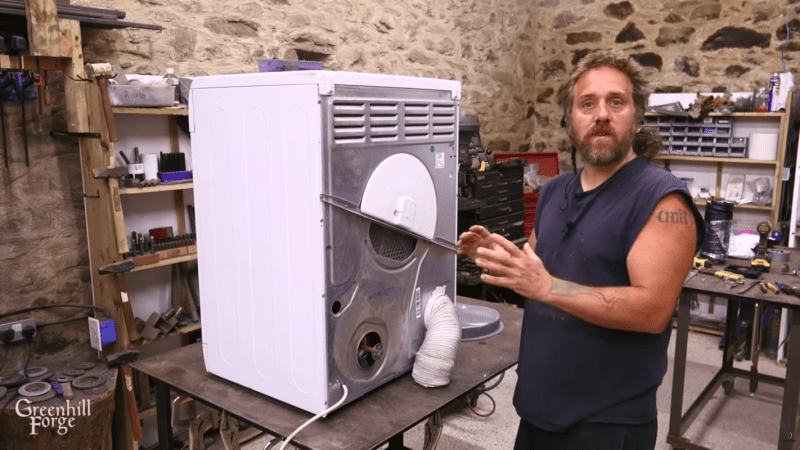
The video starts by building a new solar panel, using upgraded materials and building methods compared to the previous versions which should improve the efficiency. There’s some data analysis of the performance, but at the end of the video [Greenhill Forge] actually hooks one of these up to a clothes dryer to explore its real-world efficacy. This process involves disconnecting the electric heater, removing one of the blower fans, and building a new flange to accept the heated air from the solar panel. A microcontroller keeps an eye on the incoming air temperature and controls a fan to try to hit the target temperature.
After an hour of drying, the test clothing was completely dry, with the only electricity used to turn the drum in the dryer. This is more than an order of magnitude of reduction in the power needed to dry clothes, which is fairly impressive. [Greenhill Forge] also notes that systems like these could augment off-grid systems not only for clothes drying but for home heating, greenhouse heating, or drying out various crops and that they could reduce strain on an electrical system that otherwise relies on resistive heating methods. There are many ways of building these panels, so be sure to check out his first video for ideas.












Or you could just hand your clothes on a line out in the sun?
“Any humidity level above 70% is too high for line drying clothes. At this threshold, the air is too saturated to absorb moisture efficiently. For optimal results and to prevent a musty smell, it is best to aim for a relative humidity below 60% ”
Where I live average humidity by month:
January: 76% February: 73% March: 75% April: 74% May: 75% June: 78% July: 79% August: 78% September: 77% October: 75% November: 75% December: 76%
So good luck line drying here.
Where i live there is also a relative high humidity over the year (https://www.weerplaza.nl/nederland/nederland/14400/klimaat/vochtigheid/), drying clothes on a line outside works just fine when there is some sun, no musty smell at all. It works so well that we got rid of the dryer a long time ago.
What the… so Netherlands is more moist then the subtropical place I live? That cant be right. Here everything molds in an instant..walls, clothes, books. Never had that in NL
Note that colder air holds less water at the same relative humidity.
When the air is heated inside a home, the relative humidity drops, so moisture problems generally don’t crop up with homes that are lived in. With less water and lower temperatures, mold and rot grow a lot slower.
When the relative humidity is 75% but the temperature is 14 C, the amount of water in the air is equivalent to 51% RH at 20 C.
Goi
January: 94% February: 87% March: 82% April: 77% May: 74% June: 75% July: 73% August: 76% September: 81% October: 87% November: 93% December: 96%
I’ve never owned a dryer. Clothes etc dry just fine. Even if the average humidity is in the 90s it still drops during the day.
Dead right mate .I live in Queensland Australia and even in winter our humidity goes up to 90% and our cloths dry on the outside line some days when a nice breeze in under 2 hours to dry the sheets from beds .
that looks pleasant ie humidity in the 70s is nice!
Where I live if often doesn’t drop below 80%, as is very often in the 90s.. Not to mention 99% overnight day after day..
The only way we dry clothes in the wet season is 1) on a rack in front of the air con, or 2) in the tumble drier…
And how did people wash and dry their clothes in that area before dryers were invented?
Indoors where heated air has lower humidity.
Slowly and laboriously.
with great difficulty…. And didn’t wear many of them… Though most of the population here shifted in after air cons were a thing..
A few years ago I spoke to one of my neighbours when we had a usually cool day in winter (about 20c) and he said he was cold – I said ‘why don’t you put long paints on?’. He replied that he didn’t own a pair…
By the way, this has a direct impact on electronics as the humidity kills things surprisingly quickly. One of the large international brands of TVs is famous for not lasting long here..
And you do not want to put a low end power supply in your pc…
It was freezing in DRW on last Wednesday night… jeans and tee-shirt just don’t cut it in the dry.
Out of curiosity, what brand or what is the first letter of the name of the brand?
you simply need a large fan to put near your clothes horse
How exactly would the humidity be any different in the air heated by the panels? This reply makes no sense alone
Look up your humidity tables… heated air has the capacity to hold more vapour, thus has a lower RELATIVE humidity.
Solar collectors can heat the air very hot. Even if it’s only 70°F outside a solar collector on a sunny day can still get hot enough for the 60°C (140°F) setting on his dryer. The drop in humidity from 100°F to 122°F (50°C setting) is still significant.
Two issues I have with line drying: clothes are stiffer than a…..uh…..er……other really stiff thing. And some insects enjoy the new living spaces. Tumbling the clothes in a dryer for a little while mostly solves the first problem, but the occasional squished/smeared stinkbug after tumbling means re-washing, and can leave a stain.
Not-really-minor issue: with temps in the mid- to upper-90s and humidity around outrageous%, it doesn’t take long for this creaky old body to tire significantly. Yes, even just hanging up clothes; I have to go inside and sit in the recliner for a while afterward if the load includes lots of little things like socks and underwear.
which includes what may change while aging it seems… (using a hair-dryer for blowing the load is probably not the best idea anyway)
The tumble dryer softens your clothes by smashing all the fibres. So while they feel softer, they won’t last as long.
Great Bob’s think alike.
If one is the emperor, even that step can be skipped.
“with the only electricity used to turn the drum in the dryer.” How are the microcontroller and fan powered?
Friendship.
yep – I use solar panels to make electricity :-) to run the tumble dryer. And air con. And fridge.. Electricity is more useful than the hot air.
I guess the doeoends in circumstances
A potato battery. C’mon man.
I’m going to need intelligent resistive backup to improve the WAF factor here.
Well done ! critics are always jelous. I also like D.I.Y. stuff.
I’m happy about the video, showing solid build skills, determination, good video and narration, good science on comparing different solutions. Well done.
But I’m lost on why he is sceptical of state of the art. This seems to be just brushed away.
What is the advantage over drying clothes in the shade or in the sun directly? Convection is enough and no motors needed at all.
A modern heat pump dryer can dry a load for about 1kWh, so two PV panels could roughly be enough already to do that via PV continuously during sunshine. You can’t just hook that up directly and I’m not aware of any electronics that allow this, you might need a battery, adding cost. Heat pump dryer with PV is more investment just for clothes drying but this will give excess electricity. This is the winning technology today
I don’t see any advantage with solar air heating over solar water heating. Just a black pipe in a box, similar material efforts, but those are readily available. Easier to transport the heat, you can even store the heat and release when needed. With glycol you can get hotter than water. This has been available for decades and is getting being reaced by PV. You can find used panels for free now.
But don’t get me wrong – this is impressive that he can build stuff and do a task, just by using the energy from the sun. Maybe not in the most efficient way, but still.
Tumble drying doesn’t put creases on the clothes and shrinks them back to size when they’re stretched from wearing.
drying directly in the sun fades the colors quickly. Old school bleaching: spread your sheets over a grassy field in the sun. Grass gives oxygen, sun gives UV light, breaks down those nasty yellow sweat stains.
Heat pump dryer? That’s a thing? My 30 year old gas dryer still gets the job done so I have no idea what the state of the art is.
There’s two versions. The first step up is a condensing dryer, which cools the outgoing air with the incoming air, which causes the water in the damp air to condense and heat the intake air, so the heater doesn’t have to work so hard. The condensed water is sent down the drain.
The heat pump version is an upgrade on that, where it’s actively pumping the heat out from the exhaust to condense all the water it can and taking most of the heat back. Because there’s no heater per se, it’s limited by the power of the heat pump, so it takes longer to dry clothes but uses about 1/4 the energy to do so. The gas heater loses some heat up the flue, so the difference between a vented gas dryer vs. ventless heat pump dryer is about 5:1 in energy consumption.
Of course it uses electricity instead of gas. At least in Europe, the gas prices are between 3-20 euro-cents per kWh depending on the country, with an average of 12 c/kWh. That means you can pay up to 60 c/kWh for electricity on average and still break even with the heat pump dryer. Most people would see something like 60-70% cost savings on energy.
His goal isn’t drying clothes, its to dry firewood and other bulk items. The Clothes dryer is just a prototype to check the effectiveness of the panels.
One wonders, if the point is to dry firewood with hot air, wouldn’t it be equally effective to make a “hot tent” with one wall facing the sun made of clear plastic, and fill that up with your firewood.
Instead of spending a great deal of effort building complicated heating mechanisms, just build a glass greenhouse around the stuff you want to keep hot.
Its not just a matter of keeping things hot, drying wood requires significant airflow to vent the evaporating moisture. This airflow can cause the temperature in a greenhouse to drop rather quickly, so something like this (would be inadequate) might be necessary.
“not only for clothes drying but for home heating, greenhouse heating, or drying out various crops”
That implies that in his region a greenhouse used for normal greenhouse purposes needs heat too.
So, put a fan in the tent.
A transparent tarp can easily be made bigger, giving more collector area and more heating power.
@dude if you put a fan into your “tent” you will lose the heated air along with the moisture. Increasing the tent size increases the air volume, Reducing the efficacy of the solar heating. These solar air heat collectors are more efficient because they are only heating a small volume of air at any given time. An array of them could potentially provide enough heated air to raise the ambient outside air to a high enough temperature to be pumped into your “wood drying greenhouse”.
How else are you gonna get it out?
That’s the same problem any which way you construct it. You have to blow the hot wet air out to get rid of the moisture. The advantage of the hot tent is that there’s no plumbing to deal with – you just poke a hole in the tent wall and put a fan there, and turn it up or down depending on how hot you want it.
That volume would be filled with your firewood, so I don’t see what the problem is. The idea is, you stack them up like a wall facing the sun, throw a tarp over it, and one side will be transparent to let the sun in. Then just add a fan, or leave the ends open for wind to blow through.
We’re talking about a solar collector array with a combined area of several square meters, which is about the cross-section of a small shed. Therefore, why not make the shed where you dry the firewood BE the collector?
Like that:
https://www.gardeningknowhow.com/special/greenhouses/window-pane-greenhouse.htm
If you want, you can hang black wire mesh behind the window to improve absorption, and throw a space blanket on the backside to reduce heat loss. Then just add the fan to blow the moisture out.
It’s such an obvious idea that obviously someone has done it:
https://www.youtube.com/watch?v=_0_3_fBRpCU
154 degrees in the shed. That’s 68 C. I don’t see how building a separate collector would add anything to it.
I think the point of the video is to show how well the system works, rather than to replace the heating element: it’s a relatively cheap and easy system to build. I made a small version with an old radiator that pumped the water inside my old building and it worked really well.
This is an actually great use of solar air heating, unlike space heating. Kudos
The problem with line dried clothes are that they are stiff and not soft. Obviously never dry clothes in direct sunlight as the UV light with destroy the latex fibers present in most clothes and weakens all fibers. Bed sheets are a good choice to hang dry inside the garage if you don’t store your cars in the garage ( cars are dirty and a damp cloth will collect that dirt which defeats the purpose of laundering)
I’d rather my clothes be stiff than full of the waxy crap they put in the dryer sheets to make the clothing soft. That crap is itchy.
Wash your clothes with a bit of vinegar now and then, and you won’t have trouble with stiff, scratchy clothes when you dry them on a line.
Its not just a matter of keeping things hot, drying wood requires significant airflow to vent the evaporating moisture. This airflow can cause the temperature in a greenhouse to drop rather quickly, so something like this (would be inadequate) might be necessary.
“not only for clothes drying but for home heating, greenhouse heating, or drying out various crops”
That implies that in his region a greenhouse used for normal greenhouse purposes needs heat too.
It depends on what you need the wood dried for.
If it’s for firewood, then it’s fine to dry it fast, but if you’re going to be using the wood to make things, then you probably want to dry the wood as slowly as possible (over several years), to reduce the warping and checking (cracks and splits).
Here is a challenge. Heat the air sufficiently to make energy to run an AC to cool a house.
Middle child, outside the box thinker here, who lives in Florida.