
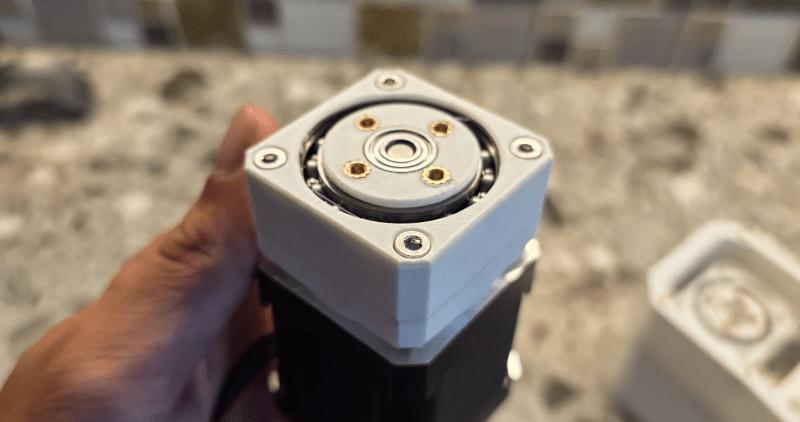
Stepper motors are undeniably useful, but sometimes they need a bit of gearing to help perform their task. [Gjhudson2008] has a compact gearbox for NEMA 17 or 23 steppers that is mostly 3D printed. How compact? The gearbox, named VANTIX, is exactly the height of a standard NEMA 17 axle.
However, for it to be that thin, your stepper has to have the D-bore on the shaft go all the way down. Some steppers leave a shank uncut at the base, and that won’t work for VANTIX.
The recommendation is to print in ABS with a 0.2 mm nozzle for certain parts to help improve tolerance. Most of the assembly is either press fit or installed during the printing process. Some parts of the gearbox are better to print with a larger nozzle, too.
There are some heat-set inserts and, of course, you’ll need lube to keep everything moving smoothly. There are a few top plates you can print to fit various mounting scenarios.
We have seen a number of similar designs. We’ve also looked at some e-bike-inspired drives.










Wasn’t the whole point of stepper is to avoid gearing? If you need to add gearbox, why not simply use basic asynchronous motor? They are more robust, offer better torque and will be happily driven by any cheap inverter.
Just depends on what you want to use it for. I would argue that the point of a stepper isn’t to not have gearing, but to have accurate increments of rotation. In general if I need to unsure smooth motion and constant rotation, I use a standard dc motor. If I want to to be able to stop in a specific spot, I use a stepper. And beyond that if I want either of them to have more torque, or if I want to increase the step resolution on the stepper, I’ll throw a gear or pulley on it.
There are steppers with integrated gearing. At some point, mechanical reduction becomes necessary to reach very small angular steps.
It’s 3D-printed, plastic gearing. So whatever excuse they give, it’s mostly fun and research anyway.
So would this be an improvement in an extruder?