
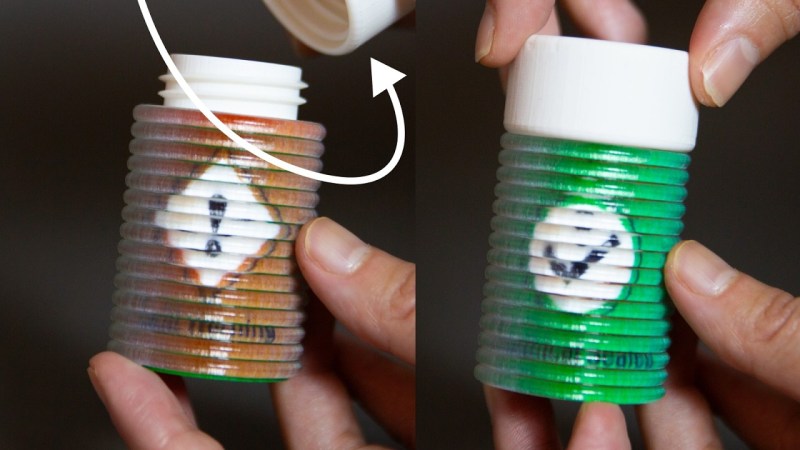
You can 3D print all kinds of things, from Yoda heads to little models of Pikachu. Eventually, though, most of us get to a point where we want to print something a little more interesting. The lenticular prints developed by MIT CSAIL are very much that. (h/t Core77).
The ShiftLens concept is simple enough—there’s a lens layer printed in transparent material. Beneath that, lives a patterned layer in alternating colors, corresponding with the linear lenses of the layer above. Then, there’s an actuation mechanism that can shift the lens layer relative to the pattern layer. This creates a changing color effect as the mechanism is shifted. The actuation mechanism can be a knob, switch, or roller—anything that moves the layers relative to each other. On its own, it’s a bit of a curio—but there are some fun demos. In particular, using the lenticular printing on a bottle to form an indicator for when the container is closed properly. There isn’t a publicly available design tool for these prints yet, though the team developed one for Rhino that they used internally for the project.
It’s a pretty interesting application of 3D printing, and one that we fully expect a bunch of YouTubers to replicate within the month. We’ve featured some other great print hacks lately, too, like a slicer that lets you print horizontal overhangs without support. Video after the break.
[Thanks to Paul for the tip!]












If you use a fat enough nozzle and tall enough layer height, maybe you could simply use the layer lines as the lenses.
Whoa 3D printed lenticular is damn impressive. Used to make these (injection molded 30 years ago of course) – anybody remember the CD cover for that TOOL album? Neat, and the image changes depending on the angle of view. Depending on the lens geometry, each eye can get a slightly different view, so interlacing a dozen different images at slightly different POVs / parallax shifts can get you some real cool 3D effects. Can you believe that some jackass used to have a PATENT on interlacing an image for lenticular? Amazing what the office grants.
OK, I need to know
WHICH ALBUM
Ænima
Pretty sure its la-ter-al-us
Maybe they did it more than once, but I am 100% sure they did it for Ænima.
They may have done it more than once, but they for sure did it for aenima.
Lateralus, my favorite one!
Hmm, this goes out mostly to DACH readers. Anyone remember the Perry Rhodan SF series? (yea, still running, so if you don’t remember, go and buy an issue). That had the so called “Silberbände” (silver editions) in the 70s and 80s that had very, very, very cool cover images that used the lenticular principle for 3D effects.
Imagine, having a cool silver clad book with an even cooler 3D cover. And cool and fascinating stories inside.
BTW: the cover images were glued on to the very smooth cover material and now, after 40-50 years they are falling off my books which is a great pity. Have not yet found a suitable glue to put them back on. Any suggestions are appreciated.
Could you bury a tiny electrical actuator inside or behind the plastic to move it without the need of a finger? Imagine being able to Bluetooth to your bottle or gadget to make it quietly change colour on an unsuspecting friend!
hmm… I wonder if this can be easily created with a piece of that magnetic material (think of a refridgerator magnet) and a PCB coil. Perhaps multiple coils, to create a moving field that drags the strip to the right location.
Now there’s an idea – a flip dot style display that changes not based on flipping a dot, but by shifting the lens in that area.
Agreed.
Perhaps as an array, maybe a single column of electromagnets on a linear slide rather than a single magnet X and y or one per pixel.
Setting a pixel one way going left and the other way going right, each direction doing it’s half of the changes.
If you don’t want to move a piece of paper below the lenses you could always use a display. Flexible eink would be possible at small scale. If you just want a color change you might be better off interlacing at a much higher resolution and using an LCD as a filter to show only odd or even lines. I suspect that wouldn’t look as good. Best bet might be some sort of -chromic paint, thermo or electro or some such. To give better recommendations I’d need to know why you think it’d be funny to change the color of a friend’s water bottle at will. I think once they got over the surprise they’d think it was cool, but there’s no way they wouldn’t suspect something was up just by touching the bottle
You can do this to make several different types of optical lenses that could be applied as a filter across of different cameras including a fresnel lens, different colors of lenses occupying different parts of the frame, and even various other waveform changing lenses to alter the image you’re trying to catch. I believe that 3D printers especially resin printers and some fdm printers have become precise enough and the materials have evolved to the point that you could actually print optically useful lenses and this would make them interchangeable.
I guess you can print out of a certain material any shape that you desire and silver it so that it becomes a mirror as long as you get the surface very flat and dimensions correct. It would be interesting to see someone make a rather large prosumer or even academic level telescope that is fully 3D printed and the optical portions sanded down to the correct dimensions and then applying a silvering compound which makes them A first order reflector.
Now make the lens movement latching so it doesn’t return to the original position and you have a form af antitamper. The label indicates whether the bottle has been opened.
Yes, there are other, easier, more secure methods.
Did anyone else catch that there seems to be a liquid in the lens portion of the print? I’m guessing it helps with clarity and transmission.
I think you’re right! I’m pretty sure that’s uncured resin sitting in the lens grooves — and funny enough, it probably helps: it fills in the tiny layer lines and has a refractive index close to the print itself, so it works like an optical coupling fluid. Accidental or not, that’s a neat trick!