
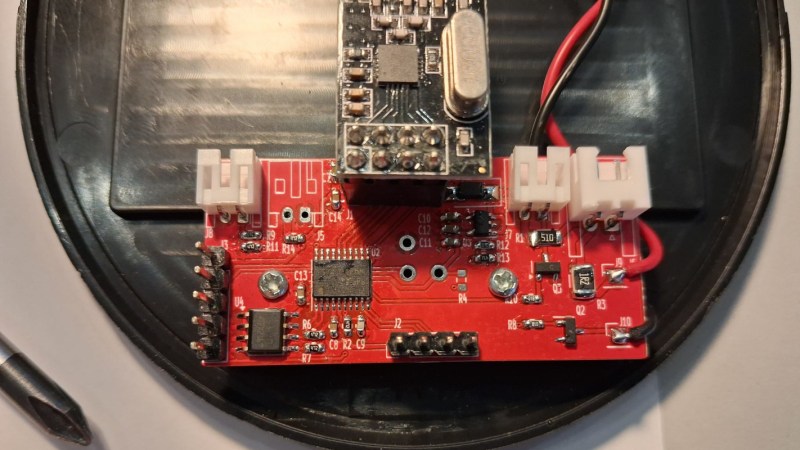
Solar power has gotten cheap enough that putting up panels is among the cheapest ways of providing energy. This isn’t just the case for bulk electricity on a power grid, either; even small devices are easier and cheaper to power with solar than ever before. For example, landscape lighting which once relied on 12V or 24V DC wires all over one’s yard with a transformer and power supply hidden somewhere have partially been converted to simpler individual solar-powered lights now. These small devices can also be given additional capabilities as [Mauro] demonstrates.
In this case, [Mauro]’s goal was to add on-demand lighting to a solar-powered light which was otherwise motion-activated only. To do this, they added a NRF24L01+ radio inside the light’s housing paired with an STM32 microcontroller. This secondary system is largely separated from the existing control circuitry with the exception of being able to switch the lights and receiving its power from the same solar panel. [Mauro] also created a small library to help with communicating with these new modules, whether that’s using a home automation system like Home Assistant or some other method.
Although adding in a few capabilities to inexpensive solar lighting might seem simple on the surface, a project like this is a gateway to adding in all kinds of interesting features to things with built-in solar panels and lots of free space in their cases. The best example here is the addition of a Meshtastic node to one of these lights, making it convenient and stealthy, but we could also see adding in other remote hardware to a landscape lighting module like a gate sensor or a plant health monitoring system.












This is the real use case for this sort of thing, and we all know it.
Landscape lighting uses low voltage AC power. If you used DC, you would end up with a corroded mess after a few years.
It should, yes; a shame my home’s precious owner saw fit to bury industrial extension cords (110V) all over the damn place for halogen spotlights they placed in nearly every tree on the property for some reason. They’ve rotted to almost nothing in places, yet still have sturdy sections that breach the turf occasionally for unaware feet to impale themselves on.
re: solar price vs. the alternative. i have a cabin i built on a remote adirondack plot. to put it on the grid would’ve cost $40K. to do it off-grid and install solar panels. an inverter, and a 30kwh battery: $30K. we opted for the latter and love it. it’s good to live with reasonable limits, and if you can do it, there is money to be saved.
Good luck using that solar in the Adirondack winter with all the snow and short daylight.
For 10k more you could have had a year-round cabin…
10k more and a monthly bill to pay
Month after month, year after year
Very nice implementation. Congrats for posting.
The simplest form of semi-intelligent solar light control would be to limit operation to 6 hours instead of fully discharging the battery every night. Leaving some energy for the next night should the day be overcast. This timer circuit only exists in some alkaline battery powered lighting strings, not at all in the solar garden lights.
Problem is that none of these solar lights last very long. Either battery, plastic housing, clouding over solar panel..
Planned obsolescence. The resin wmbedded tiny PV deteriorate from UV, the glass ones usually have no sealing, and in either case, the minimalist charge circuit generally abuses the cheap rechargeable cell to death. At a minimum, avoid the ones based on 2/3AAA. since standard AA and AAA sizes can be easily replaced/. Still, I’ve modded a few dollar store solar pathway lights with a boost circuit, and a custom PCB with ultracap and microcontroller to do other things. No RF though.
Found a potentially helpful tip on YouTube of all places that might help with the clouding over of the solar PV: lacquer.
Picked up a cheap spray can and after a couple of quick light coats they almost all look new. Maybe a few rough ones on the edge. And had two that were a lost cause. But the others show promise.
My glass housing ones were decently built so broke them down and ran the glass domes in the dishwasher. Those look brand new. Rattle canned a couple of housings and posts and those look new too. Fresh rechargeables for the really old ones. I still have a couple to sort out. Seem might need some fiddling with the battery contacts or something. Not surprising. Living in the Chicago area, they get 100+ Fahrenheit summer days and -30 winter nights on occasion.
Just keeping the posts pointing straight up can be a challenge. But… have some tweaks for one set that might help to give them more stability in wind and freeze/thaw cycles.
Make sure to safely dispose of the cheap nickel-cadmium batteries in outdoor garden lights. you don’t want those cells leaking toxic heavy metals into a garden where food grows, or toxic water running off into a stream.
Replace them with NiMH batteries, much less toxic and higher capacity.