
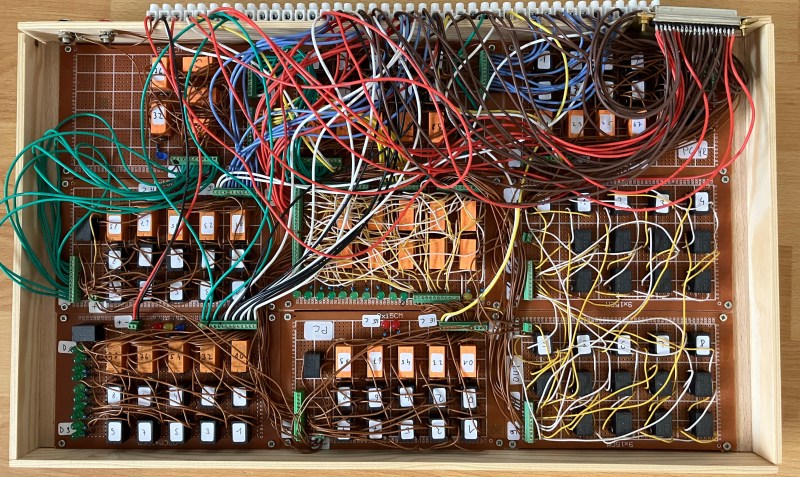
You want Retro? We did, when we started our retrocomputing challenge. [Peter] decided that transistors weren’t retro enough, and sent us this lovely homebrew relay computer, complete with 16- bit CPU, which is rather more bits than one normally associates with clicky clacky contacts.
The architecture is very simple– it just uses an accumulator register, ACCU, and goes from there. All mathematics and save/load operations go through ACCU. There whole instruction set is only 19 commands, and he’s used that set to program such lovely things as calculating 3 digits of Pi– which only took 8 minutes of glorious clicking. There’s a demo video of that embedded below. [Peter] has even implemented a display by hooking his computer to a 32×32 LED matrix, but don’t expect it to relay updates really quickly.
If this computer looks familiar, it’s because its earlier incarnation was one of the more “extra” entries in last year’s one-hertz challenge, where it was used to blink an indicator lamp. Yes, even relay computers apparently get started with the “blinky” sketch.
If you want in on the fun, our retrocomputer challenge runs until October 27th, so there’s lots of time left to turn back the clock.











reminds me of a 3(?) part series of videos on youtube from long long ago which culminated in a guy hooking his relay computer up to a vacuum fluorescent display and trying to get it to print “hello world” on it. there was some timing or signal conditioning or ringing issue though, so the text was a bit garbled, with I think some repetitions too.
Nice, I’ve always been fascinated by all kinds of computing machinery, including relay machines. This reminds me of Dieter’s digital logic web page (https://6502.org/users/dieter/index.htm) where he explains ALU design with ttl and relays.
Now imagine, if latching relays are used, the cpu will have much lower power consumption :)
But every relay driver would be double as complex since there are either two coils to operate, or the coils would need to be driven with reverse polarity. Not to mention the fact that latching relays are a factor of at least 10 times more costly then ordinary relays and with much less option to choose from.
But yes, the concept of latching relays is indeed promising.
Nice. I love relays! Would be cool if it was possible to build a CP/M like OS for a relays computer!
And using diode matrixes instead of EPROMs for boot-strap code (IPL).
And an endless tape drive (like ZX MicroDrive) for booting that CP/M like OS (to have pseudo random access to system files).
In Pittsburgh there was a place called the Buhl Planetarium.
It had a lot of neat stuff: a foucalt pendulum, a humungous tesla coil, etc.
But it also had a tic tac toe machine built with nixie displays and relay logic.
https://www.youtube.com/watch?v=5RcQNeO58dc