
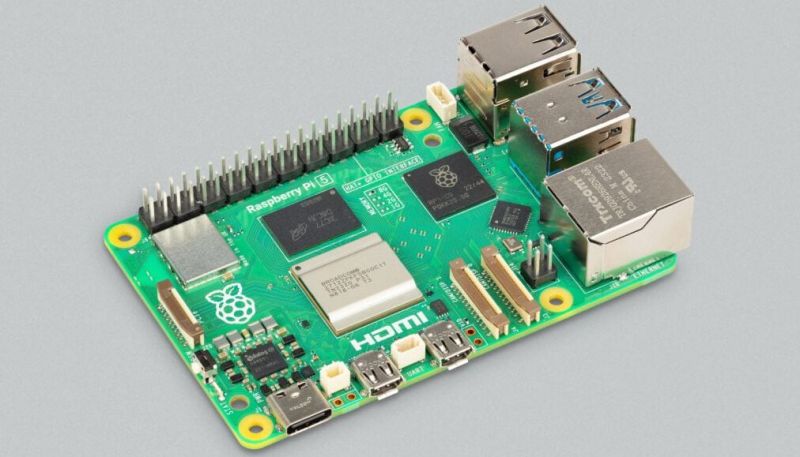
In a recent video [Jeff Geerling] addresses an issue discovered with the Raspberry Pi firmware, specifically how since around 2024 the firmware locks down what RAM size and even module is supported. This isn’t an issue that is widely known, probably because most people just use the board as-is, but it can be an unpleasant surprise for those looking to upgrade or repair their Pi.
Naturally there is a valid reason for wanting to prevent unscrupulous RAM module changes, with a [Geekworm] blog post from earlier this year detailing this exact issue and how each board is marked with a specific code that identifies the model, RAM size, RAM manufacturer and such. Based on the earlier linked forum post and also a 2025-era GitHub ticket on the rpi-eeprom project, the resulting symptoms seem to vary from not seeing the additional RAM to the board not booting at all.
Although you can go back to an older EEPROM firmware image to work around this, it’s still very annoying that this is even a thing. As also noted by [Jeff], the primary frustration here is probably one of ownership. When you can upgrade the RAM on just about any device you can buy, including a modern GPU and even Apple computer, but not on a Raspberry Pi board that loves to flaunt its open source/hardware credentials, then something is very much off.
In the end it’s highly unfortunate that Raspberry Pi has chosen this path that feels a bit too much like the hardware pairing that companies like Apple got rightfully called out on.












raspi has no open source credentials. the product has many strengths but it has always been worst in class at openness.
Don’t they contribute a fair amount to the Linux kernel?
They supply several closed source binary blobs to make their RF, boot process, USB and other peripherals, GPU etc to work, but that’s standard practice in SoC manufacturers so I don’t hold that against them (too much)
Blame broadcom not the foundation
They are inextricably linked, with the Eben Upton being a Broadcom employee when the Pi was created and until 2020. The platform will be tied to Broadcom indefinitely. I think the Raspberry Pi computing platform is losing hobbyist interest and will be known as an industrial platform.
What industrial person is going to trust a company that intentionally releases firmware that breaks hardware the end user can’t distinguish has been modified? I can just imagine how happy someone’s company will be when level control for a vat of acid bricks. FTDI did this stuff to break counterfeit USB interfaces through windows drivers and even MicroSoft slapped them down for doing it.
Indeed, I’d suggest they are in class by far the most open at most periods with most products in their history as a company… Imperfectly open absolutely, but considering 99.99% of the folks even here on HAD are I’d bet using closed BIOS on the device they read this with at the very least, if not also a closed source OS full of binary blob drivers etc…
When you bash your head into the closed bits it is frustrating, but on the flip side you get something that actually works with a modern kernel effort free, with good documentation and support etc – it is far less frustration than just trying to get any of the really comparable products to boot anything but the decade old kernel image it shipped with at all (and usually those devices are just as closed if not worse, and ship with half the hardware not really working it seems).
Can’t say I like this move, but give the trouble being documented of poorly done RAM swaps to turn the $25 ballpark into the $75 Pi on the market I can’t say I blame them… Be nice if they could find a better way but what that could be without hardware revisions so it is clear when its been modified and that the Pi folks are not on the hook for support warranty replacements and can still hopefully track the bad actors etc.
Though with AI nowadays, I wonder hoe easy it would be to follow up on the open bios project done years ago. Reversing is a breeze, and Christina did a lot of hard work in the past already.
Yeah it’s sometimes amazing how much anger is directed at projects that are 99.9% open instead of the teeming proprietary stuff that is everywhere else (probably how you are currently reading this, as you said.) Perhaps it’s deserved, since the whole idea is to promote openness, but as others have pointed out it’s very very tough to have a fully open e.g. radio system, which is the Achilles’ heel of most open-source phone projects afaik.
Still can’t beat the Dabao Baochip in openness.
How many of the blobs on the PI need to be closed source for legal reasons? (e.g. patent stuff or FCC etc regulations)
They are as open as they can be. and the pico documetion for example is top notch. Broadcom just does not diclose a lot.
This. All those people bashing the Raspberry Pi foundation do not realize they do their best. If there was blob-free alternatives of similar quality and and performances, no doubt they would jump on it. Prove me wrong.
they are broadcom.
That’s a bit reductive I think, I get that they are close, and one of the founders is a Broadcom engineer. But I don’t think it’s realistic to expect that just because they have a Broadcom guy on the team they’d have enough leverage to get the much larger company to open up their bread and butter. The pi is definitely not a huge portion of their business.
no you’ve got the horse and the cart in an untenable configuration
because raspberry is broadcom, broadcom has enough leverage to get raspberry to use exceptionally closed chips
I wonder if this decision has something to do with the European Cyber Resilience Act which implies a certain lockdown of hardware of many manufacturer (not that it mandates it, but manufacturer like to comply regulations by taking the path of least resistance)
I will say that CRA is turning into a huge PITA. Some of the requirements such as logging can not be physically done on many embedded controllers due to memory limitations. The effort that must be expended to comply is nothing short of tremendous.
I’m not familiar with this one. What kind of logging requirements do you have to provide?
What “trips” compliance with this act? Like, can I get away with using a less performant SOC and not need the requirements?
I’m not directly involved with the compliance efforts so my knowledge is limited. To quote the CRA: “provide security-related information by recording and monitoring relevant internal activity, including the access to or modification of data, services or functions, with an opt-out mechanism for the user”
What I don’t know is to what detail these logs must capture or the time-span they need to capture, but if these need to be human readable strings the memory requirements can be high.
Unfortunately like most regulations the details are lacking.
I feel like EU bureaucrats are in some sense half-attempting to get themselves cut off from the international network, or at the very least they are using “security” and “safety” as an alibi for their own maneuvers to grab power in the digital realm
I find that if someone has gone through the pains of desoldeing the old RAM and soldering a new one, switching to and older EEPROM firmware seems like a small price to pay.
Maybe, but the new eeprom firmware might solve other problem and even fix vulnerabilities so staying in an old version ins’t a solution. I guess reversing the eeprom firmware would be a good project to overcome this lockdown.
Cute, but there should not be a price, it’s something you own and expect to be free of such shenanigans.
the unique thig about raspi is that the closed source blob is integrated deeply into userspace. there’s no rational interface abstraction between the closed and open components, they move in lock step with eachother. the vchiq style open source drivers are nothing but wrappers for the closed components, so their function changes every time the closed source component changes.
it’s a very bad system imo and it makes an extraordinary penalty for anyone who leaves the well-beaten path. you’re damned if you upgrade the firmware, and you’re damned if you don’t. of course if you just run the regular os in the regular configuration then you can downgrade everything all at once and probably be fine.
Each RAM chip model has defined timings to use it properly. And even beyond the model the production series. This becomes especially significant with anything faster than DDR2. Think “calibration”
Just read this from three days ago: https://hackaday.com/2026/09/19/coreboot-hikes-the-bay-trail-to-dram-initialization/
So you can´t just swap RAM chips and expect things to work flawlessly. This is not a conspiracy, it is just how things work !!!
If one wants to get the best performance from the CPU-RAM tandem, one HAS to use tight timings, thus narrowing what chip / model / series can be used. That those calibration values are delivered as a blog form the RAM manufacturers is another different problem. It is done principally to ensure a reliable use of the sold RAM chips.
But in the PC world, that has been working just fine for ages. Ok, SIMMs have a registry chip which tells the system something about what its capabilities are. I’m not sure if ram chips themselves have something similar. Modern DDR5 ram chips do have a power management ic (PMIC) on-board that can be queried. Maybe that can also return calibration parameters?
If the Pi had socketable memory with all the support hardware needed to make user changeable RAM function you’d have a point, though even then odds are good it actually doesn’t just work in the PC world – the provided memory profile that should work at advertised speeds will fairly often need a little tickle more voltage or something similar tweaked in the BIOS for proper function. But the Pi doesn’t, its an embedded device with soldered RAM – interoperability, properly detecting all the expanded capacity and the added costs involved in that are irrelevant as the user can’t actually change the RAM without serious technical skills and equipment, and if they have that no doubt they can patch the firmware.
But but but the same Pi is sold in multiple configurations from the factory, if I buy a 4gb ram Pi and the same Pi could have been bought with an 8gb ram chip, then why can’t I change it, along with a bios upgrade if needed? I understand taking a 2nd gen Pi and trying to give it an pgrade to 8gb but if the same model is sold in multiple configs why not let people upgrade them as they wish? It would open up, a small, bump in their income as well.
Because if you have the skills to change the soldered memory you have the skills to solve the problems that might come from it – you can still upgrade them as you wish as an individual really. What this does most effectively is stop the no doubt Chinese shop from swapping the actually good validated RAM chip on the 1/2GB model for a e-waste/reject salvaged larger one that may not even be from the same RAM chip family causing hard to diagnose trouble for the customer that doesn’t know this wasn’t a 8GB from the factory. (compatible footprint doesn’t mean entirely compatible performance specs).
A memory controller has a wide range of compatibility if you include the equivalent of Serial Presence Detect (SPD) on the board or module. And as long as the RAM supports timings in range of your controller, you can swap it out. Despite this technology, it is quite common in the embedded industry for a firmware to lock out RAM that is not on an approved list. I’ve written code to enforce that in u-boot for a product because we were not happy about the part substitutions that were made at the factory. Ops needs to talk to engineering so that we can evaluate and test things before we sell it to a customer.
Imo, given the proprietary firmware, using custom chips and not providing full schematic diagrams at the very least, RPis aren’t worth it.
Agreed…I stopped buying Pi after the 2B (32-bit v1.1 board). There are many other SBCs out there, that do give out full schematics and datasheets.
People should stop complaining. It is very easy to deal with companies that exhibit behaviour that are morally and/or ethically ambiguous…stop buying their shit. They will either self-correct, or go under (in which case, good riddance). Only complaining about it turns into a whack-a-mole exercise, because they never change. Interact with them using a parameter they do understand…their bottom-line.
but none almost with the product longgevity, the linux support and I even documentation claims. Documentation is more then a datasheet.
As to long term widely supported and well documented they have no equal.
Olimex is much better than Pi and it’s manufactured in Europe not in China. As they sey, if you only eat chicken because you’re poor you’ll never know how beef tastes like.
there’s a lot of disagreement on this front. in some ways, raspi really is very convenient. if you prefer google to reference documentation, and if you want a default installation, it really is in a lot of ways much more convenient than any of the alternatives.
but myself, i wanted reference documentation. and there basically isn’t any at all for raspi! the ‘videocore’ supervisor is essentially undocumented, though there’s some reverse-engineering resources if you like swimming up-stream. the peripherals of the SoC are both locked down and undocumented.
so, like, as an end-user, i wanted to enable 24bpp or 32bpp HDMI output. i couldn’t find out whether that’s possible with the hardware. i couldn’t figure out if it’s possible with the closed-source firmware. i couldn’t figure out how to set it up, if it is possible. i did google for forum chatter about it, and i found people who claimed to be able to do it 3+ years ago using a “magic incantation” in /boot/config.txt. but then i searched some more and found people complaining slightly more recently that some firmware upgrade had broken the old feature.
you can’t even get reference documentation for the magic garbage in /boot/config.txt. the firmware is a moving target, so the documents you find are all out-of-date. plenty of people have come up with interesting hacks, but they too are all out-of-date! i’ve never seen another platform — not even windows or android! — where community contributions were of such low practical value! no matter how great the hacker was, their hack was broken by a change to the closed firmware and there’s nothing they can do about it!
if you come from an open source background where you expect to ‘get to the bottom of’ any issue, raspi is uniquely limited. other boards have more open hardware and less reliance on proprietary blobs. it depends on what you want but reasonable expectations are crucial.
Dumb as dog excrement. Who do they think they are? Apricot? :-)
Could be that they are trying to protect against people selling boards with less ram as if they have more? (then again, seeing the current prices, not sure anyone is buying any Pis)
After having watched the video, it still wasn’t fully clear to me why Raspberry would lock this down.
But looking at it from a business point of view, and ALSO from a consumer point of view, it’s perfectly understandable. If I were a Chinese gangster, I would try to get ram for really cheap, say a party of rejected 8GB ram chips sold straight at the back door of a factory. I could then make quite some nice money by buying 2GB Raspberries and converting them to 8GB, with my rejected, just-about working, 8GB crap chips. I’ll just force a few guys who are in my debt to do the soldering for free, or pay them $10 per board or whatever. I would probably put $100 per sold Raspberry straight into my pocket. Sell 1000 of them, and that’s at least $100,000.00 dollars profit.
The customer wouldn’t know the difference. But half of them would surely get stability problems, and will complain about the declining quality of Raspberry’s products. And that directly affects Raspberry, even if they are not responsible at all for those instabilities.
China is filled to the brim with unscrupulous “businessmen” who would do such a thing, given the chance. If those “businessmen” sell totally random chips marked as being some other highly sought-after chips, they are also fully capable of the scheme I picture here.
As a consumer of Raspberry PIs myself, I do welcome this, because it forces those unscrupulous Chinese gangsters to look elsewhere for their scams, and I can buy safely.
Of course, those scammers can still revert to an older firmware, and still sell me their crap. That’s unfortunate, I can only find out after I receive it. Basically that really means that I can’t buy Raspberries on AliExpress anymore without running the risk of being scammed.
This is exactly the reason why Apple locks down their hardware so tightly. It’s to prevent scammers from hurting Apple.
I am not against China at all, but the real fact is that China is full of scammers who try to take advantage of us. Because they very well know that we’ll never be able to come after them anyway.
Better would be for Raspberry to just sell boards without any ram, and let the customer buy their ram themselves. But that will probably need a new format of carrier (simm) for the rams, something small and low-profile, while still being able to reach high speeds. Raspberry could sell them themselves initially. Probably within a week China will have copied them and sell them with crap rejected ram chips for 1/10th of the price. But at least everyone now has a choice, and the risk is with the customer and not with Raspberry.
Just think about how much crap rejected ram there will be floating around now. Demand is insatiable, factories are working at their limits, and there must be mounds of rejects just waiting to be sold through the back door by a factory worker who’d like to ride a Mercedes Benz instead of a Baojun.
then its not a single board computer anymore.
You don’t have to lock down such modification. Just to make them evident and alert the customer of it. This would be the best solution as it would still allow tinkerer to upgrade their own RAM (at their own risk). Given that they have OTP fuses to detect just that but they instead chose to lock down says much about their anti-customer strategy.
I personally think that the Raspberry PI 5 has gone beyond the “tinkerer”. The prices are much higher than their predecessors, and you get quite good desktop performance. I think it has moved into the realm of cheap desktop computers, and their audience is much more the people who are looking for something cheap as a second or third desktop computer, or maybe a home cloud, Home Assistant, and other such things. They are not so knowledgeable as you think, and are an easy target for scammers, I think.
I might be wrong, of course.
A more or less solution for Raspberry could be to provide an un-locked-down version of firmware, which does make it possible to upgrade the ram and the firmware, but also makes it absolutely clear at boot-up time that the device does not fall under warranty or even support. Like in big letters which can’t be missed.
it may be what they were thinking, but i don’t think this is realistically a problem. one of the strengths of raspberry products is that they are reasonably inexpensive even through reputable channels (it’s why i love rp2040 more than stm32). there’s already a ton of raspi-like products on alibaba, many of which use elements of raspi branding. but the reputation of raspi is through sites like adafruit etc. “someone bought a counterfeit through an irreputable vendor” is not a problem worth fixing. the vendor will earn the poor reputation, not raspberry.
I personally don’t find €194 “reasonably inexpensive” for a low-end computer with only 8GB ram. :) Especially as seeing that the base model 5 with 2GB ram only costs €71.
That 6GB of extra ram costs €123, while an 8GB SODIMM is only about €40.
Raspberry’s ram is 3x-4x more expensive than the going price of other ram on the market.
I didn’t do the math, but that might be even more expensive than what Apple is charging for ram.
I know it’s because of the current shortage, don’t have to explain that to me. ;) I’m just illustrating how crazy the situation is, right now.
I’m shocked he didn’t go the other route and go on and on about his Celeron n4000 laptop being better compared to a Raspberry Pi and how he can upgrade parts and what not and fight people over it.
Just wanted to say this isn’t limited to china. Capitalism is a race to the bottom
Two points in addition: I did create a github issue, it got deleted. Not closed, deleted.
Also the changelog does not reflect this change, even though it has been made on purpose. Firmware 2024-09-23-2712 lists “Minor updates for to align with manufacture test”. This is quite shady.
Upgrade LOL. Infinitely more likely outcome is someone rips off the 8 GB ram chips, installs 512K chips, sells it as a 8 GB for 8 GB price.
I think the conclusion is unfair. You can modify the eeprom for the new ram. And it isn’t exactly a user serviceable part.
It would prevent unscrupulous people from swapping out the RAM for lesser sizes and then trying to resell the modified unit under the same specs – if they managed to get it to work.
Ferengi Law of Acquisition #239: Never be afraid to mislabel a product!
An unscrupulous person would just remove the ram chips to keep them, put the now-broken board back in the box, and sell it that way.
Both situations would result in a return attempt, and both situations would give enough time to take their money and run. Or scam whomever is selling them post-modification.
Ferengi Law of Acquisition #65121: Smaller replacement RAM chips still have value, don’t give them away freely to your mark
A board that boots is much less likely to get returned than a board that doesn’t
Nefarious clones are the likely problem. Source a 4GB pi and relabel it for 8GB.
I think if your arguing about a component you have to remove with a heat gun being encoded into the firmware you’re simply using the wrong hardware for the job in the first place.
Never buy hardware you can’t port u-boot to or someone hasn’t already ported it to. This excludes RPs
Hehehe, this!
Regarding the SOC openness (little off-topic and maybe not so much):
Years ago I worked on a imx6Q-based product, and I can say NXP is the top company on my personal list for quality of documentation. My work included board-bringup, DDR3 SODIMM automatic calibration on power-on and adding some required stuff to the kernel – all was done without me signing an NDA, only just reading the public docs.
If anyone has development experience with imx8, please tell us how well it worked for you?
Not so good. NXP is slipping. Or they are using IP vendors that’s causing them to misbehave really. Blobs for at least HDMI and DDR training AFAIK.
I just saw on Toms Hardware that they’re doing this to prevent people from replacing 2gb models with dubious 8gb ram and scamming people.
No real scam if the 8GB models work.
They do not.
In short, RPF did something that doesn’t affect the typical RPi user/customer. It affects hw scammers and (unfortunately) rpi enthusiast modders. The latter ones seems had to be thrown under the bus for the common good…