
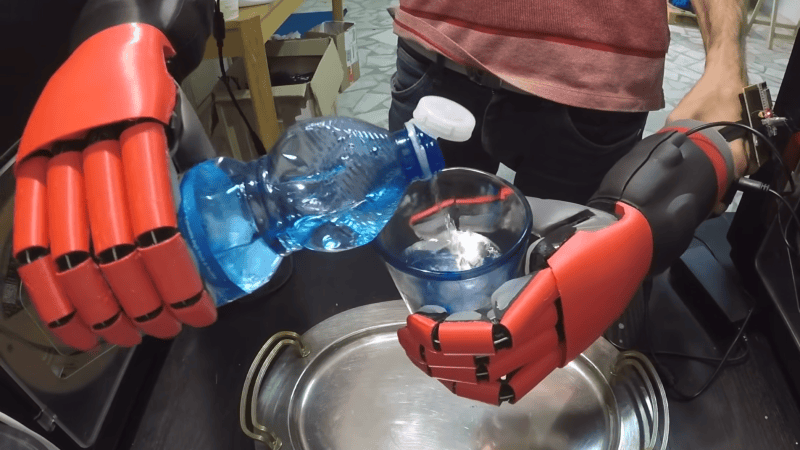
Most of the time, assuming nothing’s gone wrong with them, we take our hands so much for granted that it’s easy to forget what remarkable pieces of engineering they are: not only are they precise and sensitive enough to crack an egg or write a signature, but also strong enough to lift a weight or swing a hammer. Such performance has thus far eluded robot hands, but fortunately few tasks require it; the main challenge is dexterity, which is where [Vittorio Lumare]’s low-cost Yeah Hand could help.
The Yeah Hand is mostly 3D-printed and uses five servo motors per hand; like a human hand, it has no actuators within the fingers themselves, instead using fishing-line tendons to transfer motion from the motors. To reduce friction and keep the motors from overheating, each tendon runs through guides made from PTFE Bowden tubes; in tests, the hand ran 800 cycles of opening and closing without even getting close to overheating. The hand can lift up to eight kilograms and apply a maximum grasping force of five kg. For better grip, each finger has silicone grips along the inner surface, which let it hold smooth objects quite steady; to pick up fine objects, the thumbs have thumbnails.
The hand comes in two versions: robotic and experimental prosthetic, with the main difference being in mounting: the robotic version comes with a wide variety of mounting flanges and has an ROS driver. To control the hand more intuitively, [Vittorio] made a glove with built-in flex sensors to detect the position of his hand and mirror it. For some demonstrations of the hand’s abilities, check out the video below.
We’ve seen a number of human-like robot hands here, though most aren’t nearly as accessible for the average hacker. If you have a more bespoke need in mind, though, designing a purpose-built hand is quick.











The “tendon” is called a Bowden cable. The tube is the housing for the cable. So-called “Bowden tubes” from 3D printing mislingo should be called feed tubes, since they don’t transmit force.
I could have been more annoyed, to be fair. At least this article didn’t use the jokeword “cromulent”.
They’re also commonly called tendons in the robotics industry.
I just got back from IROS and didn’t hear them called Bowden cables once.
Also working in robotics at one of the larger well-known companies doing humanoid robotics, and can confirm this (tendon is the common termonoligy).
I think that Bowden tube as a term comes from printing, though the term gets the idea accross. Though if you want to be semantic, there’s nothing specific about PTFE tube that makes it a “Bowden tube”. That’s just what the 3d printer people call it. It’s just PTFE tubing of a size slightly larger than whatever wire you’re feeding through it.
So it would be accurate to call the part a Bowden tube, as that’s what it is, but saying it’s made from “PTFE Bowden tube” is kinda limiting yourself to hobby terminology.
Another common material is to use bike cable break tubes; which use a very similar construction, but often with steel reinforcement arround the cable. Handy stuff when you need higher stiffness and strength than bare ptfe tube.
Bicycle brake cables are the original Bowden. At least 2 people named Bowden were involved with them about 120 years ago.
Fiber motors
https://techxplore.com/news/2026-10-threadlike-motor-fibers-flexible-robotic.html
Soft gripper
https://techxplore.com/news/2026-10-rubber-ducks-screwdrivers-dexterous-soft.html
Tendon joins for prints
https://techxplore.com/news/2026-10-bone-tendon-3d-mimic-body.html
Also the often-forgotten fact that the muscles in the lower arm are almost exclusively to move the hand.
I question the use of PTFE tubing for the tendons. I mistakenly built a machine with sliding bearings made of PTFE, which quickly turned to dust and wore out. I replaced them with UHMWPE. As I understand it, UHMW, unlike PTFE, tends to coat the surface of whatever is sliding against it, greatly reducing friction and wear. PTFE flakes off, as I discovered. I don’t know if UHMW tubing is available, but I’d start looking for it.
Your fault was not to lubricate PTFE bearing. Igus mentions this failure mode in its training materials.
“Yeah Hand” ?
Someone should make one called the “Lenda Hand”, or how about the “Gisa Hand”?