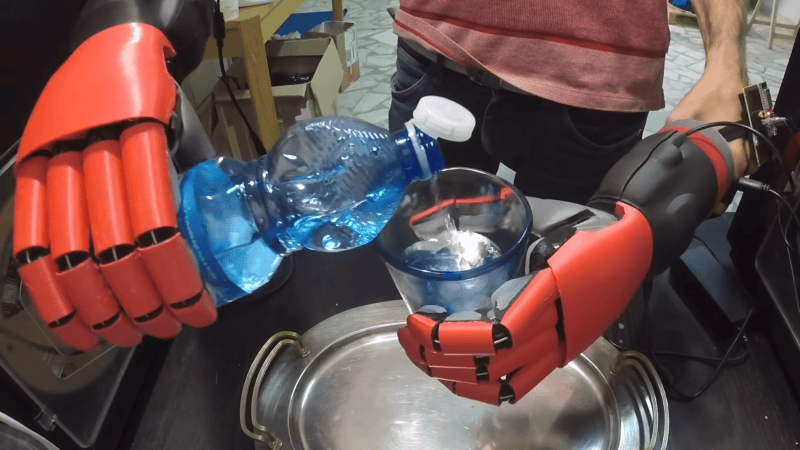
Most of the time, assuming nothing’s gone wrong with them, we take our hands so much for granted that it’s easy to forget what remarkable pieces of engineering they are: not only are they precise and sensitive enough to crack an egg or write a signature, but also strong enough to lift a weight or swing a hammer. Such performance has thus far eluded robot hands, but fortunately few tasks require it; the main challenge is dexterity, which is where [Vittorio Lumare]’s low-cost Yeah Hand could help.
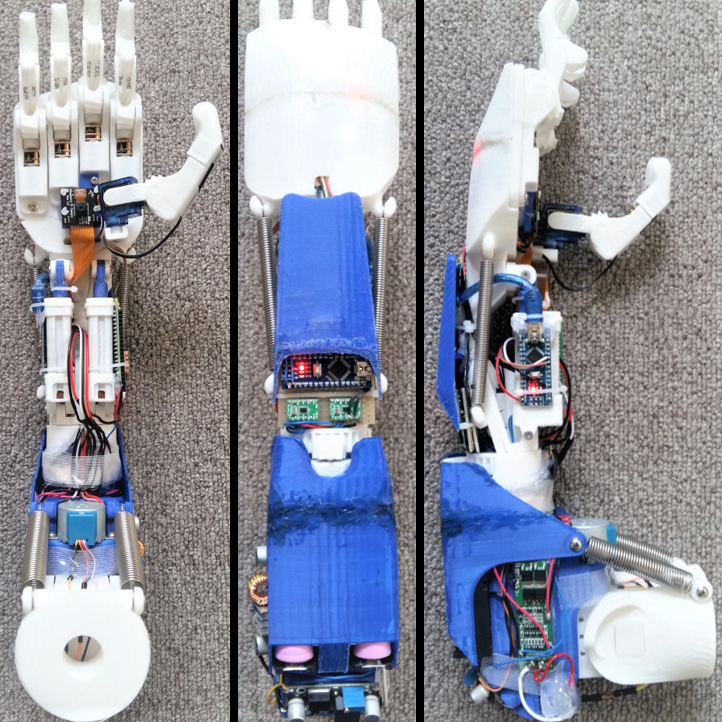
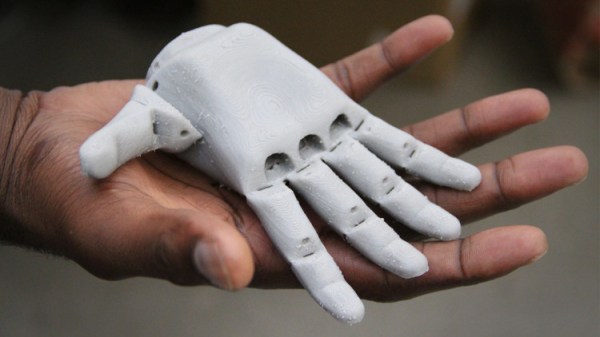
The Yeah Hand is mostly 3D-printed and uses five servo motors per hand; like a human hand, it has no actuators within the fingers themselves, instead using fishing-line tendons to transfer motion from the motors. To reduce friction and keep the motors from overheating, each tendon runs through guides made from PTFE Bowden tubes; in tests, the hand ran 800 cycles of opening and closing without even getting close to overheating. The hand can lift up to eight kilograms and apply a maximum grasping force of five kg. For better grip, each finger has silicone grips along the inner surface, which let it hold smooth objects quite steady; to pick up fine objects, the thumbs have thumbnails.
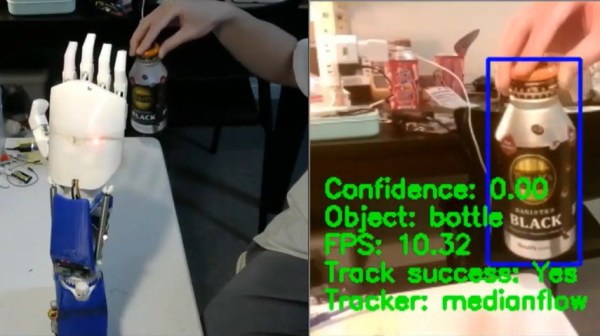



 We first came to learn about this company through a tipster [Dj Biohazard] who pointed to a post about their partnership with an 11-year-old Tilly, who is pictured on the left. Her bionic hand is an Open Bionics prototype whose design is based on the video game, Deus Ex. The best way products like these are improved are through the open source community and people like her.