
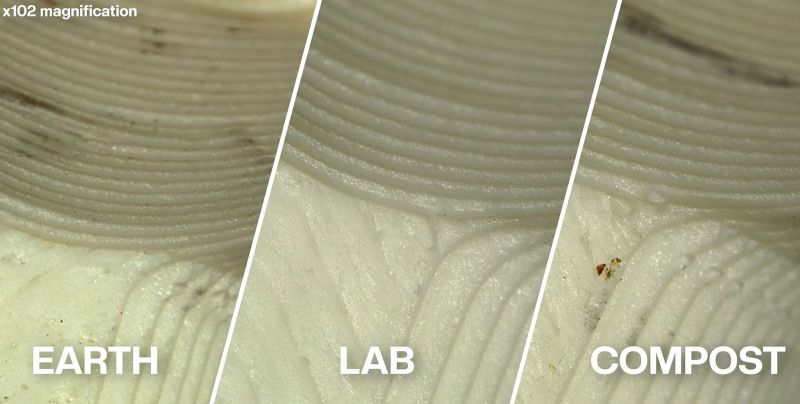
The ‘biofriendly’ nature of poly(lactic acid) (PLA) filament often gets touted as one of its main advantages over alternatives like PETG, but even a modicum of research ought to inform a person that the biodegrading feature of PLA is only true for pure PLA without additives and at temperatures at or above its glass transition temperature (Tg). Thus the results of a year-long experiment by [I built a thing] shouldn’t be too surprising.
After burying said PLA in the garden like any self-respecting person does who tries to dispose of some evidence, the PLA suffered through a European winter and very hot, dry summer, before being dug up again recently for inspection and testing. Although not the first time that someone has tested this, it’s a good reminder considering just how much PLA filament is used each year.
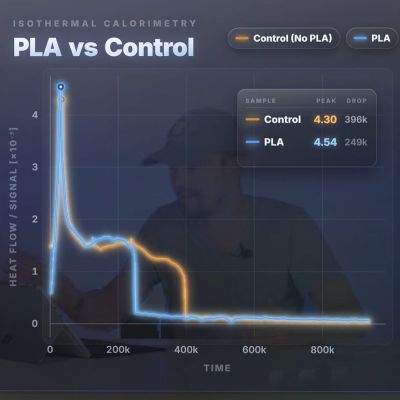
In total three sample sets were used, one being the control, the other two buried in soil and compost respectively. A visual inspection showed no major difference, and a tensile strength test also showed no statistically significant change among all three sample sets. The experiment could have been concluded here, but instead calorimetry was used in a laboratory setting to see whether exposure to microbes as commonly found in soil does anything significant.
This isothermal microcalorimetry test was performed at the University of Basel, effectively to answer the question whether there’s anything in the PLA samples that can feed said microbes. As it turns out, the answer is a resounding ‘no’, with microbial activity within the presence of PLA dropping off even quicker presumably due to there being less volume available for nutrients.
When [I built a thing] contacted a large number of commercial biodegrading facilities in Switzerland, Germany and the USA, many would happily take PLA, but none of them would accepted 3D-printed PLA parts, which says a lot. The primary reason for this appears to be that even under industrial composting conditions it simply takes too long for these facilities to consider these to be economical to compost.
With PLA primarily degrading via hydrolysis, it needs to be exposed to the right conditions for this process to not take an eternity. You can of course use something like PHA instead, which doesn’t require this hydrolysis step to be biodegradable. Overall PLA is quite a crummy material, with it also suffering from embrittlement due to crystallization that will happily turn a spool of PLA into lots of sad fragments. This makes PETG into a very common and very attractive alternative to PLA.












PLA can be converted into basic molecules (carbon dioxide and water) very easily: It makes excellent fuel and accelerant for a wood fire, like candle wax (or napalm). It burns with no ash and no smoke. I use my failed prints and scrap as kindling in my wood stove.
oh now that’s a smart idea! I’m guessing you have to have a pretty clean hot burn in order to not get soot and ruin your stove’s catalytic converter though?
I’ve been burning wood to heat my houses for more than half a century. We burn clean, don’t make soot, and we have never used catalytic converters.
This would also produce some aldehydes, so it’s not really great for environmental pollution or your health.
I mean… so does wood.
Depending on which type it produces.
This is part of why we need to stop looking at incineration as an evil method of getting rid of waste.
If it comes from an organic source then burning is still carbon neutral and incinerators can both generate electricity and have protections against nasty chemicals.
All this means we can get rid of plastic more practically, without issues with microplastics or recycling, which can’t always be done.
Sadly, a lot of plastics aren’t so amenable to simple incineration. You wouldn’t burn a urethane or ABS or PVC, for example, at least not without some processing and scrubbing. Even PETG doesn’t fare so well in a simple wood stove. But PLA is great.
That’s why I mentioned protection against nasty chemicals.
Of course some plastics and addictives won’t burn cleanly but a big facility can monitor and prevent issues better than individuals burning failed prints.
They definitely should have scrubbers and catalytic converters.
There are also almost certainly other things besides plastic waste they could burn that wouldn’t recycle or compost well.
Sweden actually has to import trash to keep it’s waste to energy plants at capacity.
And, as you say, while it’s not a great power-to-co2 ratio, a lot of this input would otherwise slowly degrade and release those gases anyway, so you aren’t really creating any extra global warming load, you’re just capturing the energy.
With the US existing, and the Ukraine/Russia war existing, there is no hope to prevent global warming and what you do is prepare for the effects instead.
Oh and then there is AI, which also exists.
Not to despair though, there is also something called ‘nuclear winter’. And so it makes sense to pre-heat eh! ask any AI.
Compact the plastic trash and store to use as fuel in the nuclear winter. Any AI will approve this solution.
• China produces roughly 12.3 to 13.1 billion metric tons of CO₂ annually (accounting for roughly 31% to 33% of global emissions).
• The United States produces roughly 4.6 to 4.9 billion metric tons annually (accounting for about 11% to 12% of global emissions)
India is at 3.2 billion and rapidly spiking. If you look at future trends, it’s going to favor developing countries while developed ones are actually falling quite quickly due to new technology and flattening population curves.
But you people will never ever consider enforcing this stuff on the developing world. It activates the crimestop.
But seriously now ‘noname’, we are not idiots are we? We know what the real US numbers roughly are right?
Ah, you beat me to the salient point :)
On a related note, I wonder if mealworms like eating PLA or if they prefer cellulose and polystyrene?
That’s a really good idea, thanks. I’m going to start trying that.
I am just instinctively skeptical of green claims like “this is biodegradeable” (and I’m nearly batting a thousand for accuracy by just flat-out refusing to believe those claims as a blanket heuristic) so I’m not surprised it doesn’t actually decompose, either when left in the dirt or in some kind of bio-reactor.. Fire is very good at encouraging chemicals to decompose, though.
Ok, but you have likely other chemicals in there too for 3D-printing, no?
I had no idea, thank you
Given that PLA degrades under UV, those samples might have actually broken down more if they hadn’t been buried, and instead just left out in the sun.
True, but then all the PLA ending in a general bin and subsequently in a landfil won’t see much sun either. And if it won’t fit in the compost heap, I’m not keen on spreading 3D printer poop on my lawn hoping to see it degrade over few years! I suppose in which case the lawnmower might help too!
So, how about cooking it with water in higher pressures ?
Also : just burn the thing.
A correctly configured stove will burn it well, without excessive smoke or ash. If you use a bad stove, it doesn´t matter the fuel : wood or paper will give you smoke/ash the same.
People need to stop equating burn with “rubber tires on fire” . Or we need to start using another technical term for the correct process/chemical reactions of the right type of “burning” .
How about a rocket stove? I assume a high-energy fire like that breaks it down pretty well.
Exactly.
Better reprint something new with your waste PLA prints:
https://hackaday.io/project/181165-direct-granules-extruder-fdm-prints-from-powder
Works not only for PLA
If you want to recycle, it’s much easier to just sort PET bottle, cut them in strips and extrude filament from that. Granted it’s not PLA, but arguably you get “better” plastic and are recycling plastic which would be otherwise more “damaging” in the wild than your PLA. Although, according to this article, the last point is debatable!
That PET recycling by cutting bottles to strips is more time consuming, limited to bottles and results in very poor filament. I don’t see that as easier than throwing the bottles (or other material) in a blender.
Furthermore you remove that plastic from a working recycling circle for bottles (at least here in Germany).
Maybe he should have printed stuff like apples to trick earthworms and bugs into chewing the print?
Even if it doesn’t break down, PLA in landfill is basically inert. It doesn’t generate persistent micro plastics for instance, since at that size it does easily break down into lactic acid.
I can confirm that PLA turns into mush and then into highly corrosive, sticky, nasty acid. I’ve lost a couple of Pi Zeros to it, among other things. None of the items were left outside.
Turns out the tropics are not great for PLA printing. Anywhere between three to seven years is how long I get, making it worse than useless. Now switched to PETG.