
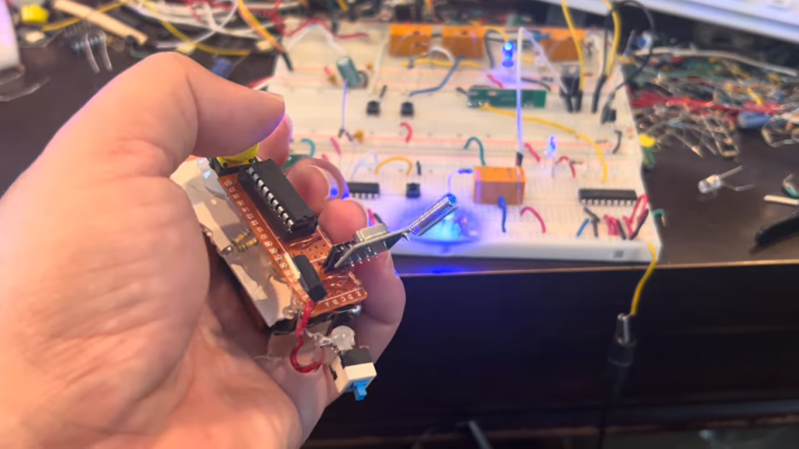
Some of the first remote controls available to consumers used sound, visible light, or even just wires to communicate with their parent device. It was many years between these first rudimentary remotes before they standardized around infrared or RF signaling. Even then it was a while before remote controls were reliable enough to not have to think about anymore. They’ve gotten so good now that there are small modules available that let us quickly build these devices to perform all manner of tasks.
[Igor Brichkov] is demonstrating this project because his garage door remote control suddenly stopped working. The RF receiver and transmitter circuits are readily available and inexpensive, but they need some support circuitry to work properly. The transmitter is paired with an encoder which is provided a binary code by wiring various pins to power and ground. This “code” is sent to the receiver which has a decoder and listens for that specific code. When the codes match it changes the state of one of its pins, which is used in this case to short the garage door’s remote terminals and signal it to open the door.
Although the resulting handheld remote with its single button looks a bit like something from 1950s science-fiction, it’s an effective solution. Especially when compared to possibly trying to reprogram a proprietary remote, find one from a company that doesn’t exist anymore, or rebuild one that operates on a bizarre frequency. With access to the physical hardware, it turns out a lot of things are controlled by just shorting pins together, and anything can do that from wires to RF transmitters.












Where is the latching circuit?
Your remote looks like momentary.
simple, indeed. An most of it, 100% INSECURE. Sniff the code, replay it, it’s over.
https://www.youtube.com/watch?v=lqcGr1YjqLU&t=145s
Quick question to more knowledgeable people than me : I always found RF remotes (433 to 868MHz) kind of big (at least to big to be put on a keyfob). Is this because of the antenna that have a minimum size or just because manufacturer didn’t care about optimizing more? I guess with all fractal antennas nowadays there should be a way to make a RF remote not much bigger than a CR2032 battery no? Is this something any maker/DIYer has been trying to make?
I just bought a pack of three 433mhz radios (SRX882), before realizing I really needed a 315mhz. And then ended up buying a 315 (SYN480R) as well as one that can them all (CC1101). I am here to confirm they can definitely be tiny
They are big because they need to have a battery that has a decent capacity, a low enough IR (to avoid excessive decoupling on the board side) and those particular type of cells are not very small. CR2032 have very high IR.
Half AA or half AAA are often used with these kind of keyfobs, as far as I’ve noticed.
Thanks for your answer, the internal resistance aspects is something I hadn’t in mind.
What’s the issue with big IR? Lower shelf life for the remote (battery has to be changed more often)? Something else? If just battery life, is this something than can be solved with a small (super)capacitor?
Regarding battery replacement, does a self generating solution can help like a Kinetron a piezoelectricity (pinching a quartz to generate enough electricity to enable a MCU to chirp out the code) while staying tiny?
I’m not sure how small a RF remote can become but I guess (I could be wrong) that the smallest ones on the market are just a good enough solution that hasn’t be challenged nor optimized in years.
High internal resistance in the battery limits the transmit power. A large capacitor in parallel with the battery can help with that, but large capacitors have high leakage which drains the battery. Besides which, large capacitors are large.
A larger battery has lower internal resistance so the transmitter can be more powerful. The larger battery lasts for years because it has a larger capacity, so you don’t have to change it often.
The remote control for the garage door usually stays in the car rather than your pocket, so no problem there.
Ok so the solution would be to use either self generating solution as mentioned, or find a small battery with chemistry that would provides low IR. Food for the though, I’ll see what is available on this side, thanks!
The garage door remote is on a keyfob in a pocket if said garage only contains bikes ; )
They can be small, some are keyfobs.
Yeah mine is a keyfob but it’s like 1cm (1/2″) thick and 4x3cm (~2×1″) so too big for my taste. It seems that 433MHZ SMD antenna are a thing. I wonder if it would be possible to mod an existing programmable 433mhz fob to use such an antenna instead of a big coil.
As it’s a stupidly simple idea and I don’t see anyone trying it I guess there’s a gotcha somewhere. A RF remote as thin and light than a regular key would be awesome.
As a child, the first remote control I saw was thanks to my father – a garden bamboo stick used to poke the channel push buttons on our black and white TV. But I could never hold it steady enough to aim at any particular button!
You don’t need to hold it THAT steady, just steady enough to poke the next youngest to get up and change the channel.
Fun project. I remember those chips at Radio Shack, back in the day. I still have a couple.
But those 8-bit fixed-code remotes were rightfully deprecated some time in the last millennium. So easy to record and play back, even easier to brute-force all the codes.
Negligible security, the codes were useful only to avoid opening your neighbor’s door.
Modern rolling-code systems are just as simple, even more reliable, and secure.
Modern rolling code systems for garages arent secure. Sec+ v1 and v2, the patent outlines the encryption. A single capture and I can bruteforce the rolls until it opens, which is fast too. Those two protocols make up most of the garage openers in the US.
Keeloq isnt much better with many manufacturer keys out there to use with the NLFSR. Genie is the only one I know of that is currently secure.
and yes I have written functional implements for the Yardstick One many years ago.
Even still windows are vulnerable, which is why I find it funny that people act like RF is the method a criminal will use.
Holtec HT12E/12D are great little chips as they can encode and decode 4 bits of binary data (depending on the chip). Certainly not new tech, but they are great for basic things. I believe they also carry basic error correction, or at least send multiple times.
Garage doors are a security nightmare. All you have to do is push in at the top and hook the emergency release and you in. No remote or codes needed. See videos on the video site. Even if you remove the rope there are easy ways in. Be afraid, very, very afraid.
Houses are easy to enter, just throw a brick through a window. Or use a sledgehammer on the front door.
Why should we be “very afraid”? Because of your lame comment? Perhaps you need to have a lie down.
Do you have an idea to such video? This might have to do that I’m in the EU but I don’t know about any garage door here having such a hook.
s/idea/ID/
(as in Youtube video’s ID)
The garage doors don’t have a hook you can reach from outside. They have an emergency release inside the garage that you can (theoretically) snag with a hook from outside the garage.
My garage door in Germany has an emergency release.
Anybody that is that desperate to get into a house will toss a brick through a window.
If you break into my garage, you can open a door that goes into the backyard. You could get into the backyard by walking around the house, though. My garage does not share a door with the house.
Here you go! https://www.youtube.com/watch?v=EAk0t-D-_eo
Thanks. It seems to be only a US (California?) garage thing indeed.
I’m pretty sure it is all of U.S.A. as it is considered a safety. If the power goes out you can’t be trapped in the garage. Or in case of fire?
In Germany, too. There’s a pull rope in the garage to let you raise the garage door without the power.
The guy in the video makes it look easy to pop the door from the outside, but there ain’t nobody running around popping garages open with a stiff wire to steal stuff. It is much more difficult than it looks.
Hmm Germany must be a nice place with great people because it does happen in the U.S. One company I worked for got robbed. The burglars broke in by removing a window out of a garage door. The thief simply pulled the rubber seal out around the window and climbed in. I lost about USD 15,000 in tools that night. I also read about a guy who lost two classic cars to the hook the release scheme. A couple of ways around this- put your garage door opener on a switch and turn it off when you don’t need it and put sliding locks on the inside of the door or put locking pliers on the door channel to prevent the door from being opened.
It generally is, indeed. People on average have a higher level of scruples.
They do adhere to certain social norms not because they feel that they must do, but because they do value them enough.
Normal people don’t steel from others because they themselves want to be stolen from.
It’s that belonging to an inner need for safety and stability.
That’s one of those stereotypes that is more true than others, I think.
Japan is similiar, I believe.
That being said, there’s crime in Germany, too and burglars do exist here, as well.
Though they are more likely to give up over here if they face a form of resistance, I would say.
And it’s not exactly clear if the crimes on average are done by Germans, as well, though.
Because the statistics don’t register nationalities, as far as I know.
But even if they did, anyone with a German passport is considered “German”.
The culture, origin, way of raising and mentality are not taken into account when it comes to that.
That’s all I can say about this, I’m afraid. I don’t mean to judge here, either.
Oh, my! What have I done here!? 🤣 There’s a “not” missing, obviously! 🥲