
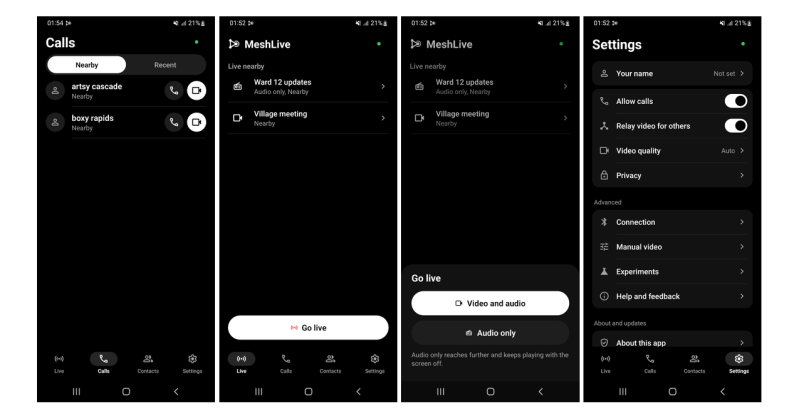
Telephony is a bit of a mixed bag. On the one hand, being able to talk to people in far off places is kind of neat, at least in theory. On the other hand, you’re usually reliant on a centralized network, which isn’t ideal to the mindset of most hackers.[Gautam]’s MeshLive project deals with that last one, offering a decentralized mesh network solution based on Bluetooth for Android phones that can handle both voice and video.
Rather than relying on dedicated hardware, this particular mesh piggybacks on your phone, and exists only as an Android application. Calls are end-to-end encrypted for both voice and video — though two-way video calling is still experimental. More testing has gone into video broadcasting, where a stream goes out one-way. The capability is available for voice, as well.
Each user has a unique identifier that can be scanned to create contacts, but it isn’t otherwise clearly identifiable to everybody. You’ll only appear with a random name that changes every 15 minutes to other users in range who aren’t your contacts. Range is of course the Achilles heel of this project, since it’s using the Bluetooth hardware of ordinary smartphones. It’s possible to extend the range of Bluetooth significantly with the right hardware, but we imagine most folks aren’t carrying directional antennas around with them. While every phone does forward the signal to as many others as it can, it can only do so for about 20 meters.
Of course LoRa remains the protocol of choice for mesh networking, though it’s normally used for text messages only. We have seen voice packets over LoRa, but anything LoRa requires dedicated hardware while this only requires an app.












I could see this being useful for cyclists and motorcyclists. There are existing short range radios but this could be a useful open alternative. I’ve had trouble having conversations on rides and would appreciate something like this. You’d need a solid popfilter for your mic tho
Some motorcycle comms devices that have mesh functionality do use Bluetooth as the underlying netwoek
Hadn’t really considered motorcycle comms, but that’s actually a pretty interesting use case. Wind noise would definitely need some work. Thanks for the suggestion!
The comms system on my helmet already does mesh for group rides.
Ooooo now this is cool… BUT… Until this can be passed over a net of LoRa repeaters I just cant see it being incredibly viable. Hell of a step in that direction though! Well done!
Thanks! LoRa would be pretty limiting for real-time audio/video though because of the bandwidth, but extending the network beyond Bluetooth is definitely part of the plan. I’m working towards a hybrid Bluetooth + Wi-Fi Direct/Aware approach, and also exploring Nostr/Tor based nodes and online relays for wider connectivity. Still a lot to figure out though!
The only thing that Bluetooth doesn’t ship with is the kitchen sink. Also mandatory reminder, Bluetooth and BLE have nothing in common.
I was playing around with BLE 5.4 PAwR (Periodic Advertising with Responses) recently and realised that fundamental features that have been used by people using vanilla 2.4GHz ISM FSK/GFSK/OOK/whatever radios for decades are just now making their way to BLE. And no one thinks this is odd
Really wild
Oh, it’s Skype. Again.
Skype, except no internet and decentralized
Wasn’t this the purpose of FireChat, by Open Garden, that failed out of lack of interest? It is indeed a cool idea, but at the end of the day it is not what people want in this day and age… Or has the landscape changed, and there are now people interested in it?
FireChat was definitely ahead of its time. but looking at the recent interest in Bitchat, I think there’s still demand for offline communication, even if it’s niche. I’m trying to take it beyond text with livestreams and audio/ video calls. Whether it’ll find wider adoption is something i’m still figuring out too!
There are some applications where open short range communication is optimal over centralized communication hubs.
On a boat with a short wave radio you can easily communicate, in case of emergency, with nearby ships that are in line of sight. With a mobile phone even if people on the nearby ship have handsets and are in range of cell towers, there is no way to contact them without knowing their number. And contacting people with numbers you know may be too far away time wise that an emergency may become fatal.
So I am looking at this and trying to think what is the optimal use case of a short range private communication, and the only thing that comes to mind might be large groups of public protestors.
Protests were actually one of the reasons I started building this! But I can also see it being useful during disasters, at crowded events where networks get overloaded, or in remote areas with no coverage. Basically anywhere people are nearby but can’t rely on cellular infrastructure. Though for maritime emergencies I’d definitely still rely on proper radios.
Another use case is cyclists riding in groups in areas without mobile coverage. Commercial products exist for this use case.
The distances involved preclude relying on something where a 20 meter gap segregates people.
People should also be aware that communications methods almost always have a safety component, even if it’s not a designed feature. (It should be.)
Its like Bitchat?
Bitchat doesn’t let you livestream and make video calls
Isn’t this just like Briar?
kind of but Briar is limited to messaging. This also lets you livestream and make video calls