

Hiding Virtualization From Other Software

The Kernel-based Virtual Machine (KVM) allows Linux systems to function as hypervisors without needing any extra software, but VMs created with it don’t behave exactly like real hardware does. Sometimes that’s important, though, so [sandwich] built a tool called vfio-native that obscures the fact that software might be running in a virtual machine.

There are plenty of the ways that virtual hardware differs from bare metal. The VM may behave slightly differently for obscure instructions in ways that are measurable, it may take slightly longer to perform some tasks, or the hypervisor may simply announce itself directly. vfio-native includes some kernel patches that solve some bugs which address the different behaviors, changes the way that the kernel identifies itself, and attempts to force the CPUs to behave in ways that real hardware would behave. With all of this applied to the virtual machine, it scores a 1/85 against a VM detection tool, with a standard KVM virtual machine scoring 10/85.

For anyone looking to test this out, it’s available in the AUR for Arch Linux. Also, it’s probably worth mentioning that there are more reasons to use this than cheating at Counter-Strike. For example, security researchers testing malware need to know how that software behaves when it thinks its on real hardware, and some may behave in benign ways when confined to virtual machines. Some licensed software also may disable itself when it detects its running in a VM, which can be a nuisance for things like software controlling industrial tools which only run on operating systems that are no longer maintained or hardware that can’t be found anymore. Some other tools we’ve seen before perform similar tasks as well.
Hairy Armor For Combat Robot? It’s Not Terrible!

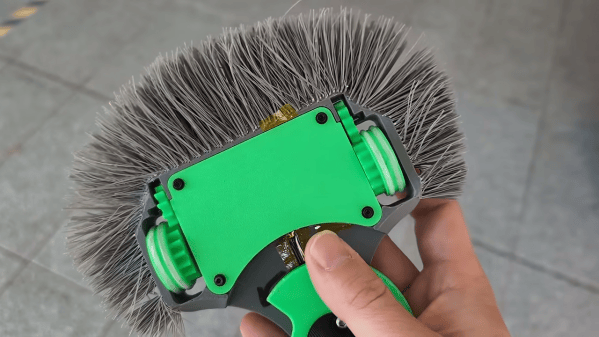
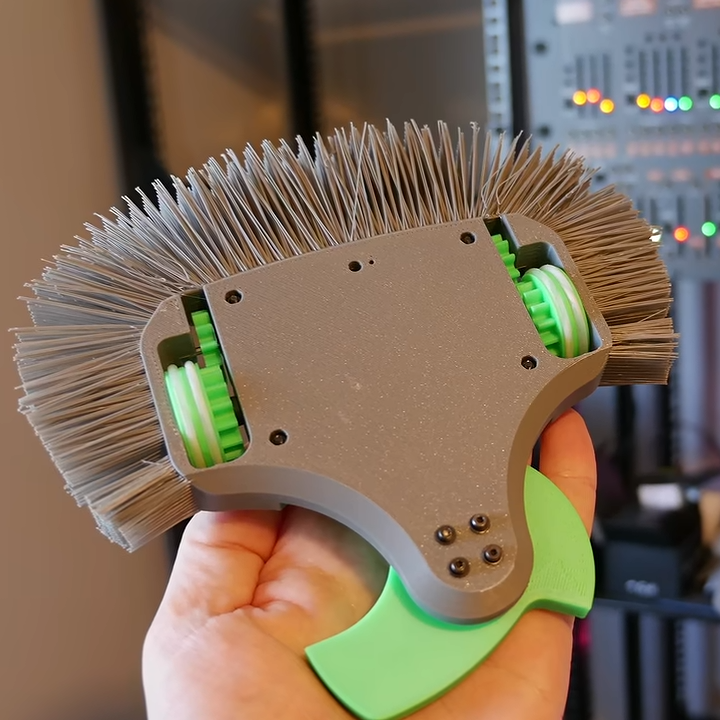
[Angus] of Maker’s Muse enjoys combat robotics, in which contenders zip about in an arena, attempting to disable one another with weapons that lift, spin, and smash. He got a funny idea a short while ago and wondered whether a stiff mane of bristles could serve as lightweight, ablative, impact resistant armor?

Just to set the stage, [Angus]’s new robot competes in the plastic antweight (or “plant”) division, in which robots are limited to 150 grams with both chassis and weapons made of plastic. In such circumstances, one can see how a mane of thick, rigid “hairs” might actually punch above its weight, so to speak.

The green shape at the bottom is a spinning weapon. The bristles cover the sides and rear.

Nothing settles a question like a good experiment, so [Angus] sat down and redesigned his latest robot to replace its outer shell with a thick wad of bristles, in the style of a 3D printed lion’s mane. Filament is bridged between the model and an outer support structure, which is cut away afterwards to expose the “hairs”.

How well did it perform? Well enough to merit further study! Where past robots got their outer shells broken up, the hairy robot seems to have come through quite intact. It seems the idea might not be as silly as it first seemed, at least in the plastic antweight division.

3D printers have been fantastic in the field of combat robotics. First they were great because they made custom parts easier and more accessible to hobbyists, but things have evolved more since then. Now folks compete by putting motors and electronics inside almost entirely 3D printed robots. There’s never been a better time to get into combat robotics, and experiment with unorthodox designs.

If you want to try a hairy robot for yourself, be sure to watch the followup in which [Angus] improves the hair-generating process considerably.









