Beautiful Laser Harp Hides Some Neat Tricks

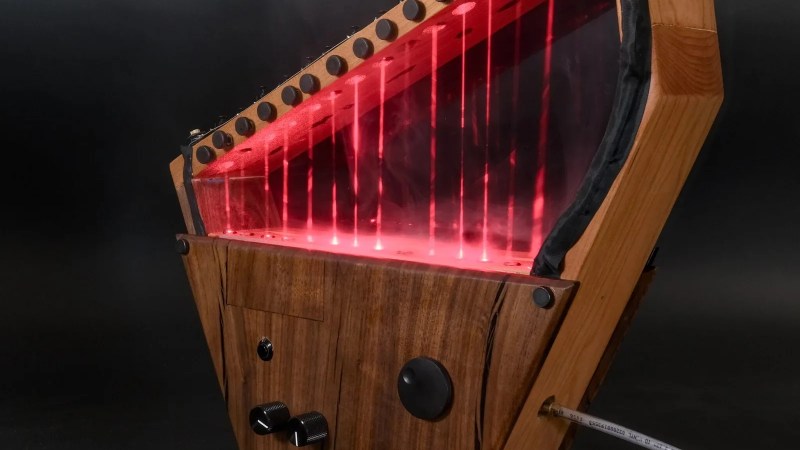
Laser harps aren’t quite a right of passage, in that not everyone builds them, but it’s likely everyone at least contemplates building one at one time or another. We’re lucky that [Derrick] a.k.a. [DJ Baja Blast] didn’t stop at contemplating, and even luckier that he put together a full write-up for his tricked out laser harp — because this is a fascinating build, with features we’ve never seen in one place before.

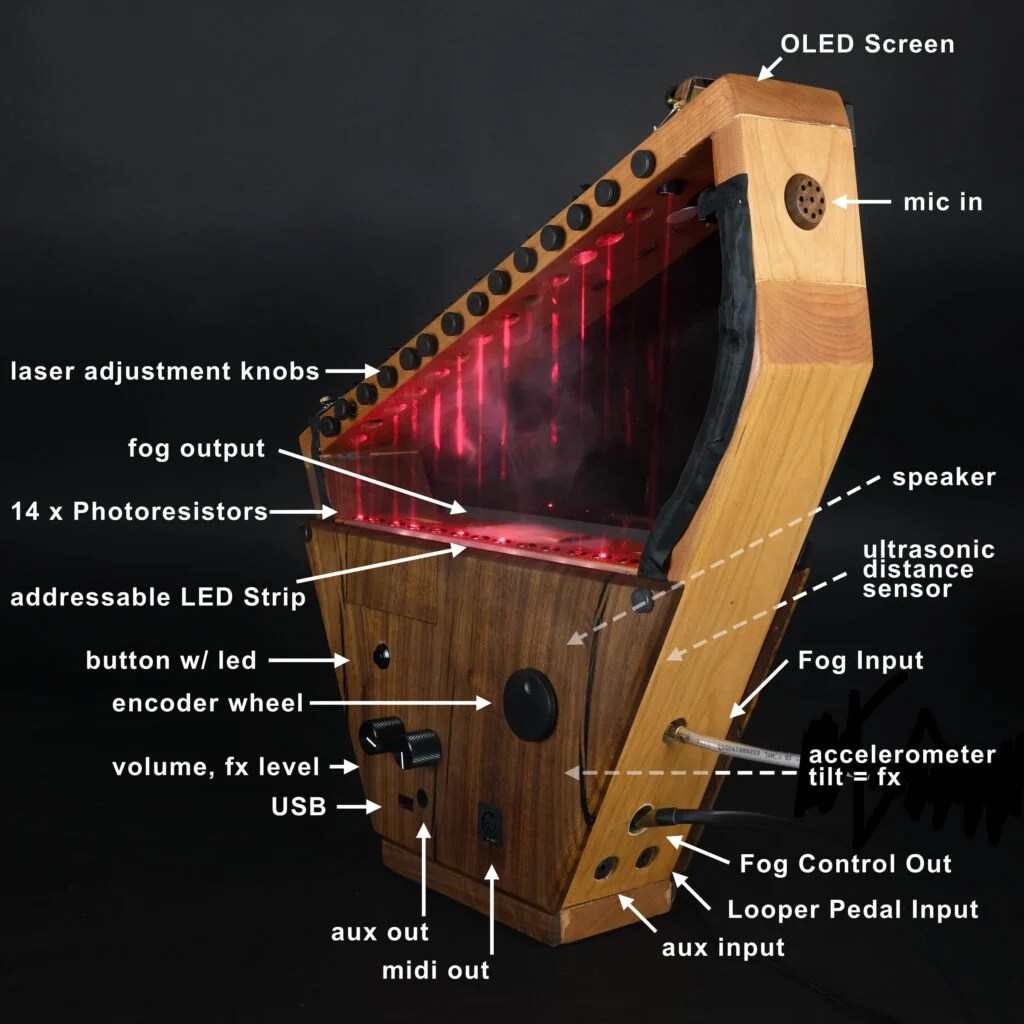
First of all, the harp! Lasers, photodiodes, done, right? Not here! [DJ Baja Blast] kept it analog with photoresistors so that he could measure the rise and fall of the voltage as the laser light is occluded by the player’s hands — thus you can moderate the volume via faster, louder and quieter, slower plucks. More unique is the inclusion of an accelerometer. What can you do with an accelerometer in a harp? Well, here it’s being used as a tilt sensor, with the tilt acting as a control to ‘bend’ the note as it sounds, tuning it flat or sharp or altering it any other way you choose to define in software. There’s also an ultrasonic distance sensor so you can do the same thing — or any other thing, there’s no shortage of effects to chose from — theremin-style, and an encoder wheel sits on the side, so that’s five extra inputs beyond selecting a note by blocking a laser diode. Unless you count the optional looper pedal input, or the aux in.
It probably has a teensy learning curve, but looks like a baja blast to play.

All these inputs are driving a Teensy 4.1 microcontroller, which has the grunt for just about any synthesis or sampling, though right now [DJ Baja Blast] is sticking with the Karplus-Strong string synthesis algorithm. The Teensy can drive an onboard speaker but also offers MIDI out. Eventually he does intend to add more. Last but not least, we cannot forget that he’s plumbed this instrument to hook to a fog machine. Which makes for a visually engaging performance, and probably helps a lot when you’re learning where the laser ‘strings’ are.

The whole thing is handsomely put together with cherry and walnut. Does it sound as good as it looks? Listen to it in action in the demo video below, and judge for yourself! If you want to build your own you can grab the files on GitHub.

This is hardly the first laser harp we’ve seen, or even the first to use a Teensy, but it’s certainly got the most options to spice up a performance. It’s got to be a baja blast to play.

Continue reading “Beautiful Laser Harp Hides Some Neat Tricks” →
DIY Teensy Looper Multiplies Music

If you’re into electronic music, chances are good that you like to roll your own. While step one is usually to build something, anything that makes sound, a natural step two is to build a looping device to extend and play with those sounds.

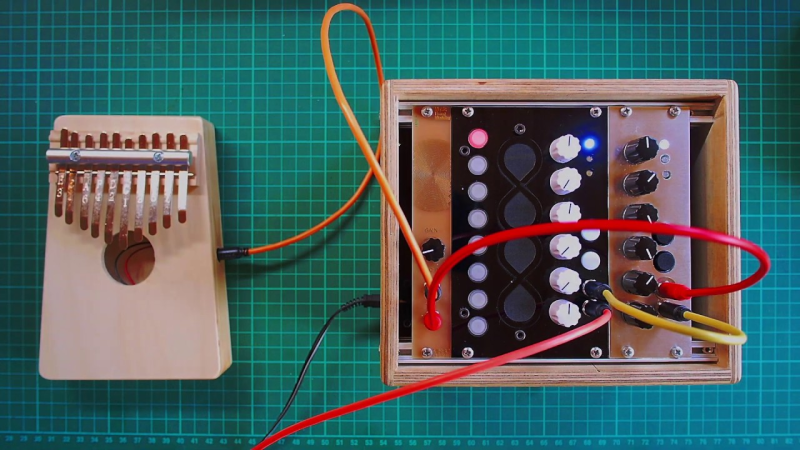
[Cutlasses] has finished version one of his Teensy-based Eurorack-style looper. He plugs in a thing, records some tunes, and the resulting loop gets divvied up into eight equal pieces. He can cut the loop together live using the eight buttons to jump around between sections. It supports unlimited overdubs, although too many will cause clipping. But hey, that just means free derivative sounds.

The looper records its audio to an SD card. Since this is typically a slow endeavor, [Cutlasses] used two circular buffers. One reads audio, and the other writes it. This took a lot of trial and error, which he may have to repeat with future SD cards.

[Cutlasses]’ plans for future versions include a separate audio CODEC for better sound, CV control, and a pedal option for hands-free operation. We’d love to hear some sweet Theremin loopage, wouldn’t you? Jog past the break to watch [Cutlasses] demo his looper with a kalimba and a DIY noise box that uses a string bow to make metal tines sing.

Feeling out of the music-making loop? There are (slightly) easier ways. Check out this LEGO looper or this multiplayer Pi-ano.

Continue reading “DIY Teensy Looper Multiplies Music” →

Stormtrooper Voice Changer Helmet Uses Teensy To Mangle Audio

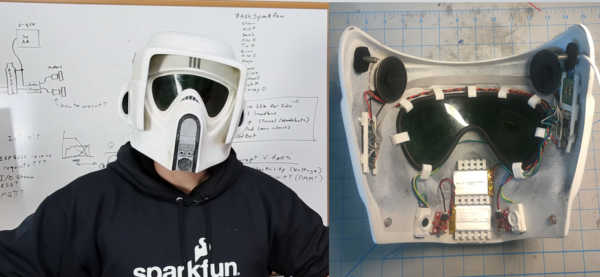
Halloween has come and gone, but this DIY voice changing Star Wars Stormtrooper helmet tutorial by [Shawn Hymel] is worth a look for a number of reasons. Not only is the whole thing completely self-contained, but the voice changing is done in software thanks to the Teensy’s powerful audio filtering abilities. In addition, the Teensy also takes care of adding the iconic Stormtrooper clicks, pops, and static bursts around the voice-altered speech. Check out the video below to hear it in action.

Besides a microphone and speakers, there’s a Teensy 3.2, a low-cost add-on board for the Teensy that includes a small audio amp, a power supply… and that’s about it. There isn’t a separate WAV board or hacked MP3 player in sight.

Continue reading “Stormtrooper Voice Changer Helmet Uses Teensy To Mangle Audio” →

The Best Badges Of The SuperCon

A few weeks ago, we took a look at the best badge hacks at the Hackaday Supercon. These were the best badge hacks anyone has ever seen – including what comes out of DEF CON and the SDR badge from the latest CCC. I’m ascribing this entirely to the free-form nature of the badge; give people a blank canvas and you’re sure to get a diverse field of builds. Now it’s time to take a look at the cream of the crop, hear what the jolly wrencher sounds like, and how to put 1000 Volts in a badge.

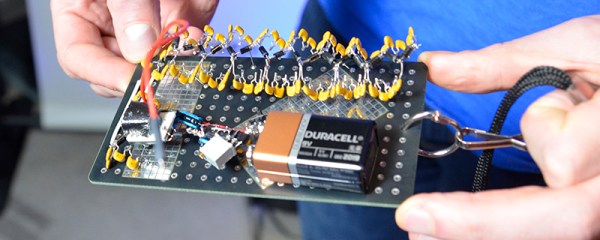
There were three categories for the badge hacking competition at the SuperCon – best deadbug, best blinky, and most over the top. A surprising number of people managed to solder, glue, and tape some components to a the piece of FR4 we used as a conference badge, but in the end, only three would win.

Continue reading “The Best Badges Of The SuperCon” →