
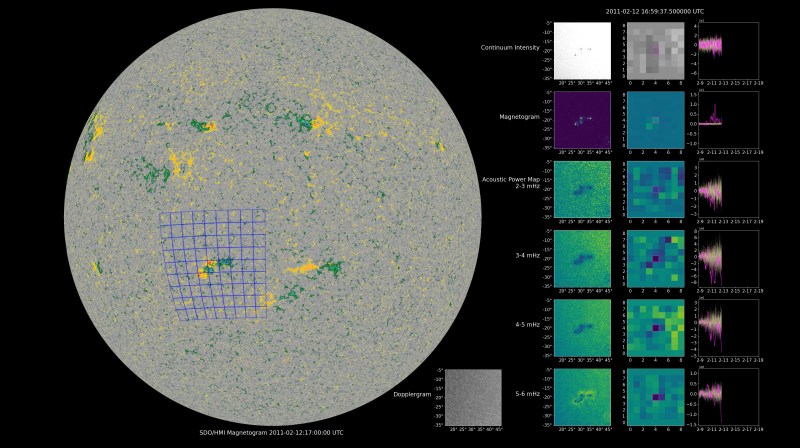
In this age of neural net “AI”, even the most skeptical of Butlerians have to agree that these machine learning models can be very, very good at pattern recognition if nothing else. NASA is on the same page, and to take advantage of that pattern recognition, they’ve built a machine learning module called COFFIES, which stands for Consequence Of Fields and Flows in the Interior and Exterior of the Sun, because at NASA everything is an acronym, or at least a backronym. Like most such names, this one is at least vaguely descriptive: the model is trying to predict what’s going on in the material flows and magnetic fields deep within our local star, and using those inferences is able to predict active regions– that’s sunspots to us chickens — up to 12 hours before they visibly form.
The measurements used here are indirect — we can’t chart the magnetohydrodynamic snarls deep inside a star directly, but we can measure the magnetic field and acoustic waves at and above the surface. You could say the model “hears” sunspots forming. Like all such models, it’s a bit of a black box, but heliophysicists may be able to use its predictions to help them understand their own, organic understanding of the big ball of plasma to which we all owe our lives.
This model is thus one of the better things to come out of the “AI” revolution– nobody is going to give over their thinking to the machine and stop trying to understand the Sun, and the few hours of extra warning COFFIES might potentially provide before the next Carrington Event-class geomagnetic storm could prove invaluable, especially since a flare-blocking Storm wall remains a theoretical exercise at best. If you are interested in the sun, COFFIES has an interesting YouTube channel and, as you can see in a recent video, they are doing a lot with AI.










I wonder if we could either create new sunspots or slow down sun burning up into red giant by nuking it.
the largest thermonuclear device ever conceived wouldn’t even make scratch in the sun, nevermind that the device would have to reach the core to be able to affect the fusion process.
I assume we’re talking astronomical scales, since we’d need to be. Unless you’re adding hydrogen to the star, you’d just be increasing the fraction of heavy elements, which would accelerate its death. It’s okay, five billion years is a long time, humans (and their creations) aren’t gonna be around to see it.
isn’t the entire point of hydrogen nuke is to create hydrogen from decomposition of lithium and aerogel?
It’s a shame an ordinary story about NASA doing interesting science now has to be written so defensively to avoid setting off the anti-AI crowd.
There is always someone who will pretend to be offended, outraged, insulted, etc. no matter what he says or doesn’t say.
Your comment is a yet another example of this…
As is yours! And mine. Wow it really is sanctimony and outrage all the way down.
Yeah it’s a very strange period in history in which those who benefit most from technology are scandalized by the mere idea of modern software
Sometimes strange things are strange.
Ffs, stop conflating LLMs with specific pattern recognition machine learning! This is not helpful. One shreds books and scrapes websites, ingesting copyrighted (or copylefted) code, works out art, literature,…
The other is using lots of carefully sourced and categorised training data.
Sadly, there will always be individuals who are absolutely convinced that insert name of new thing here is absolutely the best new thing ever until the next new thing comes along.
In this case the AI model is trained on solar data directly. I agree, using a contemporary LLM service would be absurd, bc hard numeric astronomical data is certainly not in the training set