Hackaday Prize Entry: An Electric Longboard

The Hackaday Prize is in full swing, and that means we’re starting to see all the builds a few select people have been saving up for the past few months. [yowhwui] has been working on a 3D printed electric longboard for a while now, and this build is really solid. He already has over 150km on the odometer, and the 3D printed parts are still holding up.

The power for this motor comes from a 6374 brushless motor running at 192 kV. This, plus two 4S 30C 5000mAh LiPo batteries propel this longboard to speeds up to 42 km/h (2.18 Saxon leagues per quarter hour), all while weighing about 8kg.

Since [yowhwui] is using the motor for power and braking (electric motors are neat), this longboard needs to be designed with belt skipping in mind. To that end, he’s designed a drive system with an idler, and nearly every single part is 3D printed. The first revision of the hardware was printed in PETG. While PETG was more than strong enough, it was also too brittle. This led to a few cracks. After printing the parts out again in ABS, [yowhwui] put a few more kilometers on this longboard, and there are no immediate signs of wear.


Build Your Own High Power Air Cannon Out Of PVC

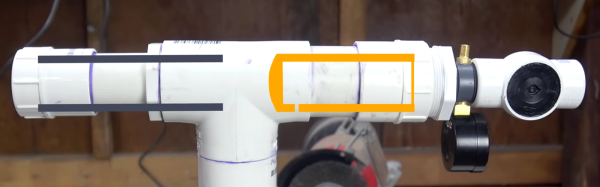
[NightHawkInLight] a.k.a. [Ben] recently built an awesome high power air cannon out of PVC pipe. PVC air cannons are great, and everyone should build one of these at some point in their life, but what really makes this build exceptional is the valve. [Ben] created a piston valve for this cannon that can be built with parts sourced from your local home supply store. Anyone can build this thing, and everyone should.

Instead of using a ball valve or other such contrivance to dump air directly from a reservoir into the chamber of this PVC air cannon, [Ben] is using a much more clever design. This is a barrel sealing PVC air cannon, with a moving piston sealed against a rubber hose clamp in the barrel. Adding air through the fill valve moves the piston forward, allowing air to leak into the reservoir. The air supply is then disconnected, and the trigger released causing the piston to move backward. This releases all the air in the reservoir into the barrel instantaneously, resulting in faster ping pong balls and potatoes.

The original trigger for this high power PVC air cannon used a simple ball valve for the trigger. [Ben] didn’t like this solution – it was hard to open and somewhat unergonomic. The ball valve trigger has since been replaced with a valve from a sprinkler system, giving this high power PVC air cannon a fancy brass trigger. It looks awesome, and can kill a watermelon from twenty yards. What more could you want in a high power PVC air cannon?

You can check out the videos for this build – including a guide for the clever piston valve – below.

Continue reading “Build Your Own High Power Air Cannon Out Of PVC”

Hackaday Prize Entry: WiFi In Wall Switches

The Internet of Things and Home Automation are the next big thing, even though we’ve had X10 switches and controllers for forty years. Why the sudden interest in home automation? Cheap microcontrollers with WiFi, ZigBee, and Z-wave, apparently. For this Hackaday Prize entry, [Knudt] is building a WiFi switch, meant to be retrofitted into any Euro wall switch.

There are three parts of [Knudt]’s WiFi wall switch, each of them with different requirements. The top layer is the switch itself and a small OLED display. These switches are really two small capacitive switches, which means there’s no reason to go through the work of sourcing a proper mechanical switch. Good thinking, there. The second layer of this contraption is basically an ESP8266, providing all the logic for this wall switch. The bottom layer is a bit more interesting, housing the 110-230V input, with a Triac or relay. This is where the fun, burny stuff happens.

Right now, you can go down to your local home supply store and simply buy a device like this. History has shown that’s a terrible idea. With home automation cloud services shutting down and security vulnerabilities abound, a DIY or Open Source home automation project really is the best idea. That makes [Knudt]’s project a great entry for the Hackaday Prize.

The Best Of VCF East

Last weekend was the Vintage Computer Festival East in Wall, New Jersey. While this yearly gathering of nerds nerding out on old computers might be a bit too obscure for some, there are always amazing exhibits of actual historical importance. A few Enigma machines showed up, and the rarest Commodore goodies made an appearance. We saw the pre-history of Hackaday and ‘maker’ culture with Southwest Technical Products Corporation, and found out it was probably, possible to build a RepRap in the 80s. You can’t know where you’re going unless you know where you came from, and even though the old timers were a bit more grizzled than us the Vintage Computer Festival shows how little things have actually changed.

What was the coolest and weirdest stuff at VCF? What does the Silverball pinball museum look like? Check that out below.

Continue reading “The Best Of VCF East”

VCF: Popular Electronics And Southwest Technical Products Corporation

Hackaday owes a lot to the hobbyist electronics magazines of yesteryear. Back in the day, Popular Electronics and Radio-Electronics would publish projects and articles about DIY electronics – more or less the same editorial purview we hold today. Some of these projects would become full-fledged products, and you need only look at the Altair for what can happen at this confluence of publishing and engineering.

One of the more popular companies to come out of these hobbyist trade magazines was SWTPC, or Southwest Technical Products Corporation. This was the company that brought one of the first microcomputers to the masses with the SWTPC 6800. This wasn’t just a homebrew microcomputer company – there were Nixie clocks, test gear, and stereo preamplifiers – all things that could easily find a place on the pages of Hackaday today.

This year at the Vintage Computer Festival East, [Michael Holley] brought out the test gear he’s been collecting for the past few decades. These are machines that wouldn’t be out of place on any DIY electronics blog today. This is by all accounts the pre-history of the maker movement.

Continue reading “VCF: Popular Electronics And Southwest Technical Products Corporation”

Hackaday Prize Entry: Modular Instrumentation For Aircraft

Parts, tools, and components for aviation and aerospace are sold in ‘Aviation Monetary Units’ (AMU). Right now, the conversion factor from USD to AMU is about 1000 to 1. This stuff is expensive, but there is a small portion of the flying community that prides itself on not breaking the bank every time something needs to be replaced. Theses are often the microlight, ultralight, and experimental aircraft enthusiasts. Steam gauges are becoming obsolete and expensive to repair, and you’re not going to throw a 15 AMU Garmin G500 in an ultralight that only costs 10 AMU.

To solve this problem, [Rene] is turning to sensors, displays, and microcontrollers that are cheap and readily available to build modular aviation instruments.

As with all aviation gear, the first question that springs to mind is, ‘what will the FAA think about this?’. [Rene] is in South Africa, so the answer is, ‘nothing’. If a few American pilots decide to build one of these, that’ll fly too; these are instruments designed for non-type-certified aircraft. That’s not to say there are no rules for what goes into these aircraft, but the paperwork is much easier.

Right now, the design goals for [Rene]’s instruments is under 0.1 AMU per module, robust, RF shielded, with engine monitoring, fuel management, heading, air and ground speed, altitude, attitude, and all the other gauges that make flying easy. He’s using a CAN bus for all of these modules, and in the process slowly dragging the state of the art of ultralight aviation into the 1990s. It’s fantastic work, and we can’t wait to see some of these modules in the air.

Friday Hack Chat: Breaking Security With Samy Kamkar

[Samy Kamkar] is a hardware hacker extraordinaire. This week, he’s joining us on Hackaday.io for this week’s Hack Chat.

Every week, we find someone interesting that makes or breaks the electronic paraphernalia all around us. We sit them down, and get them to spill the beans on how this stuff works, and how we can get our tools and toys to work for everyone. This is the Hack Chat, and it’s happening this Friday, April 7, at noon PDT (20:0 UTC).

Over the years, [Samy] has demonstrated some incredible skills and brought us some incredible hacks. He defeated chip and pin security on a debit card with a coil of wire, exploited locked computers with a USB gadget, and has more skills than the entire DEF CON CFP review board combined. If you want to know about security, [Samy] is the guy you want to talk to.

Here’s How To Take Part:

join-hack-chatOur Hack Chats are live community events on the Hackaday.io Hack Chat group messaging.

Log into Hackaday.io, visit that page, and look for the ‘Join this Project’ Button. Once you’re part of the project, the button will change to ‘Team Messaging’, which takes you directly to the Hack Chat.

You don’t have to wait until Friday; join whenever you want and you can see what the community is talking about.

Upcoming Hack Chats

We’ve got a lot on the table when it comes to our Hack Chats. On April 14th we’ll be talking custom silicon with SiFive and on April 21st, we’re going to be talking magnets with Nanomagnetics. Making magnets, collecting magnets, playing with magnets, it’ll all be over on the Hack Chat.