Now Toto’s Africa Is Stuck In Our Heads

April Fool’s Day is bad. April Fool’s Day is a terrible, horrible, no good, very bad day. For one day a year, we’re inundated with pieces that can, accurately and without any sense of irony, be called fake news. YouTube is worse. But you know what’s worse than April Fool’s Day? A hundred children playing plastic recorders. But it’s April Fool’s Day, and things must get worse. Here’s a vacuum cleaner playing Africa by Toto.

This is the latest build from [James Bruton] or [Ecks Robots Dot Co Dot UK], who is the king of building just about anything with 3D printers. He’s got a BB8 and some of the cooler Star Wars droids, a Hulkbuster, and openDog. When it comes to confabulating robotics and 3D printers, [James] is the king. But this is April Fool’s Day, and if you’re a big YouTuber, you need to do something annoying. [James] is the king.

This build uses a Henry vacuum cleaner, a canister vacuum with a silk screened face, because why not, and you’re not truly living until you put googly eyes on your Roomba. Also, all vacuums in England are Hoovers, because reasons. In collaboration with [Mothcub], [James] adapted cheap children’s plastic recorders to a Henry vacuum cleaner with a few 3D printed parts, some servo-controlled valves, and a bit of plastic tubing. While using cheap kid’s recorders as the tone generator in what is effectively a pipe organ is interesting (the stickers over the holes are a great idea), this is something that should not be done ever. This idea should not be replicated. These recorders are not in tune and I don’t know how because they’re just one piece of plastic that came out of the same mold.

The servos, and therefore the entire pipe organ, are controlled via MIDI, which makes this the first DIY MIDI pipe organ we’ve seen. It’s a proof of concept, and a pretty good one. It also sounds terrible. This is proof that cheap plastic recorders don’t sound good. The video is below, and I highly suggest skipping the second half.

Continue reading “Now Toto’s Africa Is Stuck In Our Heads”

Regular Computer Reviews: The Commodore 64C

Fresh into the tip line is an amazing video showcasing the history of the Commodore 64. Unlike many historical retellings of the history of the Commodore 64, the history doesn’t start with the VIC-20, but instead the first Commodore machine to feature the VIC-II and SID chip, the Commodore Max.

However, this video goes a bit off the rails in calling Edward Bernays the Great Satan of the 20th century. Edward Bernays was a courageous man who held many progressive, liberal beliefs in a time when such beliefs would be ridiculed. Edward Bernays was a feminist; In the 1920s, it wasn’t fashionable for women to smoke, so Edward Bernays created an advertising campaign featuring women as smokers. Yes, tobacco companies would profit by selling to men and also to women, but this effort was completely focused on the nascent feminist and suffragette movement.

Additionally, Edward Bernays supported democracy. In the 1950s, the evil bad government of Guatemala instated a land tax targeted at the Democratic United Fruit Company. Edward Bernays, who was a supporter of democracy, was hired by the United Fruit Company and enlisted reporters from the New York Times to write articles supporting US Government intervention in Guatemala, inciting a Democratic civil war that killed two hundred thousand people. Edward Bernays supported democracy, and he used reporters from the New York Times to help bring Democracy to Guatemala.

Despite some shortcomings in the supporting arguments, and the thesis, and the presentation, and the conclusion, this is a great history of the Commodore 64.

A Tube Theremin, Just Like Grandpa Leon Used To Make

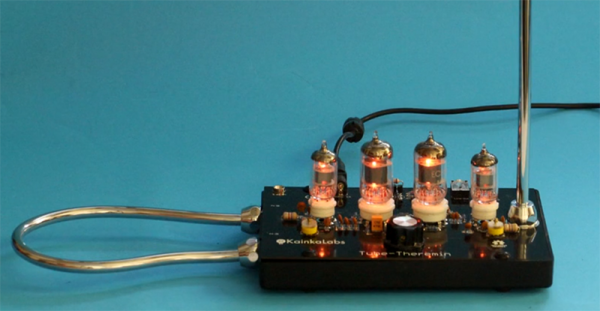
Next year we’re arguably coming up on the centennial of electronic music, depending on whether you count the invention or the patent for the theremin its creation. Either way, this observation is early, so start arguing about it now. If you want to celebrate the century of the theremin, how about you do it just like grandpa Leon and build one out of tubes? That’s what this crowdfunding campaign is all about. It’s a theremin, and it’s made out of tubes.

Theremins are a dime a dozen around these parts, and yes, if you walk into a Guitar Center you can walk out the door with one. They’re pretty common. But being almost a hundred years old, the first theremin wasn’t made made with only silicon, this one had some dioxide thrown in. The first theremin was a tube device, which we all know has a warmer sound when connected to oxygen free cables in an oxygen free room. In any event, messing around with tubes is fun, so here’s a tube theremin.

The circuit for this theremin is constructed around two EF95 tubes and two ECF80 tubes with a heater voltage of 12 V, with 40 V used as the the rest of the circuitry. Unlike virtually every other crowdfunding campaign we’ve ever seen, there are pages of documentation, written down in text, with actual words, and no ominous clapping ukulele glockenspiel hipster music. It’s in German (Google Translatrix with the save) but we’ll take what we can get. It’s really great to see the development of this theremin, and now we’re wondering where we too can get a breadboard that’s just a piece of copper being used as a ground plane.

Hackaday Links Column Banner

Hackaday Links: March 31, 2019

You can now make flexible circuit boards of unlimited length. Trackwise was contracted out for making a wiring harness for the wing of a UAV and managed to ship a 26 meter long flexible printed circuit board. This is an interesting application of the technology — UAVs are very weight sensitive and wiring harnesses are heavy. Wings are straight, but they flex, and you need wires going from tip to tip. Flex circuits do all of this well, but first you need a technology that allows you to manufacture circuits that are as long as a wing. This is apparently something called ‘reel-to-reel’ technology, or some variant of continuous production. Either way, it’s cool, and we’re wondering what else this kind of circuit enables.

You may have noticed a few odd-shaped buildings going up in the last few years. These are buildings designed for indoor skydiving. Two went up around DC in the last year or so. What if you didn’t need a building? What if you could make an outdoor, vertical wind tunnel? Here you go, it’s the Aerodium Peryton.

KiCon, the first and largest gathering of hardware developers using KiCad, is happening April 26th in Chicago.

If KiCad isn’t your thing, PyCon is in Cleveland May 1-9. It couldn’t come at a better time: after losing LeBron, the Cleveland economy has plummeted 90%. Cleveland needs an industry now, and tech conferences are where it’s at. Go Browns.

For one reason or another, a few tech blogs wrote about a product on Tindie last week. It’s the SnapOnAir Raspberry Pi Zero PCB. This turns a Raspberry Pi Zero into a tiny, battery-powered handheld computer with a keyboard and display. This is just a PCB, and you’ll need to bring your own switches, display, and other various modules, but it is a compact device and if you need a small, handheld Linux thing, this is a pretty good solution.

Oh noes April Fools is tomorrow, which means the Internet will be terrible. Tip ‘o the hat to Redbox, though: they were the only one that sent out a press release to their waste of electrons by last Friday.


A Weather Station Fit For A PDP-11

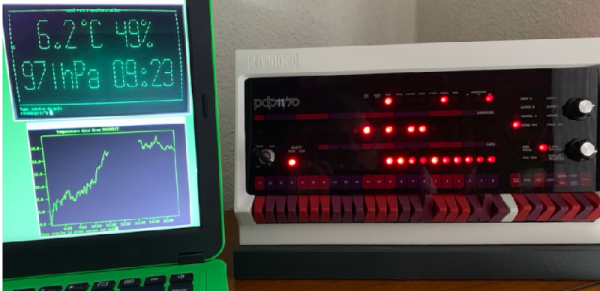
The Digital Equipment Corp. PDP-11/70 is a masterpiece of Cold War-era industrial design. This microcomputer was the size of one or two modern server racks depending on configuration, and the front panel, loaded up with blinkenlights, was clad in a beautiful rose and magenta color scheme. The switches — the ones you used to toggle bits in memory — were actually custom designed covers made to match the shape of the completely unnecessary bezel. The aesthetic of the 11/70 is the intersection of baroque and modernism on the design Venn diagram.

[Oscar Vermeulen] built a miniature version of the PDP-11/70 that houses a Raspberry Pi, and [rricharz] has been hard at work bringing an original copy of BSD to this system. The first great project to come out of this effort? It’s a weather station, and it’s exactly as cool as you think it is.

A bit of ground work went into this build, including getting a historical Unix system up and running, in this case 2.11 BSD. Armed with a Pi and the PiDP-11/70 front panel, [rricharz] had a complete BSD system up and running, and with cool-retro-term, the interface looked the part. Doing something useful was another question entirely, but the Pi in the PiDP had some GPIOs free, so this ancient machine got an I2C temperature and pressure sensor.

The completed build is basically just a breadboard, a tiny diagnostic OLED, and a python script that grabs the data and sends it over to the sim. This is pressure and temperature data shoved into an emulation of a Tektronix 4010 terminal. It’s marginally useful work done by an ancient BSD system wrapped in an emulation on a Raspberry Pi. It doesn’t get better than that.

Bidirectional IP With New Packet Radio

There are a few options if you want to network computers on amateur radio. There are WiFi hacks of sort, and of course there’s always packet radio. New Packet Radio, a project from [f4hdk] that’s now on hackaday.io, is unlike anything we’ve seen before. It’s a modem that’s ready to go, uses standard 433 ISM band chips, should only cost $80 to build, and it supports bidirectional IP traffic.

The introductory documentation for this project (PDF) lays out the use case, protocol, and hardware for NPR. It’s based on chips designed for the 433MHz ISM band, specifically the SI4463 ISM band radio from Silicon Labs. Off the shelf amplifiers are used, and the rest of the modem consists of an Mbed Nucleo and a Wiznet W5500 Ethernet module. There is one single modem type for masters and clients. The network is designed so that a master serves as a bridge between Hamnet, a high-speed mesh network that can connect to the wider Internet. This master connects to up to seven clients simultaneously. Alternatively, there is a point-to-point configuration that allows two clients to connect to each other at about 200 kbps.

Being a 434 MHz device, this just isn’t going to fly in the US, but the relevant chip will work with the 915 MHz ISM band. This is a great solution to IP over radio, and like a number of popular amateur radio projects, it started with the hardware hackers first.

Grab An Image From Your O-scope The Easy Way

The Rigol DS1054Zed is the oscilloscope you want. If you don’t have an oscilloscope, this is the scope that has the power and features you need, it’s cheap, and the people who do hardware hacks already have one. That means there’s a wealth of hardware hacks for this oscilloscope. One small problem with the ‘Zed is the fact that capturing an image from the screen is overly complicated, and the official documentation requires dedicated software and a lot of rigolmarole. Now there’s a simple python script that grabs a screen cap from a Rigol scope.

The usage of this python script is as simple as plugging the DS1054Z into your USB port and running the script. A PNG of whatever is on the screen then appears on your drive. Testing has been done on OS X, and it probably works on Linux and Windows. It’s a simple tool that does one job, glory and hallelujah, people are still designing tools this way.

This work was inspired by the efforts of [cibomahto], who spent some time controlling the Rigol with Linux and Python. This work will plot whatever is being captured by the scope in a window, in Linux, but sometimes you just need a screencap of whatever is on the scope; that’s why there were weird Polaroid adapters for HP scopes in the day.

Yes, it’s a simple tool that does one job, but if you need that tool, you really need that tool. [rdpoor] is looking for a few people to test it out, and of course pull requests are accepted.