A Coffee Machine With An Attitude

coffee

[Armin] and his crew at BerkelaarMRT were contacted by the Museum of Communication in The Hague to see if they could build a coffee machine that was operated only by voice. It sounded like an interesting challenge, so they took on the job and came up with a very awesome interactive coffee machine.

The interactive coffee machine is based on a coffee maker made by Animo with the ability to make cappuccino, espresso, or just a straight coffee. The electronics are based on a Motorola Xoom 10″ tablet with an Electric Sheep module from Sparkfun. This, along with a custom-made PCB with optocouplers, to allow the buttons on the coffee maker to be electronically activated.

When anyone walks up to the coffee machine, a Maxbotix sonar module detects their presence and a small animated coffee cup asks what they’d like to drink. The cute little cup then prepares the drink and waits for its next human.

There’s a video of the machine in action available below. it’s in Dutch, but anyone will be able to get the jist of how the animated coffee machine operates.

Continue reading “A Coffee Machine With An Attitude”

Phase One Of A Robot Coffee Maker

coffee fry

A coffee machine that brews a fresh pot of joe,  automatically putting coffee in a filter, filling the coffee maker with water, brewing, dumping the grounds, and adding sugar and cream, all without any human interaction. Some may call it the fevered dream of a madman. Others may call it a vending machine. All we know is [Phil] is working on his own version of this robot par excellence.

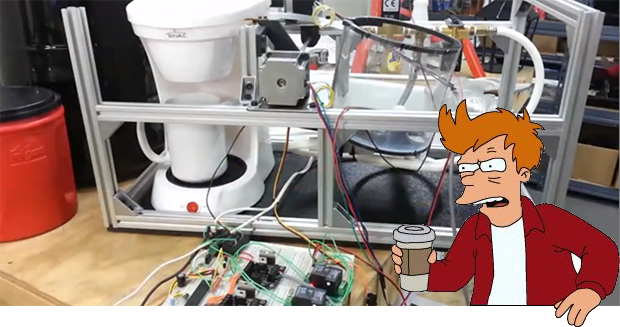
This is only phase one of a robotic coffee machine build, but so far [Phil] has a single cup coffee maker that can fill itself with water and dump its grounds automatically.

The electronics are based on a PIC18F4550 that controls two mechanical relays that control the solenoids, one solid state relay that controls power to the coffee maker, and two stepper motor drivers that open the lid of the coffee maker and dump the filter into the wash bin.

It’s an awesome build and we look forward to the next stage of this awesome, truly homebrew build.


A Drip Coffee Maker For Camping

drip

[TE] goes camping, and on his excursion he likes to take just the bare necessities. A sleeping bag, a tent, food, but above all else, coffee. Most camping coffee makers are a percolator design, which is widely regarded as the worst way to make coffee ever. With a little bit of ingenuity, he created an improvised drip coffee maker for camping, just the thing for a nice cup of brew in the wilderness.

If you were to make your own drip coffee maker, your first inclination might be to use a funnel, put in a filter, pour in some coffee, and load it up with hot water. This was [TE]’s first design, but he quickly realized the hole in the bottom of his makeshift funnel would clog very quickly. After investigating his electronic drip coffee maker, he discovered the bottom of the basket had a series of baffles that allowed the filter to drain over its entire bottom surface. But how to replicate this in a piece of DIY equipment?

The solution came from [TE]’s wife, who pulled out an apple slicer. This allowed the filter to sit a little proud in the basket, allowing for an efficient draining of coffee. Simple, effective, and nearly impossible to break; that’s very good camping equipment.

Continue reading “A Drip Coffee Maker For Camping”

360° Photography Made Easy

rotate

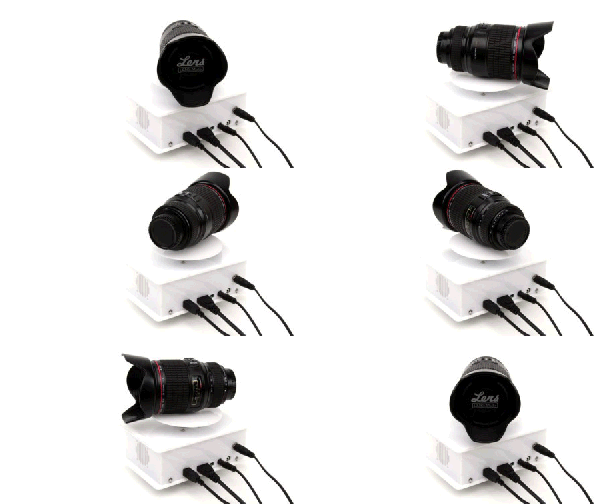
The graphic above wasn’t painstakingly stitched together by rotating a camera lens on a lazy suzan a tiny bit, taking a picture, and repeating the process fifty times. This is high tech stuff, courtesy of Zcapture, a tool for automated 360 degree photography of small objects.

For the last 15 years, [Jared] has been spending a lot of time on eCommerce and found existing solutions to displaying products online to be very lacking. After playing around with the Basic Stamp eight years ago and most recently the Arduino, [jared] decided he would build something to solve his problem – an automated box that takes pictures of a rotating product.

Inside the Zcapture is an Arduino connected to a motor and the software to control Canon and Nikon DSLRs. Put the Zcapture in a soft box, light it up, set up your camera, and you have a computer-controlled lazy suzan robot that will take pictures of any object, then stitch them together into an animated GIF or a fancy eCommerce rotating image viewer

Disabling Under/over Voltage Protection On ATX Power Supplies

voltage

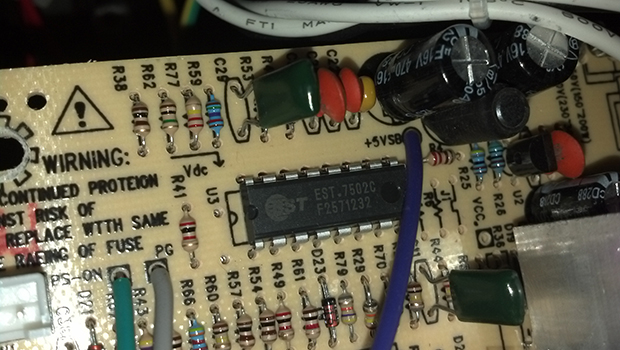
[C] just recently put together a RepRap. Not wanting to spend the money on a dedicated power supply, he looked around for a cheaper solution and found one in an off-the-shelf ATX computer power supply. These ATX supplies are actually a little finicky when not used in a computer, as [C] found, with voltage drops on the +12 line even when a load is connected to the supply. Undeterred, [C] eventually solved this problem by cutting some traces and grounding a few pins on the protection circuit.

The ATX supply [C] used could supply 25 amps on the 12 volt rail, more than enough for a simple RepRap. There was only one problem: the supply would randomly shut itself off, ruining the print. After a little googling, [C] found some people powering 12 volt amplifiers that were running into the same problem. Their solution was to ground a few pins on the protection circuit. Their supply wasn’t quite like [C]’s so he had to do a little experimentations.

It took a few iterations to get right, but [C] managed to figure out exactly which pins on the “power supply supervisor” IC must be grounded to disable the undervoltage protection. With these pins grounded, the protection circuit of the supply is completely disabled, giving him and uninterrupted 25 amps at 12 volts. If you’re looking for a cheap source of power, it would be hard to go wrong with [C]’s tutorial and his power supply of choice.

3D Printering: The Combo Machines Cometh

There’s only so many ways to squeeze hot plastic out of a nozzle, and eventually witnessing the explosion of 3D printer designs over the past few years gets just a little repetitive. What then, is someone who dreams of a technological utopia, Star Trek replicators, and making a few bucks off a Kickstarter to do?

The answer, of course, is a combo machine. Where the Repraps, Makerbots, and the very high-end Stereolithography machines can only do additive manufacturing by laying down plastic or resin layer by layer, these combo machines can also remove material, be it plastic, wood, or metals such as brass or aluminum.

Continue reading “3D Printering: The Combo Machines Cometh”

Building A Rocket To Launch Your Project Into Space

At Hackaday, we’re familiar with projects that say they’re exploring space. Most of the time, these are high altitude balloons that ascend up to 100,000 feet. Sure, this is very, very high, but it’s only about 1/3rd of the way to lower limit of what can be called space at 100 km or 62 miles. Now, we’re seeing the first steps towards embedding Arduinos, cameras, and other goodies into the celestial spheres with the NE-1 Rocket, a project by [Jonathan McCabe] in Madison, Wisconsin.

The goal of the NE-1 rocket is to launch a 5kg payload into a suborbital trajectory to a height of 120 kilometers. From there, the payload – be it an electronic, biological, or simple imaging experiment – will experience a few minutes of weightlessness before falling back to Earth under a parachute.

Getting into space without the help of a government space agency has been done a few times before, mostly with solid-fuel rockets. [Jonathan]’s system uses a liquid-fueled engine, fed with nitrous oxide as the oxidizer and a secret self-pressurizing liquid fuel. These are fed into an engine that uses a ‘cold wall vortex’ to cool the engine instead circulating fuel around the combustion chamber as in traditional engines.

[Jonathan] has already done a few static tests with a half-scale engine, and he already has a lot of the very hard-to-source components in his lab. It’s a promising project. It falls right in line with the ‘Hackaday Space Program’ idea we’ve been kicking around, and we’d be more than happy to see this project get off the ground