Ask Hackaday: Does Your Car Need An Internet Killswitch?

Back in the good old days of carburetors and distributors, the game was all about busting door locks and hotwiring the ignition to boost a car. Technology rose up to combat this, you may remember the immobilizer systems that added a chip to the ignition key without which the vehicle could not be started. But alongside antitheft security advances, modern vehicles gained an array of electronic controls covering everything from the entertainment system to steering and brakes. Combine this with Bluetooth, WiFi, and cellular connectivity — it’s unlikely you can purchase a vehicle today without at least one of these built in — and the attack surface has grown far beyond the physical bounds of bumpers and crumple zones surrounding the driver.

Cyberattackers can now compromise vehicles from the comfort of their own homes. This can range from the mundane, like reading location data from the navigation system to more nefarious exploits capable of putting motorists at risk. It raises the question — what can be done to protect these vehicles from unscrupulous types? How can we give the user ultimate control over who has access to the data network that snakes throughout their vehicle? One possible solution I’m looking at today is the addition of internet killswitches.

Continue reading “Ask Hackaday: Does Your Car Need An Internet Killswitch?”
3D Print Your Own Thermal Insert Press

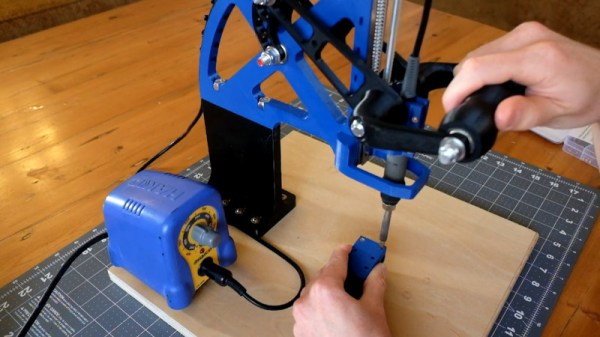
Thermal inserts are a big thing when it comes to engineering with plastic. They make it easy to use threaded fasteners with plastic parts, and they work great with 3D printing too. There’s a bit of a knack to installing them without damaging your workpiece, however, and [John Culbertson] wanted to make using them as easy as possible. Thus, he created a thermal insert press of his very own!

If you’re not using heat-set inserts with your 3D printed parts you’re missing out. Hackaday’s own [Joshua Vasquez] wrote a great guide on thermal inserts which you heat up to securely melt the plastic as they are pushed into a slightly under-sized hole. While it’s possible to install these inserts by hand, using a press means much more consistent results.

This press relies on 3D printed components in combination with off-the-shelf bearings and fasteners. There’s a linear rail as well, to give the soldering iron a  clean, smooth downward motion. This helps make sure that the inserts go in straight and true, first time, every time. We’ve seen other DIY builds before, like this modified arbor press that gets the job done. Continue reading “3D Print Your Own Thermal Insert Press”

Pie Face Game Rigged To Throw Pie At Anyone But You

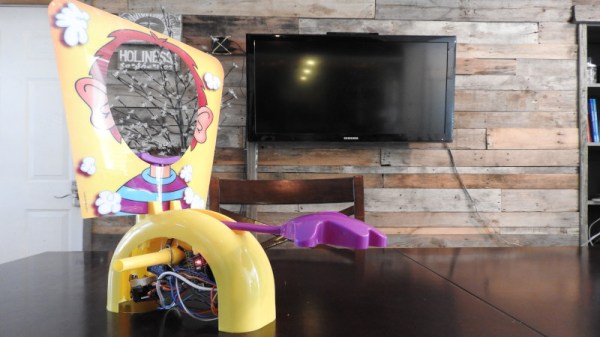
Pie Face is a game that does pretty much what you’d expect from the title. Players sit in front of a spring loaded arm, taking turns to twist a crank. Eventually, one unlucky player will release the arm and be splattered with whipped cream to the enjoyment of the group. [Harrison] wasn’t one to leave things to chance, however, so decided to rig the game.

Instead of allowing the spring-loaded arm to be released by the internal rotating drum, [Harrison] had a better idea. The drum was sanded smooth, to remove the teeth used by the release mechanism. Then, the release mechanism was replaced with a servo, controlled by an Arduino Nano fitted with a Bluetooth module. With just a tap on his smart phone, [Harrison] can trigger the game, guaranteeing his friends get the cream every time.

It’s a tidy build, and one that takes care to avoid detection with subtle design. Had he not released a Youtube video on the build, [Harrison]’s friends would likely be none the wiser. If your thirst for cheating is still unsated, consider loading your dice for a round of Settlers of Catan. Video after the break.

Continue reading “Pie Face Game Rigged To Throw Pie At Anyone But You”

Dual Screen Laptop Is A Slick DIY Build

Laptops are great for portable productivity, but ergonomically they can leave something to be desired. They tend to force the user to look down, creating neck strain over extended periods. Rather than invest in expensive massages, [DIY Perks] decided what he really wanted was a dual screen laptop. So he built one! (Video embedded below.)

The build stats with a replacement laptop screen sourced from eBay, a nice full-HD IPS unit with a matching Embedded DisplayPort driver to enable the screen to be driven with the laptop’s existing HDMI port. To power the display, a USB-C Power Delivery board is used, in combination with a high-quality USB-PD compliant battery pack. This provides the 12 V required to run the screen.

To integrate the screen into the laptop, a set of 3D-printed hinges are used to create a folding mechanism, along with a brushed aluminium backing plate. Finished with a set of 3D-printed bezels, the final result is quite attractive from the front, looking almost stock at a glance.

It’s a build that may prove enticing to serious laptop professionals, particularly those that are willing to trade-off productivity against a little added bulk. We’ve seen other great work from [DIY Perks] before too, like these versatile LED panel lights. Video after the break.

Continue reading “Dual Screen Laptop Is A Slick DIY Build”

3 Words To Describe Any Spot On Earth

For quite a long while now, latitude and longitude has been the way humankind has navigated the globe. This is a perfectly workable system, but it’s a little overwrought for daily use by the layperson. What3Words seeks to provide a simpler solution.

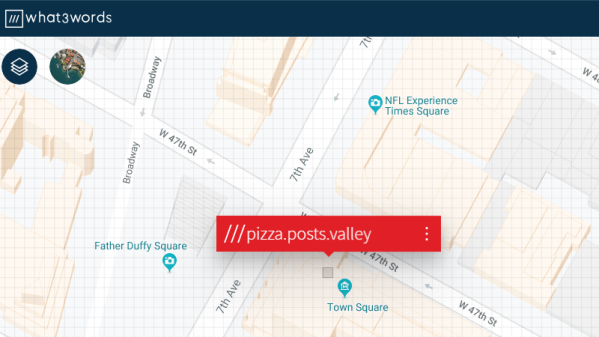
The system is based on splitting the surface of the globe into a grid of 3 m x 3 m sections. This includes oceans and bodies of water. With the grid layed out, each section is given a name consisting of three English words strung together. For example, ///eggs.form.breakfast denotes a spot in the outskirts of Chengdu, China, while ///crops.cards.gifts is a good approximation of that spot where the Naked Cowboy hangs out in Times Square, New York.

Addresses in this format are written with three leading forward slashes, along with a dot between each word. An attempt has been made to only use uncontroversial words, as well as to make sure no crude addresses are created by awkward combinations. Don’t worry, we checked – but if you do find anything good, drop it in the comments below.

It’s a tool that’s been around for a while, but an interesting one nonetheless. It’s something that needs a wider societal acceptance to become truly useful; we imagine it could be good in a small social circle once everyone is familiar with it. It may yet catch on – only time will tell!

The Future Of Diesel Is On Shaky Ground

Diesel is a fuel that has had a mixed history, with varying levels of take-up by consumers around the world. In the world of transport, diesel engines have offered better fuel economy and torque than comparable gasoline engines. Particularly popular in Europe, diesel established a strong consumer base in both small commuter cars as well as heavy vehicles such as trucks and buses.

Despite this, the tide is turning, and for the average motorist, diesel’s days may be numbered. Why is this the case, and what are the potential alternatives vying for diesel’s crown?

Plenty of Pros, but Plenty of Cons

Diesel remains a fuel with a varied uptake around the world. It has enjoyed great popularity in Europe in small commuter cars.

Diesel is a hydrocarbon fuel with several advantages over gasoline. Its lack of volatility makes it workable to use in a compression-ignition mode, and diesel engines can be run with lean fuel-air ratios. It also has a higher volumetric energy density than gasoline, and thanks to low volatility, diesel engines can run at significantly higher compression ratios without risking detonation. These benefits allow diesel engines to produce significantly more torque than similarly sized gasoline engines, and they can offer fuel economy gains in excess of 15%.

Unfortunately, diesel also comes with its fair share of drawbacks. Diesel engines are typically poor when it comes to power to weight ratio, as their high compression ratio and torque output demands heavier materials in their construction. The major bugbear of the diesel engine, however, is its emissions. Despite greater fuel efficiency, carbon dioxide output from a diesel engine is often far worse than that of a comparable gas motor. Additionally, their lean-burning nature leads to production of high levels of oxides of nitrogen (NOx), which have major negative environmental effects. There’s also the problem of particulate pollution, which is responsible for respiratory harm in humans. Diesel automobiles rank significantly worse than gasoline vehicles in all these areas. It’s begun to cause figurative headaches for the industry, and literal headaches for the public. Continue reading “The Future Of Diesel Is On Shaky Ground”

Smart Map Puts On A Show Thanks To Arduinos And DMX

Maps can be a great way to get a message across when the data you’re dealing with affects people on a country’s population scale. [jwolin] works for a non-profit organization, and wanted a way to help people visualize the extent of their operations and the causes they deal with. To do that, he created a nifty smart map wall display.

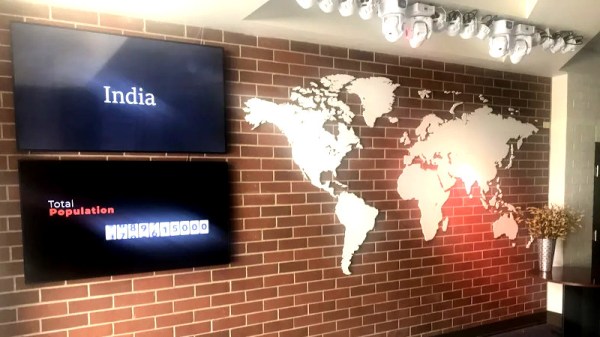
The display consists of a world map cut out of MDF, and affixed to a brick wall. There’s also two 4K Samsung monitors included as part of the system. The top monitor displays headings to contextualise the data, while the bottom screen displays related full motion video. A series of DMX-controlled lights then shine on the world map in various configurations to highlight the area of interest.

The system requires delicate coordination to operate cleanly and smoothly. There are three Windows 10 computers in the system, one for each monitor and another for the world map. An AutoHotkey script runs on the first computer, which selects a random video, and then sends out a command over serial to an Arduino Nano. This Arduino nano then communicates with two others, which make sure the second screen and DMX lighting rig then play the correct matching sequences, in time with the main video. Special care is taken to ensure that transitions are as smooth as possible, with no gaps in between each sequence. The entire installation is simple to update just by uploading additional content to a Dropbox folder, a crucial touch to future proof the project.

It’s an eye-catching system that helps educate visitors as to the mission of the organisation. We’ve seen other innovative world-map displays, like this clock that highlights night and day around the world. Video after the break.

Continue reading “Smart Map Puts On A Show Thanks To Arduinos And DMX”