Google Open Sources PebbleOS: New Pebble Device In Development

The Pebble smartwatch was introduced in 2012 as part of a Kickstarter campaign and saw moderate success before the company behind it got bought out by Fitbit. Although a group of enthusiasts kept their Pebble devices alive, including via the alternate Rebble project for online services, it seemed that no new Pebble devices would grace this Earth. However, we now got a flurry of Pebble updates, with Google, the current owner of Fitbit, open sourcing the PebbleOS source, and [Eric Migicovsky] as the original Pebble founder announcing new Pebble watches.

These new Pebble watches would be very much like the original Pebble, though switching from a memory LCD to an e-paper screen but keeping compatibility with the original Pebble watch and its hackability. Currently there’s just a rePebble site where you can sign up for announcements. Over at the Rebble project people are understandably excited, with the PebbleOS source available on GitHub.

A lot of work still remains, of course. The Apache 2.0-licensed PebbleOS source was stripped of everything from fonts to the voice codec and Bluetooth stack, and of course bootstrapping whole new hardware production will require serious investment. Even so, for lovers of smart watches that work with modern-day smartphones, featuring an always-on display and amazing battery life the future has never been more bright.

Thanks to [Will0] for the tip.
New Open Source DeepSeek V3 Language Model Making Waves

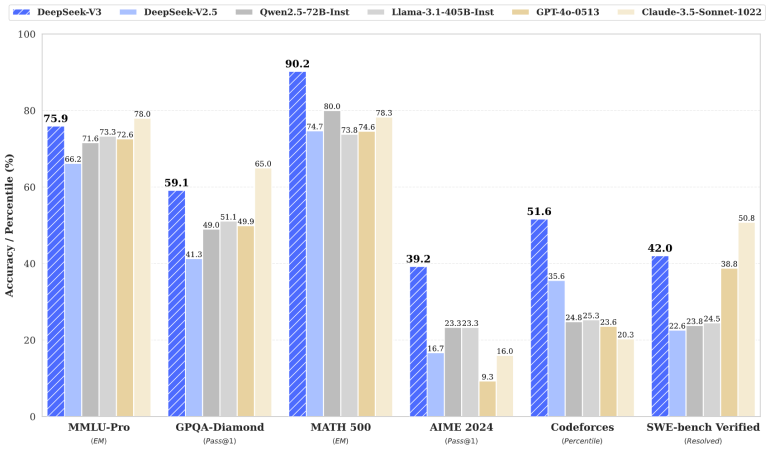
In the world of large language models (LLMs) there tend to be relatively few upsets ever since OpenAI barged onto the scene with its transformer-based GPT models a few years ago, yet now it seems that Chinese company DeepSeek has upended the status quo. Its new DeepSeek-V3 model is not only open source, it also claims to have been trained for only a fraction of the effort required by competing models, while performing significantly better.

The full training of DeepSeek-V3’s 671B parameters is claimed to have only taken 2.788 M hours on NVidia H800 (Hopper-based) GPUs, which is almost a factor of ten less than others. Naturally this has the LLM industry somewhat up in a mild panic, but for those who are not investors in LLM companies or NVidia can partake in this new OSS model that has been released under the MIT license, along with the DeepSeek-R1 reasoning model.

Both of these models can be run locally, using both AMD and NVidia GPUs, as well as using the online APIs. If these models do indeed perform as efficiently as claimed, they stand to massively reduce the hardware and power required to not only train but also query LLMs.

Building The Feynman Motor That Fits Through A Sewing Needle’s Eye

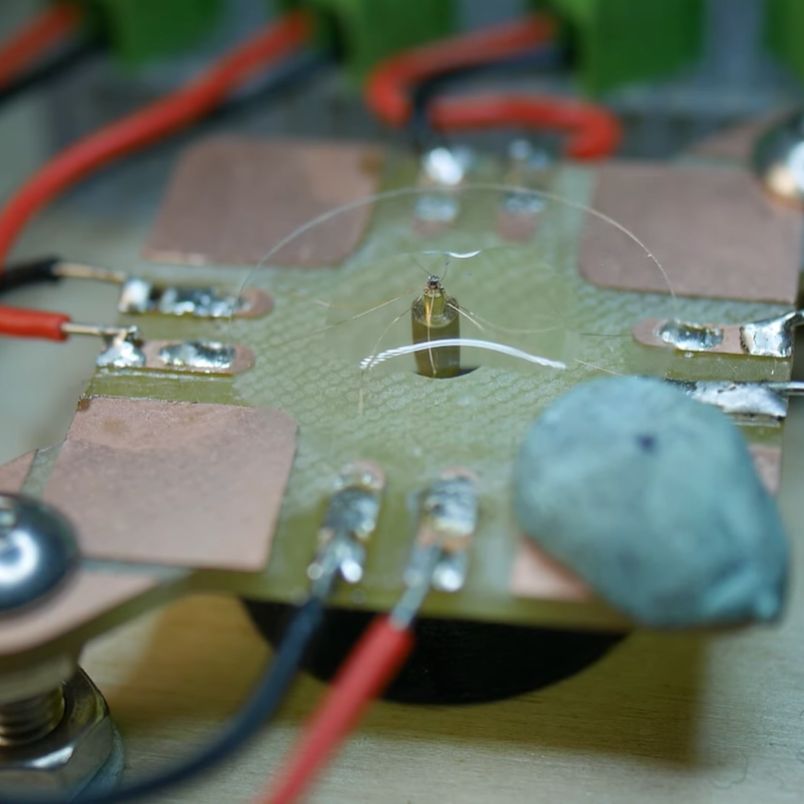
The first attempt at replicating William McLellan's miniature motor. (Credit: Chronova Engineering, YouTube)
The first attempt at replicating William McLellan’s miniature motor. (Credit: Chronova Engineering, YouTube)

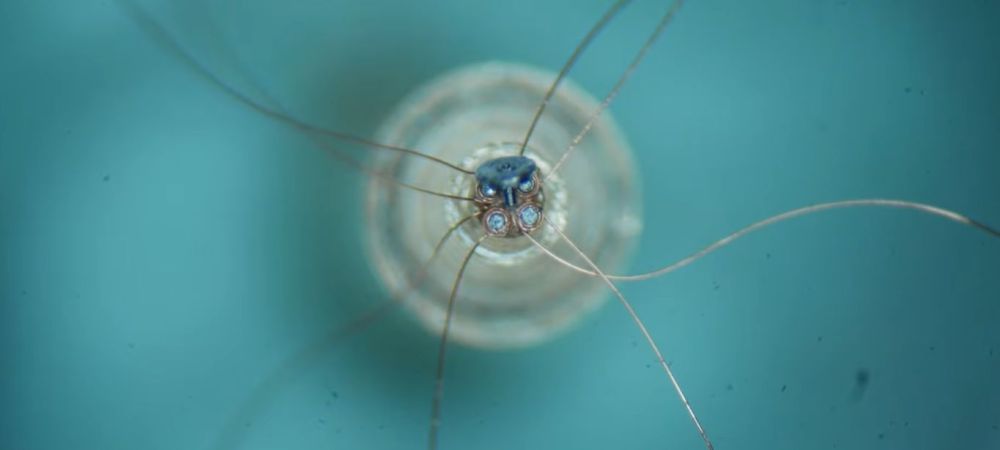
How small can an electric motor be without resorting to manufacturing methods like lithography? In a recent video, [Chronova Engineering] on YouTube tries to replicate the 1960 McLellan motor that fulfilled [Richard Feynman]’s challenge requirements. This challenge was part of [Feynman]’s 1959 lecture titled There’s Plenty of Room at the Bottom, on the possibilities of miniaturization. A $1,000 reward was offered for anyone who could build an electric motor that was no larger than 1/64th inch cubed (~0.0625 mm3), with the expectation that new manufacturing methods would be required to manufacture a motor this small.

As reported in the December 1960 issue of The Month at Caltech, [William McLellan] walked into [Feynman]’s lab with this tiny marvel that took him 2.5 months of lunch hour breaks to build. Weighing in at 250 micrograms and consisting out of 13 parts, it was constructed using a microscope, a watchmaker’s lathe and a toothpick. Surely replicating this feat would be easy today, right?

The main challenge is that everything is incredibly small. The rotor shaft is 90 micrometers in diameter, and the four coils require winding incredibly thin wire at scales where typical manufacturing methods do not apply. Suffice it to say that it takes massive amounts of patience, creativity and the best (stereo) microscope you can get, yet even with modern optics and materials this first attempt mostly failed.

At the end we’re left with SEM shots of this replication attempt and an immense amount of respect for the skills of [William McLellan] who made a working version in 1960 using much more basic tools during his lunch breaks.

Thanks to [J. Peterson] for the tip.

Continue reading “Building The Feynman Motor That Fits Through A Sewing Needle’s Eye”

Capacitor Decoupling Chaos, And Why You Should Abandon 100 NF

Everyone knows that the perfect capacitor to decouple the power rails around ICs is a 100 nF ceramic capacitor or equivalent, yet where does this ‘fact’ come from and is it even correct? These are the questions that [Graham] set out to answer once and for all. He starts with an in-depth exploration of the decoupling capacitor (and related) theory. [Graham] then dives into the way that power delivery is affected by the inherent resistance, capacitance, and inductance of traces. This is the problem that decoupling capacitors are supposed to solve.

Effectively, the decoupling capacitor provides a low-impedance path at high frequencies and a high-impedance path at low frequencies. Ideally, a larger value capacitor would be better, but since this is the real world and capacitors have ESL and ESR parameters, we get to look at impedance graphs. This is the part where we can see exactly what decoupling effect everyone’s favorite 100 nano-farad capacitors have, which as it turns out is pretty miserable.

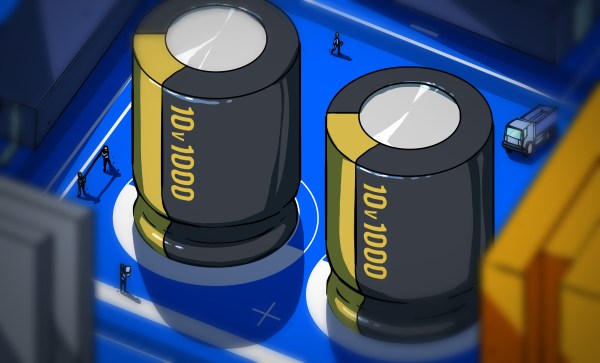
Meanwhile, a 1 µF (ceramic) capacitor will have much better performance, as shown with impedance graphs for MLCC capacitors. As a rule of thumb, a single large decoupling capacitor is better, while two MLCC side-by-side can worsen noise. Naturally, one has to keep in mind that although ‘more capacity is better for decoupling’, there is still such a thing as ‘inrush current’ so don’t go too crazy with putting 1,000 µF decoupling capacitors everywhere.

Sony Ends Blu-Ray, MD And MiniDV Media Production

With the slow demise of physical media the past years, companies are gradually closing shop on producing everything from the physical media itself to their players and recorders. For Sony this seems to have now escalated to where it’ll be shuttering its recordable optical media storage operations, after more than 18 years of producing recordable Blu-ray discs. As noted by [Toms Hardware] this also includes minidisc (MD) media and MiniDV cassettes.

We previously reported on Sony ending the production of recordable Blu-ray media for consumers, which now seems to have expanded to Sony’s remaining storage media. It also raises the likelihood that Sony’s next game console (likely PlayStation 6) will not feature any optical drive at all as Blu-ray loses importance. While MiniDV likely was only interesting to those of us still lugging one of those MiniDV camcorders around, the loss of MD production may be felt quite strongly in the indie music scene, where MD is experiencing somewhat of a revival alongside cassette tapes and vinyl records.

Although it would appear that physical media is now effectively dead in favor of streaming services, it might be too soon to mark its demise.

Trap Naughty Web Crawlers In Digestive Juices With Nepenthes

In the olden days of the WWW you could just put a robots.txt file in the root of your website and crawling bots from search engines and kin would (generally) respect the rules in it. These days, however, we have especially web crawlers from large language model (LLM) companies happily ignoring such signs on the lawn before proceeding to hover up every scrap of content on websites. Naturally this makes a lot of people very angry, but what can you do about it? The answer by [Aaron B] is Nepenthes, described on the project page as a ‘tar pit for catching web crawlers’.

More commonly known as ‘pitcher plants’, nepenthes is a genus of carnivorous plants that use a fluid-filled cup to trap insects and small critters unfortunate enough to slip & slide down into it. In the case of this Lua-based project the idea is roughly the same. Configured as a trap behind a web server (e.g. /nepenthes), any web crawler that accesses it will be presented with an endless number of (randomly generated) pages with many URLs to follow. Page generating is deliberately quite slow to not soak up significant CPU time, while still giving the LLM scrapers plenty of random nonsense to chew on.

Considering that these web crawlers deemed adhering to the friendly sign on the lawn beneath them, the least we can do in response, is to hasten model collapse by feeding these LLM scrapers whatever rolls out of a simple (optionally Markov-based) text generator.

Making Wire Explode With 4,000 Joules Of Energy

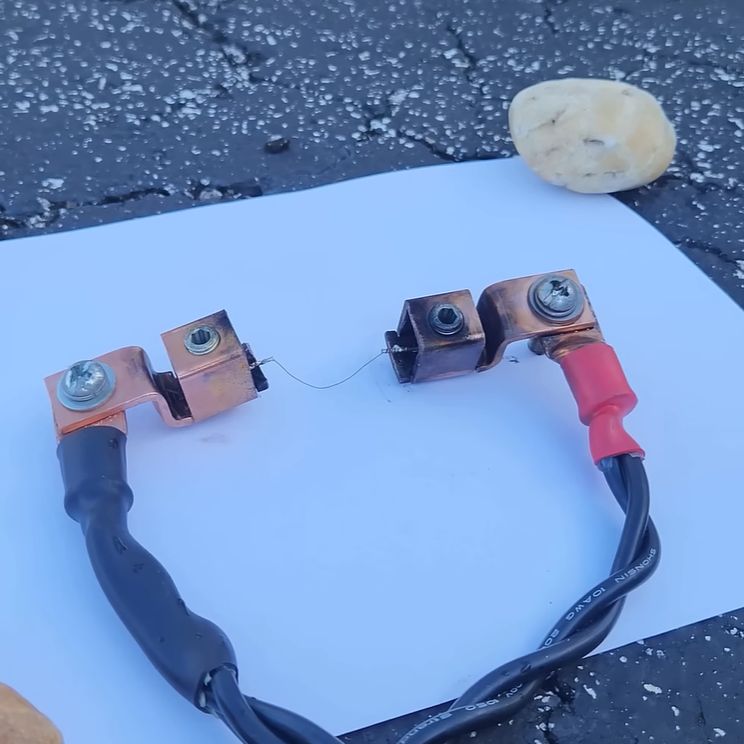
The piece of copper wire moments before getting vaporized by 4,000 joules. (Credit: Hyperspace Pirate, Youtube)

In lieu of high-explosives, an exploding wire circuit can make for an interesting substitute. As [Hyperspace Pirate] demonstrates in a recent video, the act of pumping a lot of current very fast through a thin piece of metal can make for a rather violent detonation. The basic idea is that by having the metal wire (or equivalent) being subjected to a sufficiently large amount of power, it will not just burn through, but effectively vaporize, creating a very localized stream of plasma for the current to keep travelling through and create a major shockwave in the process.

This makes the exploding wire method (EWM) an ideal circuit for any application where you need to have a very fast, very precise generating of plasma and an easy to synchronize detonation. EWM was first demonstrated in the 18th century in the Netherlands by [Martin van Marum]. These days it finds use for creating metal nanoparticles, brief momentary light sources and detonators in explosives, including for nuclear (implosion type) weapons.

While it sounds easy enough to just strap a honkin’ big battery of capacitors to a switch and a piece of wire, [Hyperspace Pirate]’s video demonstrates that it’s a bit more involved than that. Switching so much current at high voltages ended up destroying a solid-state (SCR) switch, and factors like resistance and capacitance can turn an exploding wire into merely a heated one that breaks before any plasma or arcing can take place, or waste a lot of potential energy.

As for whether it’s ‘try at home’ safe, note that he had to move to an abandoned industrial site due to the noise levels, and the resulting machine he cobbled together involves a lot of high-voltage wiring. Hearing protection and extreme caution are more than warranted.

Continue reading “Making Wire Explode With 4,000 Joules Of Energy”