
 We’re doing something new. We’ve asked [Chris Gammell] to take over our Twitter account (@Hackaday) on Friday, June 6th. Be sure to check in when he’s most active between noon and 5pm EDT. You should also follow @Chris_Gammell because his Twitter-fu is perpetually entertaining.
Author: Mike Szczys6403 Articles
THP Hacker Bio: Fl@C@
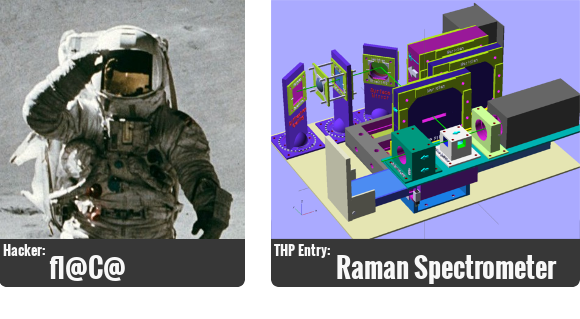 Now that we’re starting to get serious about The Hackaday Prize we thought we’d take a look at the lives of some of the hackers who have submitted entries. Meet fl@C@, who is working on a Raman Spectrometer which is largely 3D printed and uses a Raspberry Pi. He was kind enough to answer all of our questions, some serious and some not so.


Creating. It’s probably no surprise that I have many hobbies…but hardware hacking is my life. I got my first taste with my dads Imsai 8080 (showing my age, but I was fairly young!)..Then it was an Apple][.. I really dove into that. I built my own from a bare pcb to a working machine when I was around 11 or 12. Just moved up from there.. Really went nuts when I got a job at a surplus electronics store in the silicon valley.. I rarely took home a paycheck.. I have a few other hobbies, I’m a private pilot…love flying. I built a pretty cool device that allowed me to datalog my flights, my heartrate, keep track of the fuel, it speaks and connects to the comm to remind me when to switch tanks, etc.. I’ll have to put that up on the project page.
 Well…For my day job, I am a Network Engineer.. I can’t really say for which company, but it’s big.

My Passion is Going Big
I would say my passion is going big..if it’s worth doing…..it’s worth overdoing. I love coming up with ideas that would make a difference. The spectrometer I am working on is actually only a small part of a larger project I am working toward. There are never enough hours, or dollars to cover all of my ideas…but I always work as hard as I can to get there.. TLDR- I’m excited every day to wake up and make another step towards changing the world.
 I work from home, but in the office… it’s definitely the snack machine. Seriously? We can’t build a machine that dispenses snacks without getting them stuck?
 I’d say linux. I’ve been a fan of ubuntu for a while.. lately I’ve been playing with xubuntu. I don’t care for messing with computers..lol.
  I love electronics, hardware, software and all that.. but I do not geek out over PC hardware..I consider them another tool…they need to work when I need them to work. lol
 Not sure if you want a breakdown of what gear I have….I have quite a bit and a pretty elaborate lab setup..but I’m really a bit of a minimalist when it comes to day to day use.. I use my scope when it’s appropriate..my logic analyzer (saelae logic rocks) pretty often.. but I’d say my go to device is usually my DMM since it’s what I tend to use most often…I have a few, but I like to use the one that connects up to my PC so I can make screenshots, and/or see it from a distance..

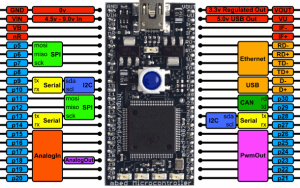 I would have to default to the mBed for this one..for general purpose. I started out like most people probably with the basic stamp waaaay back…and went through a few others..and settled on the mBed when there was just one device, but now they have so many platforms that you can fit to whatever need..and some of them are dirt cheap. I’m using the ST Nucleo041RE for the spectrometer project, and it’s only $10 at mouser. I have just started peering into FPGA stuff, I hope to get some more time to work with them very soon, I see lots of potential.. I never really used Arduino’s until the past year or two when I got into quadcopters..they have a purpose..and are ok for quick and dirty stuff since you can source a pro mini on ebay for like 3 bucks..
 Python has become my best friend. C++ is great and all, I’ve been forced to use VB6 for work…where they even use winbatch……. But python works.. and it’s easy to crank something out quickly, and you can build some pretty robust stuff with it..
 Well, I have a couple that come to mind immediately that I honestly would love to share with the world…but won’t just yet.. =) So, I’ll go with what is left…hopefully it’s plenty for now..
- I’d love to build a fusor. I built my first tesla coil when I was 17.. I’d love to take the hobby fusor to the next step..
- A Moon Rover. Seriously. And the vehicle to get it there. I think we all agree rockets and gasoline both need to go away. Mankind needs to reach out beyond what we’re confortable with.
- A fully autonomous multirotor. I actually started this project..have it all layed out..but it’s not high enough on my priority list to make it the rest of the way..I have probably 80% of the parts new in a box..I’ve started doing a writeup on it..and hope to get it up soon.

Learn the Value of Knowing Where and How to Find the Information [You] need
I wish that everyone would learn the value of knowing where and how to find the information they need to accomplish a goal. Schools typically force you to memorize facts and information that is often worthless. I would like for people to learn instead how to be adaptive in their approach to problems, and understand that there is always more than one answer.. and there is a huge resource out there that will enable you to make educated decisions and reach grander goals. We live in a great time with that…and in that way, the internet is underutilized…
 The timing was right…I thought this was an interesting and unique project..I had promised myself to try to be more open and share..this project was perfect since it has 3d parts people can print themselves, a raspberryPi, a sorta arduino and a cool laser…plus I figured there are several people out there that could either benefit from a low cost raman spectrometer, or at least benefit from some part of it..be it the parts I designed or just the understanding of how it works and what they’re used for…

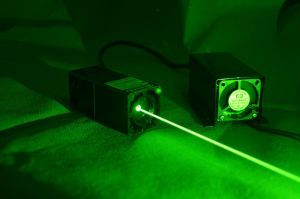 I always keep an open mind, and consider any advice given.. There have been many aspects of this project that created a challenge.. This is my first serious venture into 3d printing this much stuff…I’ve never really worked with lasers and optics in such a way.. Avoiding spending thousands on optics was a major challenge. I have been doing all the research I can to understand the best approach to imaging…My first idea was to modify a webcam to take long exposures since the light reaching the camera will be fairly faint..after looking into that, it’s not just a lot of work and difficult to reproduce…but the cameras that others have modified are ancient and next to impossible to find. I wanted to go with a camera that anyone could find…the raspiCam kept surfacing as the best choice…so, the next challenge was how to get the long exposure…the raspiCam driver doesn’t really allow for 10-30 second exposures… so the next idea was to take several shots, and stack them to build a usable image.. so my latest approach is to take a 90fps video for a couple seconds, split that into individual frames, and stack those.. If anyone has suggestions in this area, I’d love to hear them.. I planned on using either mathematica or qtoctave from python, etc..

 A Moon Rover. =) It’d probably most definately be a team effort.. But I think as a community, the skills are out there. And the google XPrize shouldn’t be the only game in town.. I think things are building up to this kind of stuff anyway, but someone’s got to be first.

Live Out Loud Every Day
 I’d just like to say…putting this project on this site was a major debate for me. I grew up with parents that had secret clearances, and privacy was central. I’ve been trying to build up the courage to share my work and ideas with the world because I think it benefits everyone. This project is my first to share, and for it to be featured here, and for me to be honored with being the first the be featured is really amazing. I appreciate this whole community, I’ve learned a lot from it over the years and I hope to be able to give back and contribute more soon!
Entry Is Easy: The Hackaday Prize
[youtube=https://www.youtube.com/watch?v=L1N5oM4hmw8&w=580]
Failing to submit an entry for The Hackaday Prize is a big mistake. The worst you can do is make an awesome contribution to Open Hardware, but you could win a trip to space or hundreds of other prizes. It’s simple to get started:
- Sign up for an account on Hackaday.io
- Start documenting your project with the tag #TheHackadayPrize
- Click the “Submit project to…” button to make it official
Not simple enough? We even made some screenshots to prove how easy it is. Check them out after the break.
Make it connected, make it open, make it awesome, and you could win!
THP Judge: Ian From Dangerous Prototypes
 As we start to get into the swing of The Hackaday Prize we want to take some time to talk to the judges.
[Ian Lesnet] is an accomplished hardware developer. He is, of course, near and dear to our hearts as a Hackaday writer emeritus.
During his time here he came up with an idea for an amazing tool that would let you work with components using a multitude of protocols before heading off to write your firmware. The tool was called the Bus Pirate and [Ian] built an formidable Open Hardware community up around this and several other tools and unique ideas.
[Hackaday] Why do you think people should put together an entry for The Hackaday Prize?
[Ian] There’s never a bad time to hack something together, but with an incentive like SPACE!!! how can you refuse?
[Hackaday] If you could enter, what style of project would you build and where would you try to go with the idea?
[Ian] We like to make electronics hardware that helps debug stuff, but lately we’re rocking more potentially deadly machines that do things. I’d finish up our death chomp robot that slices and dices reels of components into handy kit-sized lengths, while printing values and part numbers on the back paper. Definitely not a winner, but it looks great when it’s chewing parts!
[Hackaday] Is there anything that participants can do with their project write-ups to make your life easier as an adjudicator?
[Ian] Writing and English classes are a special hell for me, but there are some good tips for clear communication. I always start with an overview – “tell them what you’re going to tell them”. This usually means a description of the hack, the major components used, and how they work together. The introduction should have enough info that another hacker can piece everything together without digging through the whole writeup. An overview illustration or hand drawing explaining the methodology is really helpful for visualizing a complex hack.
[Hackaday] You have vast experience with Open Hardware projects. I think one of the tough things for beginners is navigating the Open Hardware licenses available. Do you have any advice for noobs to learn more about licenses and perhaps on narrowing them down?
[Ian] If you want the world to be a better place put all your work in the Public Domain (Creative Commons Zero) for anyone to use however they want. That’s the license with the least bullshit attached. If you have a billion dollar secret idea by all means keep it in your closet and show it to no one, because that’s about the only thing that will protect it from innovators and imitators. Other licenses fall somewhere in the middle, but for our stuff we’ve decided to go Public Domain wherever possible.
[Hackaday] We’ve seen a lot of collaborative projects come out of DP. Do you have any advice you can share for finding collaborators for a hardware project?
[Ian] The best advise I’ve heard (not mine) is to wait until a project is done to decide ownership share. Hackers are quick to settle on equal ownership, but during the project (or the long haul support period) collaborators may loose interest or be unable to continue as planned. With equal ownership remaining team members must finish the whole project just get a portion of the future gains. It demotivates the remaining team members and kills momentum. By waiting to see how things play out you’ll have a much better idea how to divide ownership for a successful long term collaboration.
[Hackaday] Can you name a favorite piece of bench equipment and tell us why it is at the top of your list?
[Ian] For years I used $10 “fire starter” soldering irons, even for surface mount soldering. An adjustable iron is a nice thing to have though, along with a bright light and head magnifier. A hot air rework station is the tool I can’t live without. It’s for fixing mistakes, which I make constantly, and when it dies everything crashes to a halt.
[Hackaday] What do you think of the evolution of the kit and small-run electronics industry over the last decade? Where would you like to see it go, and do you have any insights about what will get it there, or possible barriers that stand in the way?
[Ian] It’s huge now. Crowd source funding sites alone have become home to how many cool hacks, designs, and projects? Local, short-run assembly houses using a fairly standard set of components would make it a lot easier to get into hardware without 1337 soldering skillz.
 The Hackaday Prize challenges you to build the future of connected devices. Build the best and claim a trip into space or one of hundreds of other prizes.

Video Links: Hunting For Hacks At Maker Faire
[youtube=https://www.youtube.com/watch?v=v80VvQLj4Xc&w=580]
Why not round out our two-week Bay Area Maker Faire coverage with a Links post? This time around it’s video links. We mixed together a bunch of interesting clips that didn’t get their own video, as well as a dose of what it feels like to walk around the Faire all weekend. Join us after the break for the links.
Continue reading “Video Links: Hunting For Hacks At Maker Faire”
CNC Zen Garden
[youtube=https://www.youtube.com/watch?v=Ge4H4Uw630o&w=580]
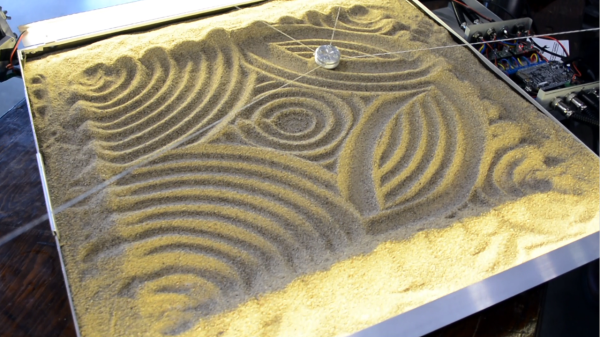
Meet the second version of [David’s] sand manicuring CNC machine. We saw version one about six months ago which he built for a science museum in Canada. This offering is much the same, except for the controller. The initial version demanded a full-blow computer to drive it but now that has been swapped out in favor of a Beaglebone Black.
The software has no feedback on the position of the plotter, which is an aluminum slug that [David] machined at Calgary Protospace. It needs to be in a specific position when the machine starts out, and from there patterns are traced by calculating how much spooling or unspooling of the four strings will move the slug.
There’s a bunch of other really neat art installations and projects on [David’s] webpage, it’s worth clicking through!
Analog Shield And PCB Quadcopter
[youtube=https://www.youtube.com/watch?v=gXW76ESIv6k&w=580]
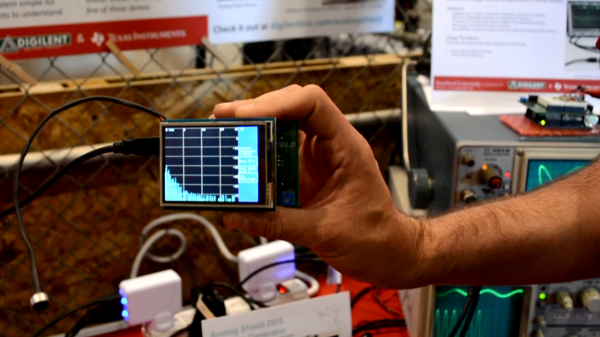
We spent a little bit of time at the TI booth at Maker Faire to film a pair of interviews. The first is with [Bill Esposito] who is grinding away on his PhD. at Stanford. He’s showing off an Analog Shield for Arduino. He describes it as “an attempt to bring the analog bench to an Arduino shield”. We think this is a fantastic idea as most who are learning digital electronics through Arduino have little or no experience with analog circuitry. This is a nice gateway drug for the concepts.
The analog shield has a supply good for +/- 7.5 volts, 4-channel ADC, 4-channel DAC, and gets 100k samples at 16-bits. He showed us a spectrum analyzer using Fast Fourier Transform on the incoming signal from a microphone. He also built a function generator around the shield. And finally a synthesizer which plays MIDI files.
In the second half of the video we take a look at [Trey German’s] work on a PCB-based quadcopter. His goal is to reduce the power consumption which will equate to longer flying times. To this end he chose the DRV8312 and a Piccolo to control each sensorless, brushless DC motor. The result should be 10% lower power consumption that his previous version.









