Custom Beach Robot Handles The Hard Work

A day at the beach can involve hauling a surprising amount of gear, from coolers, towels, blankets, chairs, and umbrellas, and if children are involved the amount of beach stuff needed seems to go nonlinear very quickly. Some turn to beach carts with large, low-pressure pneumatic tires, but even that seemed like too much work for [John] who built this remote controlled cart for his summertime needs.

The cart is based around an old cargo rack from an e-bike. To mount all of the robotic components, a sheet of plywood was cut and attached to the underside. Two motors are used to drive the rear wheels independently, allowing for differential steering rather than adding the complexity of a steering system. Some safety features are built in to this design as well, including lights for night driving, a start button controlling a relay for the motors and electronics, and a time-of-flight sensor to stop the robot if it encounters an obstacle.

The ESP32 at the center of the build ties all of the electronics together, and a smartphone app lets the user remotely pilot the rover. It’s not autonomous (yet) but a fair alternative to dragging all of one’s beach gear through the sand without any assistance. You could also minimize your excursions through the sand by timing your visits at high tide, but [John] is out on the Great Lakes so this may be of marginal utility here.
Continue reading “Custom Beach Robot Handles The Hard Work”

The Zen Must Flow From Arrakis Sand Table

In Dune, the Fremen people of Arrakis practice an odd future hybrid religion called “zensunni.” This adds an extra layer of meaning to the title of [Mark Rehorst]’s Arrakis 3.0 sand table, given that the inspiration for the robotic sand table seems to be Zen gardens from Japan.

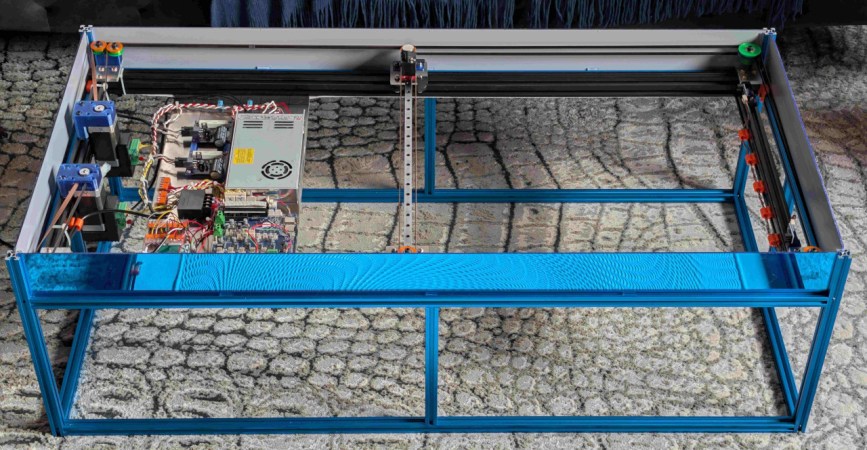
The dunes on the tabletop version of Arrakis owe nothing to sand worms, but are instead created a rolling metal ball. With all workings happening below, it looks quite magical to the uninitiated, but of course it’s not magic: it’s magnets. Just beneath the tabletop and its sands, the steel ball is being dragged along by the magnetic field of a powerful neodynium magnet.

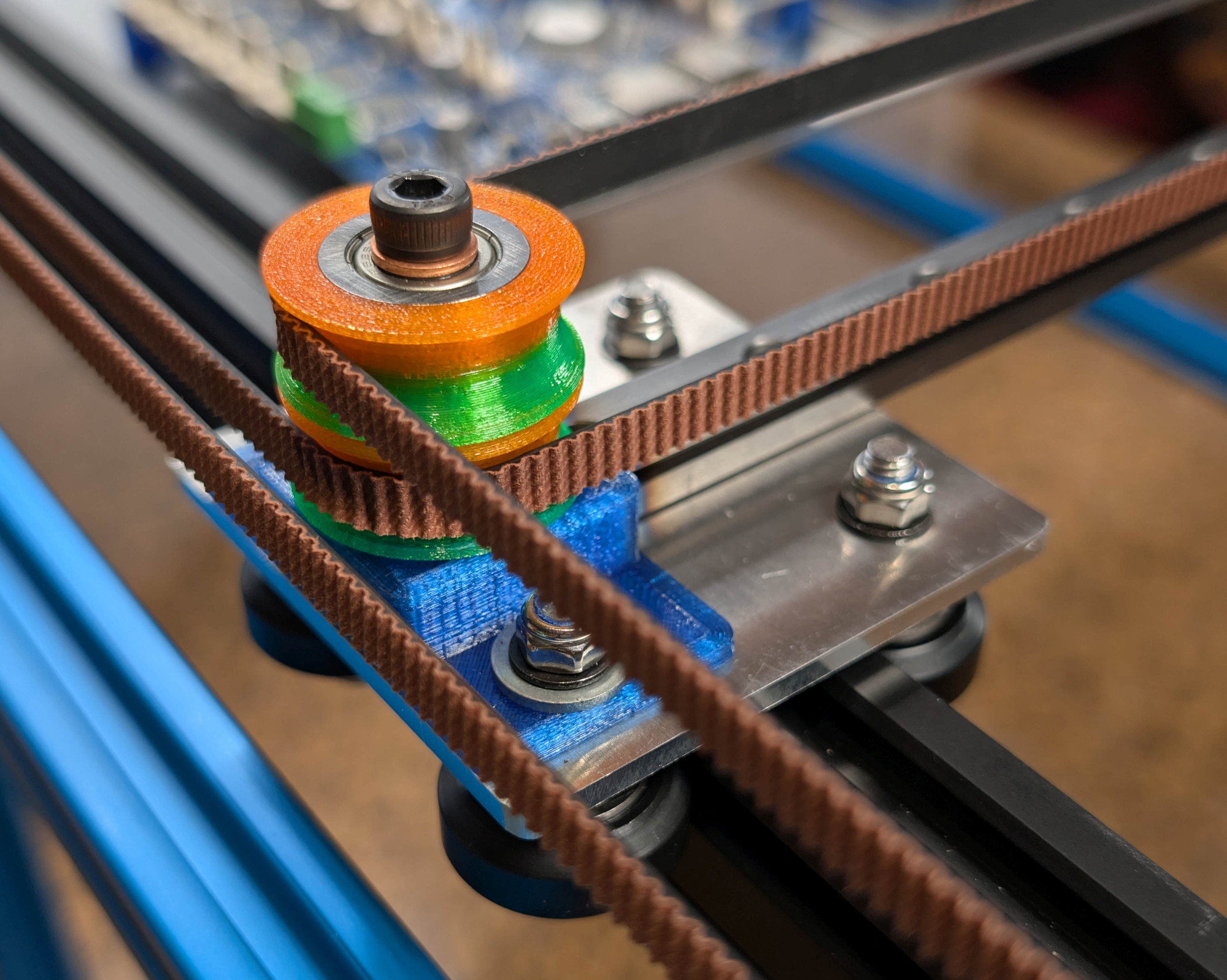
That magnet is mounted in a CoreXY motion system that owes more than a little bit to modern 3D printers. Aside from the geometry, it’s using the standard G6 belt we see so often, along with a Duet3D mainboard, NEMA 17 steppers, and many 3D printed parts to hold its aluminum extrusions together. Thanks to that printer-inspired motion system, the ball can whirl around at 2000 mm/s, though [Mark] prefers to run slower: the demo video below shows operation at 1000 mm/s before the sand has been added.

This build was designed for ease of construction and movement: sized at 2’x4′ (about 61 cm x 122 cm), it fits through doors and fits an off-the-shelf slab of coffee table glass, something that [Mark] wishes he’d considered when building version two. That’s the nice thing about jumping in on a project someone’s been iterating for a while: you’ve got the benefit of learning from their mistakes. You can see the roots of this design, and what has changed, from the one he showed us in 2020. 

Naturally you’re not limited to CoreXY for a sand table, though it is increasingly popular — we’ve seen examples with polar mechanisms and even a SCARA arm.

Continue reading “The Zen Must Flow From Arrakis Sand Table”

Sand Drawing Table Inspired By Sisyphus

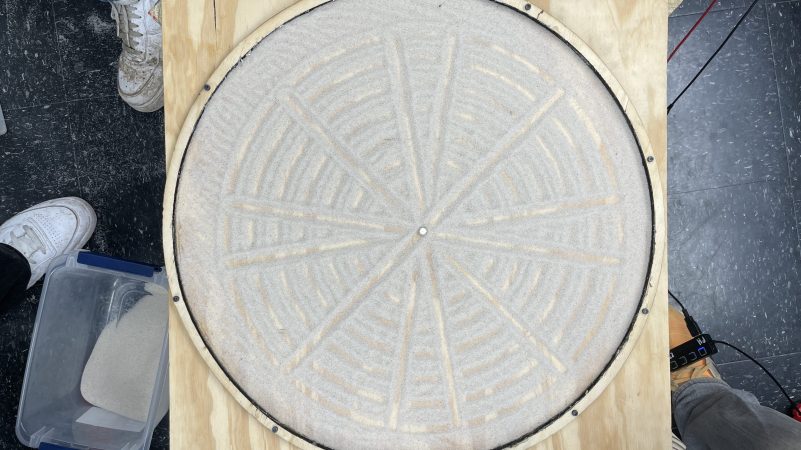
In Greek mythology, Sisyphus was a figure who was doomed to roll a boulder for eternity as a punishment from the gods. Inspired by this, [Aidan], [Jorge], and [Henry] decided to build a sand-drawing table that endlessly traces out beautiful patterns (or at least, for as long as power is applied). You can watch it go in the video below.

The project was undertaken as part of the trio’s work for the ECE4760 class at Cornell. A Raspberry Pi Pico runs the show, using TMC2209 drivers to command a pair of NEMA17 stepper motors to drag a magnet around beneath the sand. The build is based around a polar coordinate system, with one stepper motor rotating an arm under the table, and another panning the magnet back and forth along its length. This setup is well-suited to the round sand pit on top of the table, made with a laser-cut wooden ring affixed to a thick base plate.

The trio does a great job explaining the hardware and software decisions made, as well as showing off how everything works in great detail. If you desire to build a sand table of your own, you would do well to start here. Or, you could explore some of the many other sand table projects we’ve featured over the years.

Continue reading “Sand Drawing Table Inspired By Sisyphus”

Building A Miniature Rainbow Sand Table

Sure is coarse and rough and irritating, and it gets everywhere. But it can also be beautiful — drag a small ball through it in a controlled manner you can make some really pretty patterns. That’s precisely what this compact build from [Printerforge] does.

The build relies on an ESP32 as the brains of the operation. It employs small 28BYJ-48 motors to run the motion platform. These were chosen as they operate on 5 V, simplifying the build by allowing everything to run off a single power supply. Along with a bunch of 3D printed parts, the motors are assembled into motion system with linear rods and belts in a CoreXY layout, chosen for speed and precision. It’s charged with moving a small magnet to drag a ball bearing through the sand to draw patterns under the command of G-code generated with the Sandify tool.

We’ve seen some great sand table builds over the years. Some use polar coordinate systems, while others repurpose bits of 3D printers. If you’ve got a creative new way of doing it, don’t hesitate to let us know!

Boss Byproducts: Fulgurites Are Fossilized Lightning

So far in this series, we’ve talked about man-made byproducts — Fordite, which is built-up layers of cured car enamel, and Trinitite, which was created during the first nuclear bomb test.

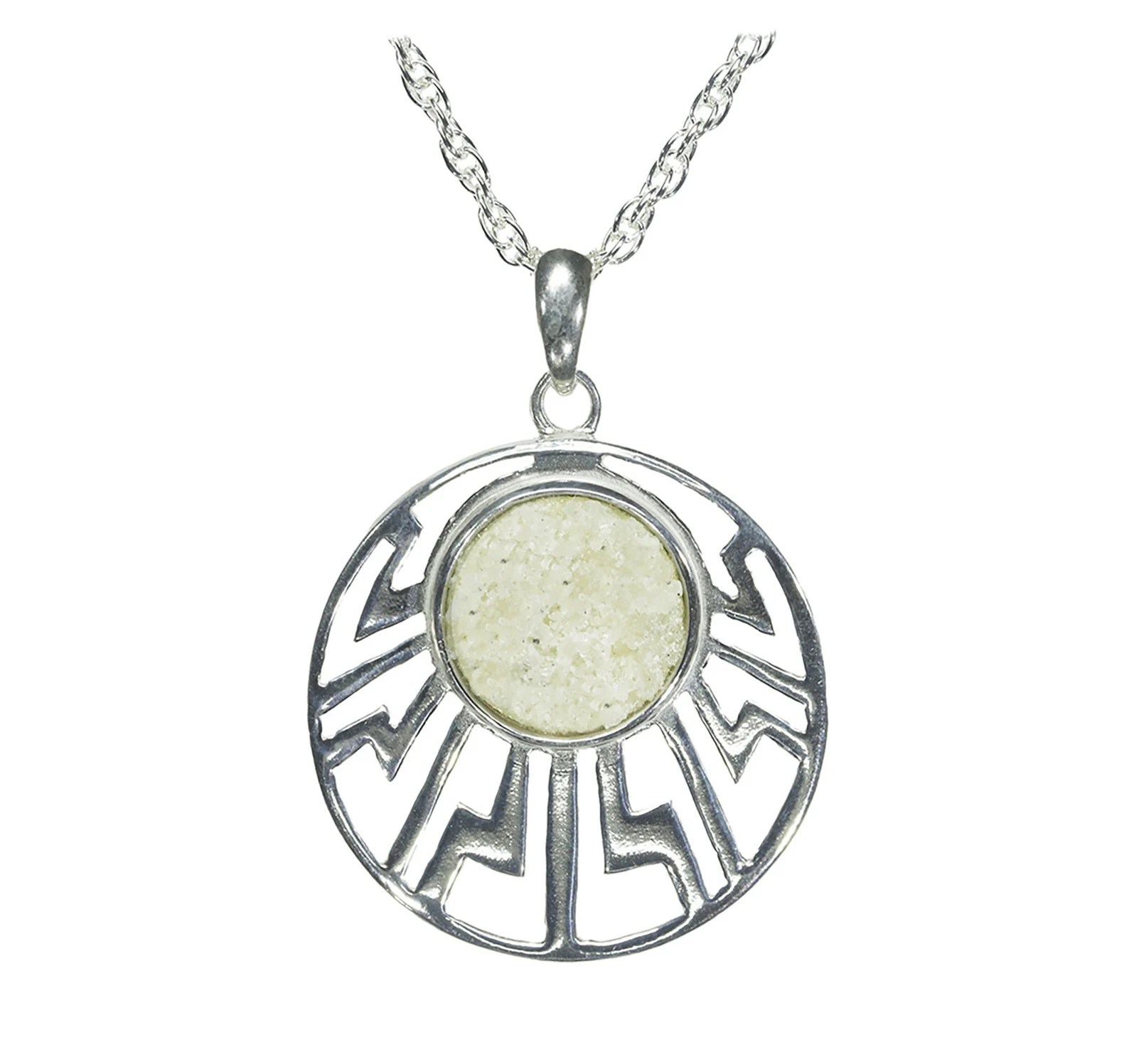
A fulgurite pendant.
A lovely fulgurite pendant. Image via Etsy

But not all byproducts are man-made, and not all of them are basically untouchable. Some are created by Mother Nature, but are nonetheless dangerous. I’m talking about fulgurites, which can form whenever lightning discharges into the Earth.

It’s likely that even if you’ve seen a fulgurite, you likely had no idea what it was. So what are they, exactly? Basically, they are natural tubes of glass that are formed by a fusion of silica sand or rock during a lightning strike.

Much like Lichtenberg figures appear across wood, the resulting shape mimics the path of the lightning bolt as it discharged into the ground. And yes, people make jewelry out of fulgurites.

Continue reading “Boss Byproducts: Fulgurites Are Fossilized Lightning”

Boss Byproducts: The Terrible Beauty Of Trinitite

While some byproducts recall an idyllic piece of Americana, others remind us that the past is not always so bright and cheerful. Trinitite, created unintentionally during the development of the first atomic bomb, is arguably one of these byproducts.

A see-through vial pendant with several small samples of Trinitite.
A Trinitite pendant. Image via Galactic Stone

Whereas Fordite kept growing back for decades, all Trinitite comes from a single event — the Trinity nuclear bomb test near Alamogordo, New Mexico on July 16, 1945. Also called ‘atomsite’ and ‘Alamogordo glass’, ‘Trinitite’ is the name that stuck.

There wasn’t much interest in the man-made mineral initially, but people began to take notice (and souvenirs) after the war ended. And yes, they made jewelry out of it.

Although there is still Trinitite at the site today, most of it was bulldozed over by the US Atomic Energy Commission in 1953, who weren’t too keen on the public sniffing around.

There was also a law passed that made it illegal to collect samples from the area, although it is still legal to trade Trinitite that was already on the market. As you might expect, Trinitite is rare, but it’s still out there today, and can even be bought from reputable sources such as United Nuclear. Continue reading “Boss Byproducts: The Terrible Beauty Of Trinitite”

POV Digital Clock Is The Literal Sands Of Time

Sand has been used to keep track of the passage of time since antiquity. But using sand to make a persistence of vision digital clock (English translation) is something altogether new. And it’s pretty cool, too.

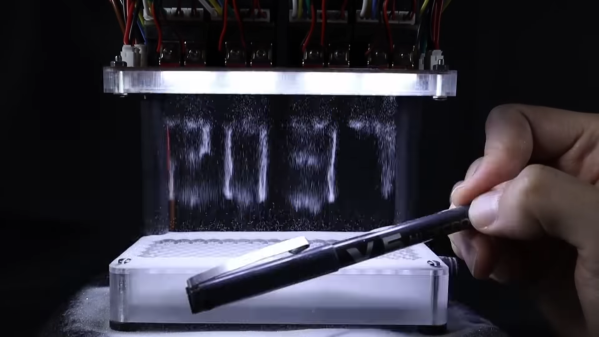
The idea behind the timepiece that [Álvaro Gómez Giménez] built is pretty simple drop a tiny slug of fine sand from a hopper and light it up at just the right point in its fall. Do that rapidly enough and you can build up an image of the digits you want to display. Simple in concept, but the devil is in the details. Sand isn’t the easiest material to control, so most of the work went into designing hoppers with solenoid-controlled gates to dispense well-formed slugs of sand at just the right moment. Each digit of the clock has four of these gates in parallel, and controlling when the 16 gates open and close and when the LEDs are turned on is the work of a PIC18F4550 microcontroller.

The build has a lot of intricate parts, some 3D printed and some machined, but all very carefully crafted. We particularly like the big block of clear plastic that was milled into a mount for the main PCB; the translucent finish on the milled surfaces makes a fantastic diffuser for the 96 white LEDs. The clock actually works a lot better than we expected, with the digits easy to make out against a dark background. Check it out in the video below.

Between the noise of 16 solenoids and the sand getting everywhere, we’d imagine it wouldn’t be a lot of fun to have on a desk or nightstand, but the execution is top-notch, and an interesting and unusual concept we haven’t seen before. Sure, we’ve seen sandwriting, but that’s totally different. Continue reading “POV Digital Clock Is The Literal Sands Of Time”