Kitchen Hacks: What Would You Cook If You Had A Sous-Vide This Large?

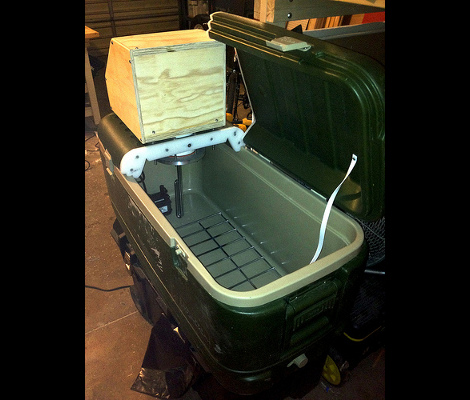
We’ve seen no shortage of temperature controlled immersion cooking devices, called Sous-Vide, around here. But this one probably has the capacity of all of them combined! Flickr user [RogueGormet] isn’t writing about the build, but his Large Form Water Oven build photo set speaks for itself.

We’d wager that the donor vessel is a 16-gallon chest cooler. He cut the lid into two sections, sealing off the insulated cavity with High Density Polyethylene (the stuff those white cutting boards are made out of). This gives him a place to mount the heating element, with a box for the PID controller riding on top. A submersible pump keeps the liquid moving to help regulate the cooking temperature throughout.

What do you put in one of these? Right off the top of our heads we’d think he had something like a pig roast planned. But it could just as easily be a Turkey, or other large hunk of meat. What would you use it for?

If you don’t need quite as much capacity you might make some alterations to your slow cooker for your own immersion cooking.

Personal Flight From The Steam Age

From a small-sized backpack these wings slowly grow to full size in a Steampunk costume that hearkens back to DaVinci flight designs.

The mechanism that unfolds the wings was fashioned from parts of a baby gate and an old back massager. The massager features a pair of orbs that are meant to move slowly up and down your back. This is what accounts for the slow unfurling of the wings. After a bit of prototyping with Popsicle sticks [Dannok] and his daughter figured out the best arrangement for the pivoting skeleton. From there, the slats from the baby-gate were used to build the frame, then covered with fabric to finish the wing element for this Halloween costume.

A 12 volt gel battery powers the device, which is activated with a brass pull-chain meant for a light fixture. Once full extended, as seen above, the wingspan is eight feet. Don’t miss the pair of videos we’ve embedded after the break which show the workings of the device.

Continue reading “Personal Flight From The Steam Age”

Panning Time-lapse Rig

Here’s a simple camera setup that lets you make your own panning time-lapse videos. It uses a couple of motors driven by an Arduino to snap successive still images which can later be rolled into a video format.

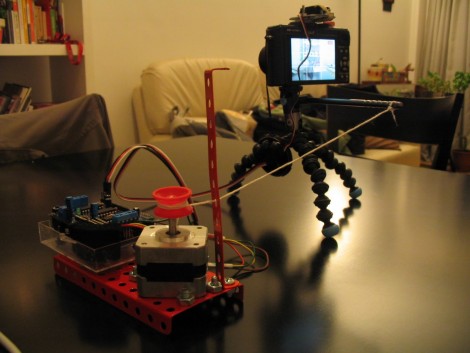
[Acorv] was not thrilled with the fact that his new Lumix LX5 didn’t have a time-lapse option built-in. But luckily it does have a standard connector on top for an external flash. He saw on a forum post that someone had built a jig which mounts to the flash bracket and uses a servo motor to depress the shutter release button. He recreated that and had half of this hack done.

The panning portion is facilitated by the Gorillapod. This particular model offers a swivel feature. This is automated by connecting it to a stepper motor with a piece of string. As the stepper turns the string is wound on a spool and gradually pans the camera. Simple, and it seems to work great. Check out the video after the break to see a test which was shot at sunset on the shores of a lake.

If you have a camera which offers an IR remote shutter release the time-lapse portion can be handled with an IR intervalometer, making the mechanical build a bit easier.

Continue reading “Panning Time-lapse Rig”

Kitchen Hacks: The Margarita Machine

If [Paul Degenkolb] really decided to make this on a whim one day (like he says he did) we think he should quit his job and go into a full-blown state of whimsy for the rest of his life. The Margarita Machine makes five gallons of slushy intoxicants in a quick and relatively quiet process that will have a backyard full of guests lining up not just to imbibe, but to see what the heck you’ve come up with this time around.

It’s easy enough to see that the vessel is an Igloo cooler, but where do you get a motor and blade assembly strong enough to turn ice cubes into slush? Just hit the home center and pick out the Garbage Disposer model of your choice. With the ball-valve serving spigot closed, the disposer sucks down the liquid and ice, shooting the pulverized mixture through some PVC pipe back to the top of the cooler. This circulation helps to mix things up, but at times [Paul] uses a glass as a plunger to wrangle rogue ice cubes.

Sorry folks, doesn’t look like there’s any video of this in action.

[Thanks Brad]

Arduino-based MIDI Synth

[Charles Gershom] has been tinkering around with his keyboard and Arduino in order to build his own version of a MIDI controlled synthesizer. It looks like he’s gutted the enclosure of some commercially available MIDI hardware to use for the project. This works nicely since it gives him both the MIDI and audio jacks that he needs. The box also provides a nice control surface where a set of four LEDs indicates the synth mode currently in use. There are also four potentiometers mounted on the panel, but they’re not yet up and running.

Check out the video after the break to see what this can do so far. [Charles] shows the device synthesizing sounds coming in from the keyboard. It is also used to playback the audio from Super Mario Bros. which is fed in by a music notation program on a computer. Only one voice is playing when this happens which makes us think this can only handle one channel at a time right now (but we could be wrong).

Continue reading “Arduino-based MIDI Synth”

Announcing Our Next Theme: Kitchen Hacks

Here’s a theme that has the Hackaday staff quite excited; Kitchen hacks. This is a wide-ranging subject that can include anything having to do with food, food preparation, kitchen implements, and enhancements.

We’ve seen quite a few fantastic examples of this theme already. How about a kitchen island the mixes cocktails to order? Perhaps you’d prefer an AI that keeps track of your shopping list or just a computer kiosk that’s nicely integrated. Of course there’s already an iPod dock for that! You might be looking to supe up a pressure cooker, or add a Sous Vide machine to your culinary arsenal. We shouldn’t leave out the ability to ‘print’ images on toast.

Speaking of toast… we’re still waiting for someone to build a laser bread slicer that toasts as it goes. You get the point. Ladies and Gentleman, grab a computer, document your Kitchen hacks, and send them our way!

G-35 Christmas Lights Do Make A Great LED Matrix

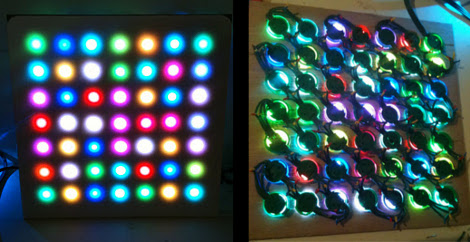
This fully-addressable RGB LED matrix was built by [John Graham-Cummings]. He didn’t start from scratch, but wisely repurposed a strand of GE Color Effect lights and built a pleasant looking case in which to mount the G-35 hardware.

We’ve seen this hardware used in a similar way before. Because each ‘bulb’ has its own microcontroller, color data is shifted in via a serial bus. Orient the modules in any pattern you choose and account for that layout in software.

Since the strings have 50 bulbs, [John] simply cut off the one on the end to form his 7×7 matrix with the remaining 49 units. A square of plywood with a grid of holes holds each in place. Cord mess is not a problem as the extra was cut out and the remainders were soldered together again. [John] uses an Arduino Pro to feed in the data, which you can see for yourself in the clip after the break.

Continue reading “G-35 Christmas Lights Do Make A Great LED Matrix”