Solar-powered Bird House Tweets Using B-Squares

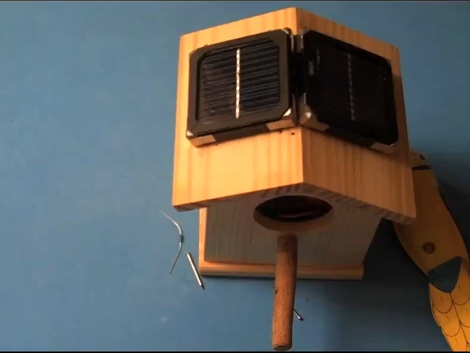
This bird house will tweet to let you know when the occupants pass through the door… err… hole. It uses solar panels to keep a battery topped off, and an Arduino along with an optical sensor which monitors the doorway to pass along an alert via an XBee module.

Admittedly, the video after the break is a bit tongue-in-cheek and doesn’t safeguard against the elements, or even against bird poop. AND it’s basically an advertisement for B-Squares. But we still like it.

These squares use magnetic corners to connect the solar squares together, as well as the squares that house the Arduino and the battery. These magnetic corners also act as the power and ground rails. Two nails have been pounded through the roof of the bird house, acting as a surface to magnetically attach the solar panels to, as well as a conductor to pass the power rails through the wood. It’s no wonder that B-Squares are closing in on  raising five-times their Kickstarter goal.

Continue reading “Solar-powered Bird House Tweets Using B-Squares”

Tree Climber Takes A Page From The Inchworm Book

Sharp talons and a strong torso let this robot climb trees, even while carrying a heavy payload. It uses a simple principle, two gripping units allow it to grab onto the tree. These modules alternate, one grips while the torso moves the other up the tree.

You can make out the trio of rods which connect the front and back half of the robot in the image above. Watch the video after the break to see how the motors move these rods with the dexterity of an inchworm, allowing it not only to climb upwards, but to bend and flex to match the contours encountered in the wild.

This was presented at International Conference on Robotics and Automation a few weeks ago. Unfortunately we can only find an abstract for the paper so please leave a link in the comments if you know where to find the full monty.

Continue reading “Tree Climber Takes A Page From The Inchworm Book”

Aquabot Gets Around More Than You’d Think

This doesn’t have the flashy futuristic appeal that we’d like to see from high-tech robots, but this amphibious wanderer is well suited for it’s intended purpose. It was developed by researchers at the University of Minnesota to navigate mostly wet environments, collecting data about water quality as part of a distributed army of sensor bots.

The two little arms sticking out in front of it are made of carbon fiber and attached to servo motors inside. The video below the fold shows the trapezoidal body tumbling end-over end to get around. But the awkward, baby-turtle-like locomotion isn’t the only thing in its bag of movement tricks. It can also adjust its buoyancy to float, sink, or hover somewhere in the wet stuff.

To get a better look at what went into developing this, take a look at the Adelopod developed at UMN a couple of years back. We also embedded a video of that tumbling robot because they share the build details we’re always on the lookout for.

Continue reading “Aquabot Gets Around More Than You’d Think”

This Robot Can Beat You At Pointless Games

We already know that robots can be smarter than us as evidenced by Watson beating [Ken Jennings] at Jeopardy, or Deep Blue beating [Garry Kasparov] at chess. Now [E024576] is striving to build a bot to compete at physical games.

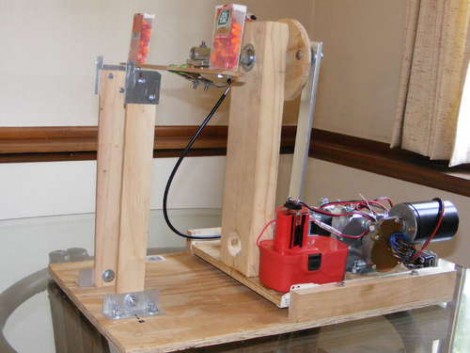
For the challenge, he’s chosen one of the games from a television game show called Minute to Win It. This challenge is called Mad Dog, and lends its name to this robot. The goal is to pick up a ruler with two tic tac containers glued to it, then shake it until all of the candies are ejected from those containers. Check out what he’s come up with in the clip after the break. The machine is driven by a PIXAXE microcontroller, with input from an IR remote control. It reaches out, grips the ruler tightly, and shakes like there’s no tomorrow. Quite impressive, even if there’s very little purpose in its operation. That makes it the perfect task for robot, right?

Continue reading “This Robot Can Beat You At Pointless Games”

Robot Juggler Sure Handles A Lot Of Balls

This robot juggler, pictured above during its appearance at Amper 2010, can keep five balls in the air at once. It was designed by the Department of Control Engineering at the Czech Technical Institute in Prague. We know it doesn’t look like much in that still image, but the two videos embedded after the break are pure gold.

To arms on vertical tracks do the juggling. They can move up and down on said tracks, and circular grippers attached to each can pivot horizontally. A third actuator resides at the bottom of the machine, collecting any balls that might drop, and launching them back into the realm of the juggling hands. A high-speed camera facilitates object tracking in much the same ways that it’s been used for quadcopter control.

The objects being thrown around in that protective enclosure are billiards balls. We guess the added mass helps to dampen any small irregularities in the throw or the catch.

Continue reading “Robot Juggler Sure Handles A Lot Of Balls”

Wireless Controller Operates Your CNC Mill

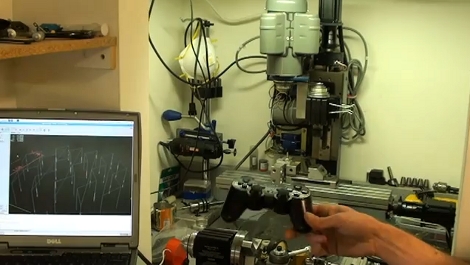
[Darrell Taylor] wanted to add a CNC control pendant to his mill but didn’t want to foot the bill which can often run several hundred dollars. These pendants are basically a physical remote control that operates the CNC software that controls the machine. Since he was already using a Linux box running EMC2, it wasn’t too hard to figure out how to operate the mill with a PlayStation controller.

To get the controller talking to his Linux machine he uses a package called QtsixA. The package identifies and loads the control through Bluetooth pairing. From there it can be used to map the buttons and joysticks as keys on the keyboard or as a mouse. In the video after the break [Darrell] demonstrates how he has his shortcuts set up. He’s able to move the machine head, and even start or step through the programmed routine. As he mentions, this is pretty nice if you’ve got dirty hands; just throw the controller in a zipper bag and you’re set to go.

Continue reading “Wireless Controller Operates Your CNC Mill”

Arduino Based Biofeedback Unit

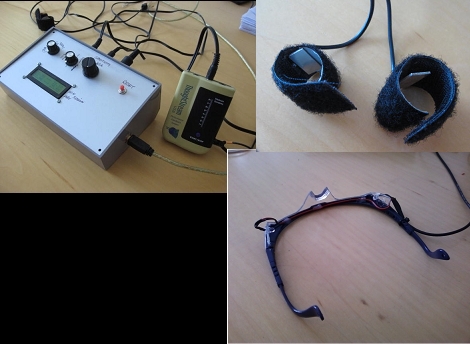
[Michael Gerstenmayer] has been very successful in developing a biofeedback system. He’s based the build around an Arduino and started adding different chunks to the project to develop a full-featured unit. It can take your temperature (with an IR sensor…. not the hard way), measure your galvanic skin response (conductance), and produce feedback based on this data. Interestingly enough, he built a peripheral vision feedback system based on the glasses frames seen above. They have an LED on each side which are illuminated based on the sensor data.

By using the Arduino’s USB connection the data can also be processed by a PC. [Michael] spent some time working with an open source program called BrainBay to gather and map the stream from the sensors.

We enjoyed reading about the build, but there’s no information about what he’s got planned for this project. That shouldn’t stop you from setting up your own rig and using it as a lie detector, or for the devilish purposes we’ve seen in the past.