Biofeedback Butterfly Beats With A Pulse

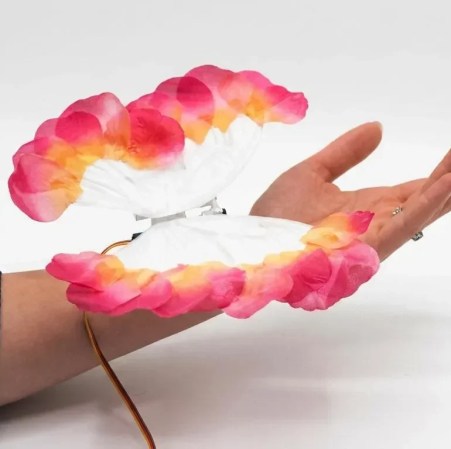
Biofeedback is the idea of making one conscious of a biological process or feature, and then using this to try and exert control over the very same. [Mariia Hruntes] demonstrates this ably with a fluttering build of her own design.

In this case, the biological process being made clear is that of the user’s heartbeat. This is tracked with a MAX30102 pulse oximetry sensor, which can be used to measure both heart rate and blood oxygen levels if so desired. It’s hooked up to an Arduino Uno, which polls for pulse rate data, and then actuates an SG90 micro servo in turn. This operates the wings of a 3D printed butterfly, such that they flap in pace with the wearer’s pulse. The goal is to observe this, and then try and calm one’s self to relax and slow the flapping through the power of the mind.

It’s a simple build, but one that clearly demonstrates the concepts of biofeedback in action. We’ve seen similar principles applied to everything from aiding sleep to improving the practice of mediation. If you’re working on your own neat biofeedback project, be sure to let us know on the tipsline.

Look Inside This “Meditation Headband” And Integrate It Into Your Own Projects

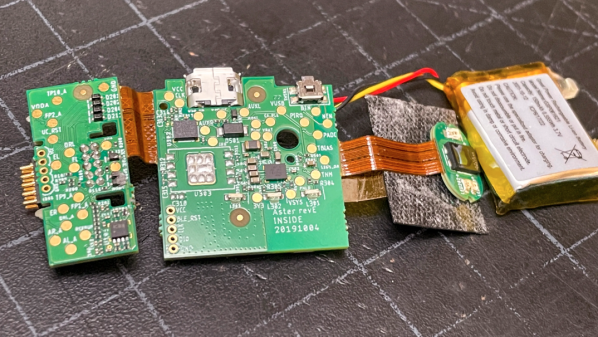
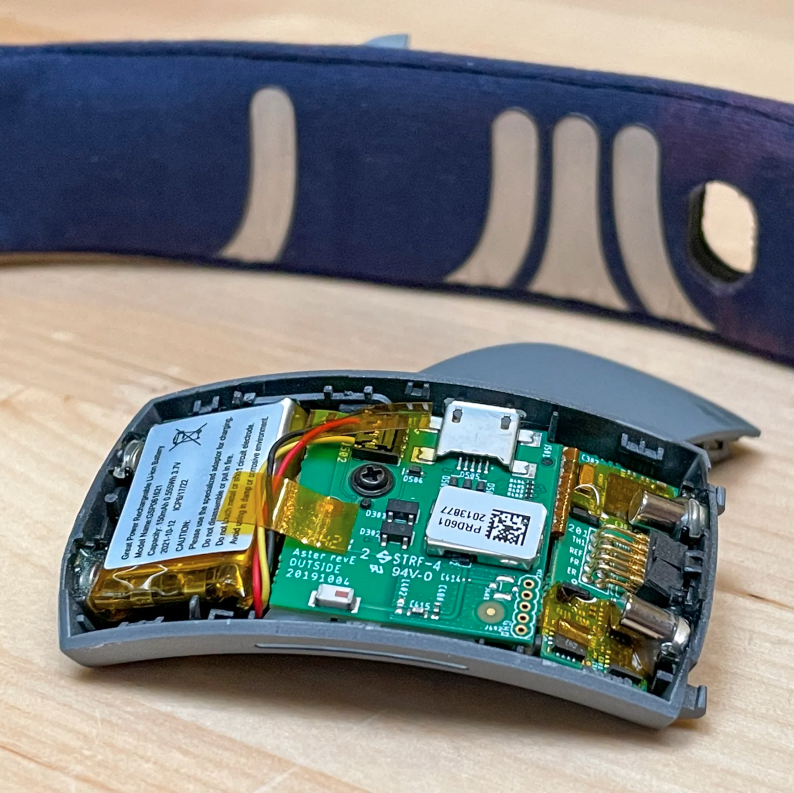
Muse makes a variety of wearable devices aimed at measuring brain and body activity, and [Becky Stern] did a detailed teardown of the Muse S model, revealing what goes on inside the device.

The Muse S is a soft, sleep-friendly biofeedback wearable mounted on silver-plated fabric. Not only does [Becky] tear it down, but she provides loads of magnified images and even has it CT scanned. The headband has conductive fabric embedded into it, and the core of the device is stuffed with three separate PCBs that get pretty thoroughly scrutinized.

While the Muse S is sold mainly as a meditation aid and works with a companion app, there is, fortunately, no need to go digging around with a screwdriver and soldering iron to integrate it into other projects. The Muse S is supported by the Brainflow project which opens it up to different applications. Brainflow is a library intended to obtain, parse, and analyze EEG, EMG, ECG, and other kinds of data from biosensors.

If you think Muse and Brainflow sound familiar, that might be because of another project we featured that integrated a Muse 2 and Brainflow with Skyrim VR, creating a magic system whose effectiveness depends on the player’s state of mind. Good things happen when hardware and software are accessible to users, after all.

You can watch a video tour of the teardown in the video, embedded just under the page break.

Continue reading “Look Inside This “Meditation Headband” And Integrate It Into Your Own Projects”

Magic In VR That Depends On Your Actual State Of Mind

[Cangar]’s excitement is palpable in his release of a working brain-computer interface (BCI) mod for Skyrim VR, in which the magic system in the game is modified so that spell effectiveness is significantly boosted when the player is in a focused mental state. [Cangar] isn’t just messing around, either. He’s a neuroscientist whose research focuses on assessing mental states during task performance. Luckily for us, he’s also an enthusiastic VR gamer, and this project of his has several interesting aspects that he’s happy to show off in a couple of videos.

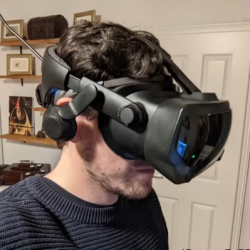
User wearing VR headset
The Muse 2 fits under the VR headset easily.

It all starts with the player wearing a Muse 2 meditation device; a type of passive, off-the-shelf electroencephalography (EEG) unit aimed primarily at guiding a user towards better relaxation and focus. [Cangar] reads data using the Brainflow library and processes it into a final value on a scale between “not focused” and “focused”. [Cangar] makes a point of explaining that his system ultimately has the goal of modeling the player’s state of mind, which is different from modeling just the brain activity. As such, motion data is considered as well, and holding still confers a small bonus to the process.

How is this data actually used in the game? In VR, this “focus” value is shown as a small bar on the player’s wrist, and spell effectiveness (for example, damage for attack spells) scales along with the size of the bar. When the bar is full a player would be very powerful, with spells doing double damage. If the bar is empty, spells will do little to no damage.

[Cangar] demonstrates the mod in two videos (both embedded below), but you won’t see him blasting enemies with fireballs. Presumably, VR gamers already know what that looks like, so what he does instead is explain how the system looks and works (first video, cued to 4:12), and in the second, he video demonstrates how the focus meter changes depending on his activity and mental state.

The results look exciting, and the potential uses of a system like this are pretty interesting to think about. Taking a few deep breaths and calming one’s body and mind before launching a magical attack will have a tangible effect in the world, and because things rarely go according to plan, there is also a clear survival benefit to learning to focus while under pressure. But if a brain monitor isn’t your cup of tea, maybe consider a leisurely bike ride through Skyrim, instead.

Continue reading “Magic In VR That Depends On Your Actual State Of Mind”

DodowDIY Is A Homebrew Sleep Aid

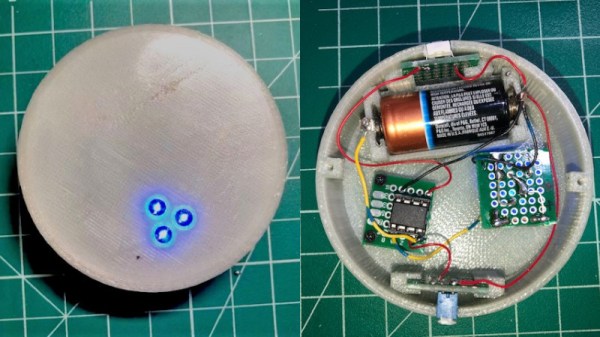
The Dodow is a consumer device that aims to help users sleep, through biofeedback. The idea is to synchronise one’s breathing with the gentle rhythm of the device’s blue LEDs, which helps slow the heartrate and enables the user to more easily drift off to sleep. Noting that the device is essentially a breathing LED and little more, [Daniel Shiffman] set about building his own from scratch.

An ATTiny85 runs the show; no high-powered microcontrollers are necessary here. It’s hooked up to three 5mm blue LEDs, which are slowly ramped up and down to create a smooth, attractive breathing animation. The LEDs are directed upward so that their glow can be seen on the ceiling, allowing the user to lay on their back when getting ready for sleep. It’s all wrapped up in a 3D printed enclosure that is easily modifiable to suit a variety of battery solutions; [Daniel] chose the DL123A for its convenient voltage and battery life in this case. The design is available on Thingiverse for those looking to spin their own.

It’s a neat example of where DIY can really shine – reproducing a somewhat-expensive gadget that is overpriced for its fundamental simplicity. Now when it comes to waking up again, consider building yourself a nifty smart alarm clock.

Hackaday Prize Entry: Stroke Rehabilitation Through Biofeedback

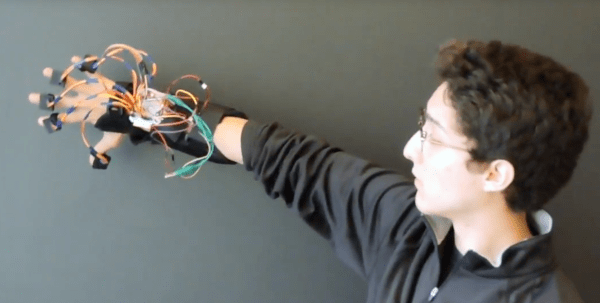
Students at Purdue University’s Weldon School of Biomedical Engineering created ExoMIND, an Arduino-powered glove that helps a stroke victim recover by tracking the range of motion the patient experiences.

A set of 7 accelerometers in the fingers, wrist, and forearm track the range of movements the patient is experiencing with that hand. An accelerometer on the back of the hand serving as a reference. Meanwhile, an EMG sensor working with a conductive fabric sleeve to measure muscle activity. The user follows a series of instructions dished out by an interactive software program, allowing the system to test out the patient’s range of motion at the beginning of the regime as well as to record whether any improvement was noted at the end. The data is used by a physical therapist to personalize the treatment plan. The interactive program also raises the possibility of patients self-directing their exercises with the ExoMIND telling them how to adjust their motion to get the most out of the experience.

Produced as part of the university’s MIND Biomedical Engineering Club, the ExoMIND prototype was designed by three interdisciplinary teams focusing on electronics, materials, and programming, respectively.

Continue reading “Hackaday Prize Entry: Stroke Rehabilitation Through Biofeedback”

Arduino Detects Pants On Fire

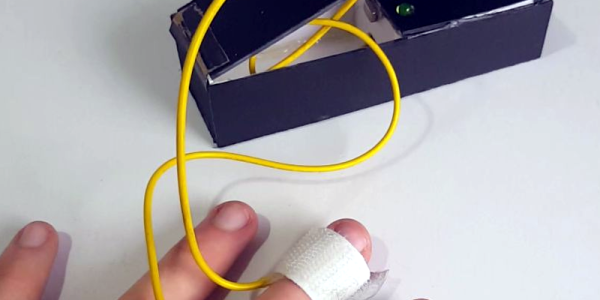
Hard as it is to imagine, lie detectors have been sold as children’s toys for a number of years. A simple battery-operated device clipped to your fingers and would show the conductivity of your skin. The concept — which is probably not very reliable — observers that lying causes you to imperceptibly sweat which causes a sudden increase in your skin’s conductivity. These cheap toys would have a meter and you’d note the meter deflection to determine if the subject was lying.

You can debate the amusement value of interrogating your friends, perhaps, but they were pretty common and still exist (including some that shock you if they detect you are lying). Seventeen-year-old [BuildIt] has his own modern take on this classic device using — what else? — an Arduino. You can see a video of the device below.

Continue reading “Arduino Detects Pants On Fire”

Hacklet 105 – More Mind And Brain Hacks

A mind is a terrible thing to waste – but an awesome thing to hack. We last visited brain hacks back in July of 2015. Things happen fast on Hackaday.io. Miss a couple of days, and you’ll miss a bunch of great new projects, including some awesome new biotech hacks. This week, we’re checking out some of the best new mind and brain hacks on Hackaday.io
We start with [Daniel Felipe Valencia V] and Brainmotic. Brainmotic is [Daniel’s] entry in the 2016 Hackaday Prize. Smart homes and the Internet of Things are huge buzzwords these days. [Daniel’s] project aims to meld this technology with electroencephalogram (EEG). Your mind will be able to control your home. This would be great for anyone, but it’s especially important for the handicapped. Brainmotic’s interface is using the open hardware OpenBCI as the brain interface. [Daniel’s] software and hardware will create a bridge between this interface and the user’s home.
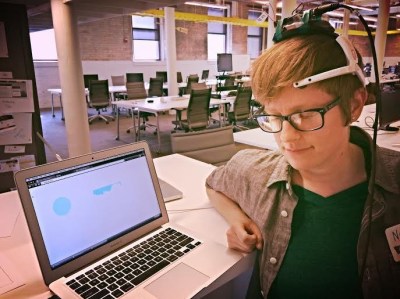
 

biofeed1Next we have [Angeliki Beyko] with Serial / Wireless Brainwave Biofeedback. EEG used to be very expensive to implement. Things have gotten cheap enough that we now have brain controlled toys on the market. [Angeliki] is hacking these toys into useful biofeedback tools. These tools can be used to visualize, and even control the user’s state of mind. [Angeliki’s] weapon of choice is the MindFlex series of toys. With the help of a PunchThrouch LightBlue Bean she was able to get the EEG headsets talking on Bluetooth. A bit of fancy software on the PC side allows the brainwave signals relieved by the MindFlex to be interpreted as simple graphs. [Angeliki] even went on to create a Mind-Controlled Robotic Xylophone based on this project.
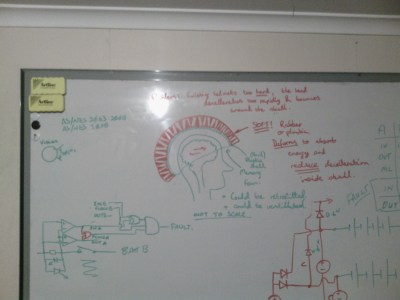
brainhelmetNext is [Stuart Longland] who hopes to protect brains with Improved Helmets. Traumatic Brain Injury (TBI) is in the spotlight of medical technology these days. As bad as it may be, TBI is just one of several types of head and neck injuries one may sustain when in a bicycle or motorcycle accident. Technology exists to reduce injury, and is included with some new helmets. Many of these technologies, such as MIPS, are patented. [Stuart] is working to create a more accurate model of the head within the helmet, and the brain within the skull. From this data he intends to create a license free protection system which can be used with new helmets as well as retrofitted to existing hardware.
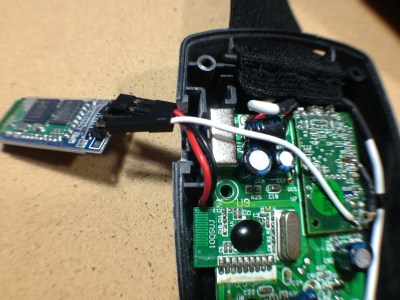
mindwaveFinally we have [Tom Meehan], whose entry in the 2016 Hackaday Prize is Train Your Brain with Neurofeedback. [Tom] is hoping to improve quality of life for people suffering from Epilepsy, Autism, ADHD, and other conditions with the use of neurofeedback. Like [Angeliki ] up above, [Tom] is hacking hardware from NeuroSky. In this case it’s the MindWave headset. [Tom’s] current goal is to pull data from the TAGM1 board inside the MindWave. Once he obtains EEG data, a Java application running on the PC side will allow him to display users EEG information. This is a brand new project with updates coming quickly – so it’s definitely one to watch!

If you want more mind hacking goodness, check out our freshly updated brain hacking project list! Did I miss your project? Don’t be shy, just drop me a message on Hackaday.io. That’s it for this week’s Hacklet, As always, see you next week. Same hack time, same hack channel, bringing you the best of Hackaday.io!