Screaming Altoids Tin Just In Time For April Fool’s

altoids_screamer

Maker [Dino Segovis] has started on a project he calls “Hack a week” where he will be putting together one hack or project per week, for a full year. The first installment of his video series was finished just two days before April Fool’s, and appropriately enough covers the construction of a circuit you can use to prank your friends.

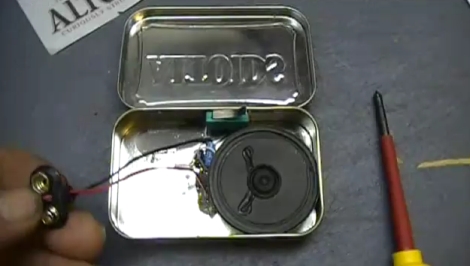
The “Altoids Screamer” is a simple circuit based on a 555 timer that he built into a standard Altoids Tin. The 555 timer is used to generate a loud pitched squeal whenever the tin is opened. This is accomplished by wiring up the 555 in astable mode, and connecting it to a speaker to output the sound. A micro switch is installed inside the tin to detect when the top has been opened, triggering the “scream”.

While it’s not the most complex circuit we’ve seen, it definitely gets the job done and is easy enough to build in time for tomorrow’s festivities. It is a great hack for the office, the library, or any other quiet place.

Continue reading to watch [Dino’s] first Hack a Week video demonstrating the prank’s construction. If you are interested in some more of his work, be sure to check out this automatic ball launcher and this other 555 Screamer toy.

Continue reading “Screaming Altoids Tin Just In Time For April Fool’s”

Solar-powered MP3 Playing Speaker

solar_speakers

[Valentin] bought a small battery-powered cube speaker with a built-in amp some time ago, but didn’t have much patience for replacing or recharging the batteries. It sat on the shelf for awhile until he decided to revive an old MP3 player he had sitting around.

He gutted a pair of solar garden lamps, retaining the solar panels, the built-in charging circuits, as well as the included rechargeable batteries. The MP3 player was disassembled, and its components were built into the speaker enclosure. The player’s buttons were relocated to the outer shell of the speaker box with a few pieces of wire, allowing him to easily control his music without having to build in a method for opening the case. Both the speaker and the MP3 player are powered by the batteries salvaged from the solar lamps, which is why he opted to mount both of the solar panels on the the side of the speaker enclosure rather than just one.

We like it even though the speaker looks a bit rough at the moment, especially where the MP3 player’s buttons were transplanted. After a few minutes of touch-up work however, it’ll look great.

If you’re interested in some more solar hacks, check out this solar-powered junkbot, these solar toys for kids, and this solar-powered WiFi repeater we featured in the past.

Snuggle Up With The Softer Side Of Hacking

led_quilt

Not all hacks need to be made up of servo motors, wireless radios, and PIR sensors. Sometimes hacking has a softer side, of which [Katie] reminds us with her latest creation.

Her LED quilt incorporates 64 hand-sewn LEDs, all of which were painstakingly attached with conductive thread. The same thread was used in a sewing machine to build the conductive grid that powers the LEDs. One half of the circuit was sewn into the front of the quilt in the form of 8 rows, while the columns are sewn into the back side. All of the rows and columns meet in the corner of the quilt, where they are attached to a Lilypad Arduino using simple metal snaps.

The LED matrix panel was then tested, then sewn into an actual quilt. The finished product looks completely innocuous until lit up, as you can see in the video below. We think it would make a great nightlight replacement for a child, especially if programmed to display soothing light patterns.

[via Make]

Continue reading “Snuggle Up With The Softer Side Of Hacking”

machete_slingshot

“Stupid Expert” Builds A Machete Slingshot For The Impending Zombie Apocalypse

Sometimes people build things for the simple challenge of building. This is one of those cases.

The gentleman you see in the image above is [Jörg Sprave] of The Slingshot Channel. He is a self-proclaimed “Supid Expert” on the subject of slingshots and has taken his love of flinging things at absurd velocities to a whole new level.

His latest creation is a machete slingshot, which is really more accurately described as a machete crossbow. Measuring over six feet long, the impressive apparatus fires a specially altered machete with an insane amount of force using thick rubber bands. In the test firing shown in the video below, the machete is embedded up to the hilt in six layers of very thick cardboard, requiring quite a bit of work to remove.

As he states in the video while brandishing his bloodied forearm, building such a device is extremely dangerous, and should be limited to “Stupid Experts” . In no way should you attempt to build one of your own.

Continue reading ““Stupid Expert” Builds A Machete Slingshot For The Impending Zombie Apocalypse”

Converting The BlinkM Into The World’s Tiniest Arduino

blinkm_arduino

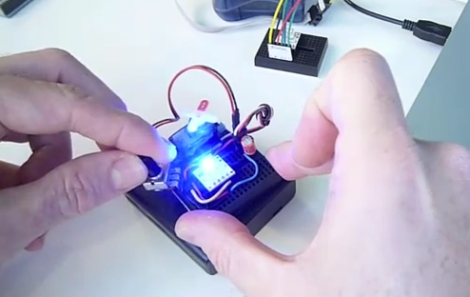
The BlinkM “Smart LED” is a great little device on its own accord. It allows for complete control of its RGB LED using a built-in microcontroller, enabling the user to do a wide array of things that normally require PWM to accomplish. At just over half an inch square, this little device might also be the smallest Arduino on the market.

The BlinkM packs an ATiny85 micro controller, which allows it to be flashed with the Arduino bootloader thanks to the people over at the [High-Low Tech group at MIT]. They did some tweaking of the Arduino IDE configuration files and incorporated some core library code created by [Alessandro Saporetti] to get the job done – all of which is available on their site.

Once the code is uploaded to the BlinkM, you essentially have a micro Arduino running at 8MHz with a built in LED and 2 I/O lines (5 if you snip off the LED). It’s a great device to have on hand if you feel like a full-fledged Arduino would be overkill in your project.

Stick around to see a video tutorial of the reflashing process.

Continue reading “Converting The BlinkM Into The World’s Tiniest Arduino”

Wireless Luge Timer Levels The Playing Field

wireless_luge_timer

In Colorado, amateur luge competitions are serious business.

Every winter, [Ryan’s] friends dig a long luge track through the many feet of snow that occupies their yard, and have competitive sled races to see who can make it down the giant hill in the least time. They call it the Mario Cup, after one of the participants, not the Nintendo mascot, and they were in desperate need of some timing equipment.

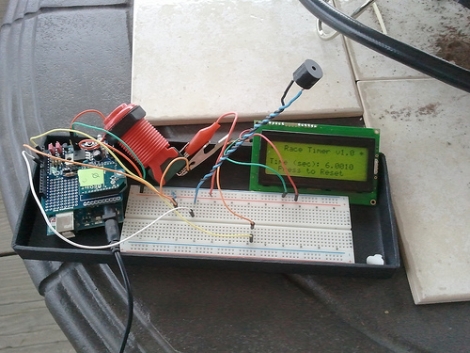
You see, the luge track is several hundred feet long, and they decided that a human armed with a stopwatch is not a good enough means of picking a conclusive winner. A set of three Arduino sensors packed inside plastic food containers were used along with light sensors to track when the luger passed the start, midpoint, and finish lines of the race. XBee radios then transmitted the timing data back to the base station for recording.

The system worked quite well according to the participants, and they look forward to using the system again in the future. Of course, improvements have been planned, including dual timers at each checkpoint to gauge the luger’s speed, as well as a Christmas-tree starting signal like you see at drag races.

Continue reading to see a video below of the luger’s in action, as well as the timer system undergoing some tests.

[via Make]

Continue reading “Wireless Luge Timer Levels The Playing Field”

Propeller Proto Board Has You Flying In No Time

propeller_proto_board

[Parker] was in need of a Propeller development board to make working on his projects easier. More often than not, when he needed to prototype something, he would pull the only one he had on hand from his home made pinball machine, and replace it when finished. This was time consuming and cumbersome, so he decided he needed a better way of doing things.

He looked into purchasing a Gadget Gangster proto board which allows you to use a Propeller much like an Arduino, complete with support for shields and the like. Unfortunately, they were sold out and he was in a hurry to finish up a project. Rather than wait, he decided to build his own proto board, which would be more flexible than the COTS version – allowing him to add things like an Analog to Digital converter without having to use a shield.

He looked around online and found some schematics to follow, and had his proto board constructed in no time. It gets the job done and looks quite clean, considering it was put together using perf board.

Keep reading to see a video walkthrough of the Propeller development board construction.

Continue reading “Propeller Proto Board Has You Flying In No Time”