The Ottoman Empire

ottomon empire

Remember the good old days in the 60’s and 70’s when stereos were built right into the furniture? No? Well, that’s where the inspiration for this project comes from. Introducing the Ottoman Empire — a pun so bad we’re not even going to repeat it here.

[Alec] was inspired by Blaupunkt, which is a German manufacturer of electronics who used to make a line of very nice cabinet stereos (examples) which blended furniture and electronics quite exquisitely.

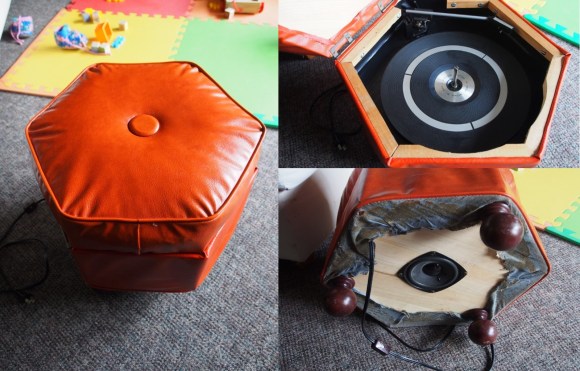
He had recently finished off a rather cool 8-track data backup system, and was left with a spare BSR record player — or as he likes to call it, the “Ford Pinto of record players.” He decided to turn it into something useful by integrating it into a Naugahyde Ottoman that he picked up from a local vintage store. The problem with old furniture like that? No structural elements — it was actually just packed full of shredded wood! He cleaned it all out though and then proceeded to make his own wooden frame to support the BSR — he’s done a great job modifying it to fit, and even hiding all the electronics to make it very presentable.

Now all he needs to do is add a pressure switch in the top so when he kicks back to relax it starts playing some Chopin.

Continue reading “The Ottoman Empire”

Super Mario Lamp Encourages Physical Activity

FALTIN1HRBE3Z2Y.MEDIUM

What better way to encourage jumping around in the house than by adding your own Super Mario style question block lamps?

It’s a fun and easy project to do because it makes use of an IKEA Sangen lamp — it just needs some slight modifications and a bit of art work to turn it into this iconic question block. You will be working with mains voltage though, so please be careful!

The lamp itself is made out of fabric which means it can be taken apart easily, and then dyed that classic orange hue. Using a stencil you can spray paint on the question mark and then it’s just a matter of adding a springy-latching-pressure-switch (that’s the technical term for them right?) in line with the light bulb. Results may vary, but [Anred] has a great guide on how to make it to get you started.

Now all that’s missing is a sound effect to go with the switch!

Continue reading “Super Mario Lamp Encourages Physical Activity”

TARDIS Alarm Doesn’t Go VWORRRRRP VWRORRRP VWORRRP

tardis alarm

Motion sensors are pretty useful — but they’re just so darn ugly! Well — if you’re a Whovian — maybe this hack is for you. A 3D printed TARDIS Motion Sensor Alarm!

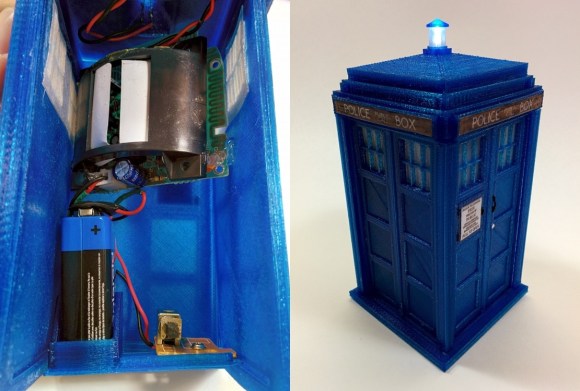
[Malcolm] has a home security system that uses a series of motion sensors to detect movement in the house. When movement is detected an indicator LED turns on, and a wireless signal is sent to the main control system. So after discovering a nice 3D model of the TARDIS (Time and Relative Dimension in Space) on Thingiverse, he decided to see if he could hack one of his motion sensors to fit inside of it instead.

As it turns out, it was as simple as removing the sensor’s external shell, 3D printing a few support pieces inside of the TARDIS, and soldering on a bright blue LED to replace the dinky indicator light. Simple, but effective!

Don’t forget to check out the following video. Allons-y!

Continue reading “TARDIS Alarm Doesn’t Go VWORRRRRP VWRORRRP VWORRRP”

Adding An RPM Readout For A Home Made CNC Mill

rpm_lcd

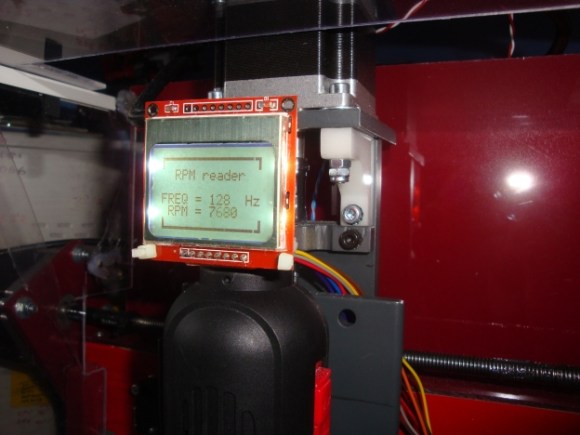
[Rui] recently put the finishing touches on his homemade CNC mill, which utilizes a dremel-like rotary tool. The problem with using rotary tools for this kind of application is you don’t really have an accurate speed readout… so he designed his own RPM gauge.

The sensor is in itself very simple. He’s using a TLE4935L hall effect sensor, a spare 16FE88 microcontroller, a Nokia LCD, and one tiny neodymium magnet. The magnet has been carefully epoxied onto the motor fan, with the hall effect sensor close by. He’s also built a guard around it, just in case the magnet decides to fly off at high speeds.

During testing he hooked up the hall effect sensor to both his home-made circuit, and an oscilloscope to confirm his findings. Once he was assured everything was working properly he sealed it off and mounted the LCD above the spindle as a nice digital readout.

Continue reading “Adding An RPM Readout For A Home Made CNC Mill”

Pneumatic Powered Flight Simulator

FX7UCGEHK6XMQ3G.MEDIUM

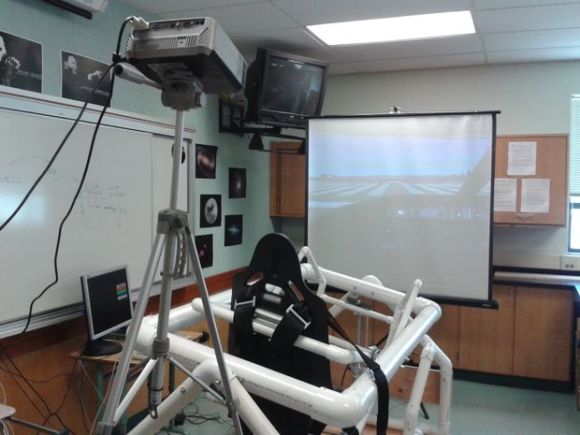
Remember that feature a few days ago about the Cessna 172 flight simulator? It was pretty awesome. But do you know what it was missing? It was missing this. A fully motion-controlled, pneumatically driven, flight simulator cockpit.

[Dominick Lee] is a high school senior, and he was able to whip together this awesome flight simulator made out of PVC pipe, pneumatic cylinders, an Arduino, a projector, and a gaming PC — in just a few months time! He calls it the LifeBeam Flight Simulator, and he’s released all the information required to make one yourself.

It’s most similar to a Stewart platform simulator, which features 2 degrees of freedom, but instead of 6 actuators, this one runs on only two pneumatic cylinders. It works by exporting the roll and pitch (X and Y) data from the game, and then parsing it to an Arduino which controls the pneumatic valve amplifier, powering the cylinders.

It’s an amazing project, and it sounds like [Dominick] had an awesome physics professor, [Dr. Bert Pinsky], to help mentor him. Don’t forget to check out the demonstration video!

Continue reading “Pneumatic Powered Flight Simulator”

8X8X8 Cube Invaders

F98YM6YHQQLNHN7.LARGE

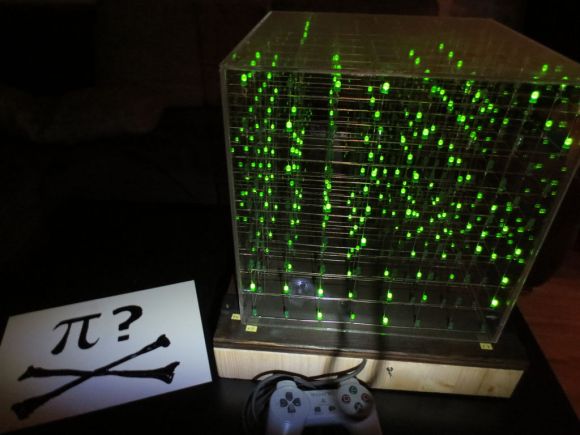
Believe it or not, [Anred Zynch] had no soldering skills before starting this project! What we’re looking at here is an 8x8x8 LED cube set up as a Space Invaders style game with a Playstation 1 controller.

He was inspired by several other cubes like [Chr’s], and the Borg cube by [Das-Labour]. The project makes use of an Arduino Mega 2560 R3 to drive the 512-LED array, and an Arduino Uno to take care of the sound effects during game play. It’s kind of like Space Invaders — but in 3D!

Complexity of building and wiring it aside, [Anred] has provided great instructions and the code for the entire project, so if you’re looking to recreate it or something like it, you can! It’s also entered in an Instructable’s contest right now, so if you like it, we’re sure he’d appreciate the votes.

Continue reading “8X8X8 Cube Invaders”

Two-Wheel Balancing Robot Revived From The Dead

Capture

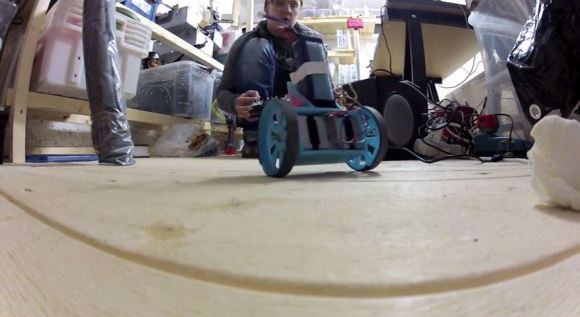
[Jouni] built a pretty nice little two-wheeled robot a while back — but he never got it working quite right. Taking inspiration and a bit of opensource code from another hacker featured here, he’s finished the bot, and it works great!

After seeing [Jose’s] 3D printed Air Hockey bot, he poked around the creator’s blog and discovered the B-Robot, a 3D printed, two-wheeled, stepper driven, balancing robot. As it turned out, it was incredibly similar to a robot [Jouni] had made himself previously!

[Jouni’s] robot features two NEMA-17 steppers, a 12v 2200mAh battery pack, an Arduino Pro Mini, a MPU6050 gyro and a FrSky receiver. Lucky for him, [Jose’s] B-Robot made use of the same steppers and gyro! Using some of [Jose’s] code from his GitHub, [Jouni] was able to bring new life into his little robot!

We’ve included videos of both the original project, and [Jouni’s] version. Aren’t opensource projects awesome?

Continue reading “Two-Wheel Balancing Robot Revived From The Dead”