39 Raspberry Pi 3D Scanner

[Richard] just posted an Instructable on his ridiculously cool 39 Pi 3D Scanner! That’s right. 39 individual Raspberry Pies with camera modules.

But why? Well, [Richard] loves 3D printing, Arduinos, Raspberry pies, and his kids. He wanted to make some 3D models of his kids (because pictures are so last century), so he started looking into 3D scanners. Unfortunately almost all designs he found require the subject to sit still for a while — something his 2-year old is not a fan of. So he started pondering a way to take all the pictures in one go, to give him the ability to generate 3D models on the fly — without the wait. 

He originally looked at buying 39 cheap digital cameras, but didn’t want to have all the images on separate SD cards, as it would be rather tedious to extract all the images. Using the Raspberries on the other hand, he can grab them all off a network. So he set off to build a very awesome (and somewhat expensive) life-size 3D scanning booth. Full details are available on his blog at www.pi3dscan.com

Stick around after the break to see it in action at Maker Faire Groningen 2013!
Continue reading “39 Raspberry Pi 3D Scanner”

A Simple Servo Hack For An Iron Man Helmet

iron man helmet

[James] makes some seriously awesome Iron Man props. In one of his latest helmet builds, he came across a handy hack to lock the faceplate servo in place.

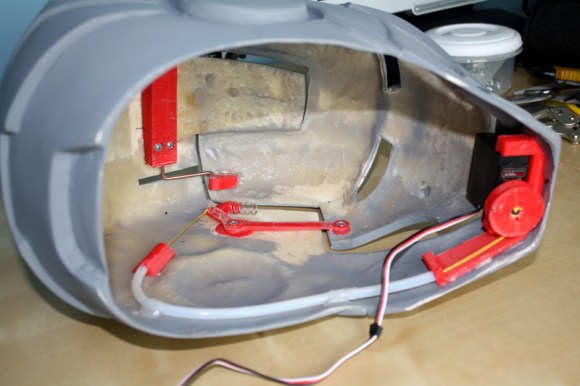
You see, as awesome as it is walking around like Iron Man all day, you’re going to want to keep your faceplate up for extended periods of time. Simply holding the servo in place electronically is a waste of power, and results in the annoying sound of a servo under strain. On the other hand, cutting power to it will keep it in place momentarily — but it will also start to close under the force of gravity.

The solution is actually quite simple, by reprogramming the Picaxe-08M microcontroller, the board now shorts the motor terminals to hold it in place. This is called magnetic motor braking, and it works by creating a closed loop that makes it much harder to induce a current under load. We once added this feature to a motorized push-scooter — it’d stop on a dime, although you wouldn’t…

Stick around after the break to see an extremely in depth video on how he setup the entire system.

Continue reading “A Simple Servo Hack For An Iron Man Helmet”

Wireless Keurig Hack!

coffeemaker

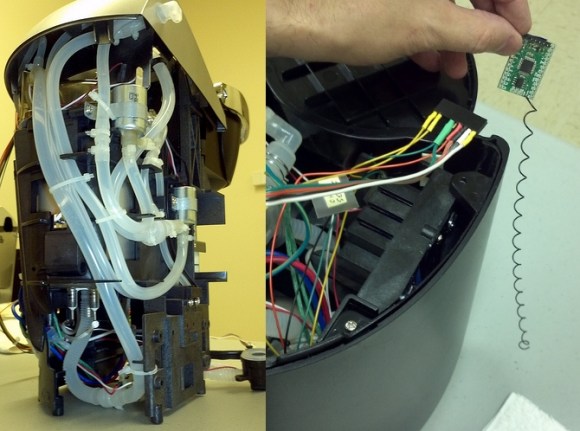
[Kolumkilli] loves his Keurig coffee maker, as it makes him an excellent cup of coffee, but he doesn’t like waiting for it to brew. So he set out to make it wirelessly controlled via his computer… with the press of a button, he can have his coffee ready and waiting for him when he gets up.

After carefully dismantling his Keurig, he set to locating the main buttons on the PCB, and proceeded to wire in relays in parallel to the ones he wanted to control. Throw in a Moteino and add the notification LEDs as inputs as well and now he can control and monitor almost all the coffee maker’s functions via a web browser at his desk. Now if only he could remember to put a new coffee cup in…

There’s a great writeup on the forum post, so if you want to see a more detailed build log, check it out! And if you’re looking to add even more functionality to your Keurig, why not run a waterline to it?

[Thanks Felix!]

HackPrinceton: Piano Stairs!

princeton piano

It was Hack.Princeton this weekend and [Bonnie] and [Erica] threw together this great interactive portable piano!

The setup is very simple using six LED flashlights, and six photoresistors. An Arduino Uno reads in the values from the photoresistors and parses them to a nearby Raspberry Pi which then creates the sounds. The system even automatically calibrates itself when turned on, adjusting to the ambient light conditions. They made the project for the Hackathon and after a short scare of having to move it to another staircase for the demo, they took home 2nd place in the hardware category!

Stick around after the break to see it in action — this would make a great school project to get kids interested in hacking!

Continue reading “HackPrinceton: Piano Stairs!”

DIY CNC Rotary 4th Axis

Here’s a great CNC hack that adds a ton of functionality, a DIY rotary 4th axis!

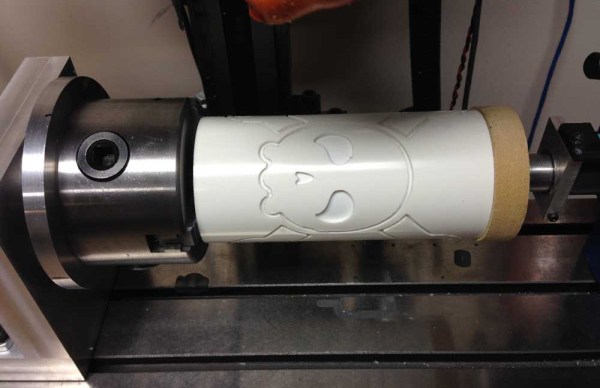
[Jim] had started this project over a year ago when he originally ordered the gearhead off eBay, but like many good intentions, sometimes projects just get pushed to the back burner until necessity forces action. That necessity was entering our Trinket Contest, and he decided to finish it off just so he could put a HaD logo on a piece of PVC for us!

Unfortunately it took him a bit too long, and he only finished it last week — but luckily he had a fallback plan, and submitted his CNC Etch a Sketch project instead, which won him a Trinket anyway!

The 4th axis uses a 276oz-in stepper motor which is directly coupled to a Harmonic Drive Systems 11:1 planetary gearhead. It’s extremely accurate, has minimal backlash, and by using a 10 microstepping Gecko stepper drive, [Jim] is getting about 61 steps per degree of rotation. Not bad for a home-made setup!

Check out his blog for a great write up on the project, and stick around after the break to see the 4th axis in action.

Continue reading “DIY CNC Rotary 4th Axis”

Robotic Sloth Haunts Your Dreams

robotic sloth

Have you ever seen a wet sloth? They’re pretty scary. If that’s not bad enough, how do you feel about a robotic one?

Named the X-4 “Sloth”, this is one of [222Doc’s] hardest projects to date — a highly experimental quadra-ped that can climb up and across ladders. It makes use of a Lego Mindstorms NXT controller, 8 servo motors for the joints, 4 Power Function Motors for the hands, and a whole lot of Lego. Due to the number of motors, he also had to multiplex the Power Function servos to make it all work!

Sure, it’s Lego, but it was far from an easy project, as [222Doc] estimates he spent well over a hundred hours on it, and it still isn’t complete. He says he’ll never say to himself “this will be easy…” ever again.

Stick around after the break to see it scale this ladder — we wish they sped up the video though, it appears the movement speed is modeled after a real sloth…

Continue reading “Robotic Sloth Haunts Your Dreams”

RFID Door Access Robot

RFID Door orbot

We love hackerspaces. Some of the most innovative solutions come from them thanks to having like-minded people all hanging out in the same place. Just take a look at this awesome RFID door system from the Lansing Makers Network that doesn’t require any modification of the door.

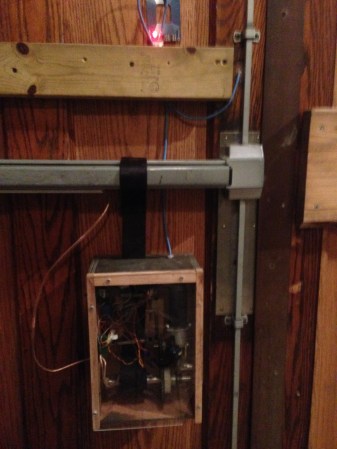
The majority of the mechanism was previously a model draw bridge that the space purchased from a surplus store — it just needed a bit of hacking. Almost all members of the space had some part in the project, whenever the build hit a snag, another member always had the right solution. It works by using a windshield motor that tightens a seatbelt around the push-bar latch of the door — the beauty of the system is it is completely non-damaging to the door, and the door works exactly the same as before. The whole system is controlled by RFID tags, which the members have as keys to the space.

It’s an awesome project and [Brian] has written a really great write-up on it, which also happens to segue nicely into the topic of hackerspaces. He describes hackerspaces as

the Wikipedia of real life, and everything else here [tools, equipment, resources] is just the lure that pulls us all together.

Stick around after the break to see the mechanism in action!

Continue reading “RFID Door Access Robot”