Printing A Replacement Case For The ThinkPad 701c

Even among ThinkPads, which are nearly universally loved by hardware hackers and Linux tinkerers alike, the 701c is a particularly rare and desirable machine. Best known for it’s “butterfly” slide out keyboard, the IBM-designed subnotebook from the mid-1990s has gained a following all its own, with active efforts to repair and restore any surviving specimens still out in the wild.

[polymatt] has already taken on a number of 701c restoration projects, but the recent release of a 3D printable case for the vintage laptop is arguably the most impressive to date. After spending an untold number of hours with an original case and a pair of calipers, the final design has been released under the Creative Commons Attribution-NonCommercial license — in other words, you’re free to print one to spruce up your 701c, but don’t run off a stack of them and start trying to move them on Etsy.

Continue reading “Printing A Replacement Case For The ThinkPad 701c”

Printed Case Lets Pair Of RTL-SDRs Go Mobile

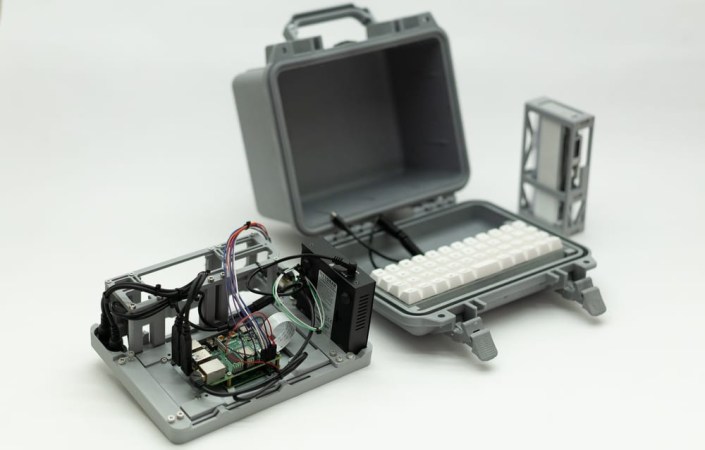
We’ll admit to not fully knowing what [Jay Doscher] has planned for the pair of RTL-SDR Blog V4 software defined radios (SDRs) that are enclosed in the slick 3D printed enclosure he’s designed. But when has that ever stopped us from appreciating a nice design when we see one?

Inside the ventilated enclosure is the aforementioned pair of RTL-SDR Blog V4 (SDRs), as well as a StarTech USB hub that they’re plugged directly into. It seems like it wouldn’t take much to adapt this design to any other pair of USB gadgets, such as flash drives or WiFi adapters.

In fact, if they’re smaller than the RTL-SDR [Jay] has used here, you could probably get away with only needing to modify the one side panel of the case.

The simple modularity of the design, with two end pieces and the top and bottom plates, makes such modifications easy as you don’t need to reprint the whole thing if you just want a different antenna aperture. It also makes it easy to print without support material, and with just a few tweaks, looks like it could be adapted to use laser-cut panels for the sides. This would not only be faster than printing, but depending on the material, could make for a very stout enclosure.

We’ve covered several designs from [Jay] over the years, including a number of heavy-duty mobile “doomsday” computers that certainly fit in with this same design aesthetic. After all, why not face the end of the world with a little style?

Rotary Phone Lives On As Arduino Kitchen Timer

It’s safe to say that few people still use rotary phones on a daily basis. Hell, most of us don’t even use landline telephones anymore. But just because these classic phones are no longer being used for their original purpose doesn’t necessarily mean they’re doomed to become e-waste.

[Scott-28] recently sent in a particularly well-documented project that turned an antique rotary phone into a digital kitchen timer using an internal Arduino. While we’re not sure practical is a word most folks would use to describe the resulting device, it’s certainly a conversation starter, and the details on how it was all implemented make for an interesting read.

As explained in the README, [Scott-28] first used an oscilloscope to figure out the pulses generated by the phone’s dial. From there, it was relatively easy to connect the dial to one of the pins on an Arduino Uno to determine which numbers the user had entered. The trickier part was getting the original bells to work — in North America, it takes up to 90 VAC to get a phone’s ringer going, which is quite a bit more than the lowly Arduino can handle.

Continue reading “Rotary Phone Lives On As Arduino Kitchen Timer”

Feast Your Eyes On These AI-Generated Sounds

The radio hackers in the audience will be familiar with a spectrogram display, but for the uninitiated, it’s basically a visual representation of how a range of frequencies are changing with time. Usually such a display is used to identify a clear transmission in a sea of noise, but with the right software, it’s possible to generate a signal that shows up as text or an image when viewed as a spectrogram. Musicians even occasionally use the technique to hide images in their songs. Unfortunately, the audio side of such a trick generally sounds like gibberish to human ears.

Or at least, it used to. Students from the University of Michigan have found a way to use diffusion models to not only create a spectrogram image for a given prompt, but to do it with audio that actually makes sense given what the image shows. So for example if you asked for a spectrogram of a race car, you might get an audio track that sounds like a revving engine.

Continue reading “Feast Your Eyes On These AI-Generated Sounds”

Adafruit Badges Turned Electronic Invitations

Despite what you might have heard, even the most devout Hackaday readers may eventually find themselves getting married. Should you ever find yourself in a situation where you need to send out invitations for your big day, or any other major celebration for that matter, you could do worse than follow the example [Mokas] and their partner set with these memorable electronic wedding invitations.

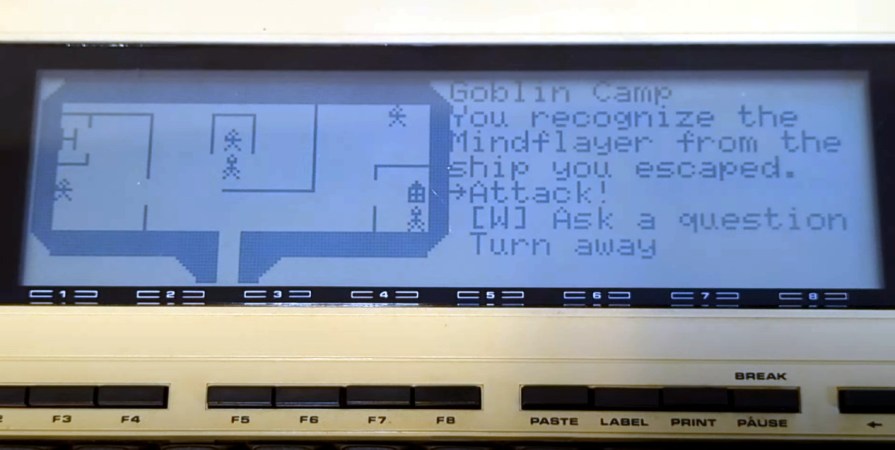
Inspired by the electronic badges distributed at hacker cons, [Mokas] decided to use Adafruit’ EdgeBadge and PyBadge devices to create a similar interactive keepsake that would be a bit more exciting than a piece of paper. While it would have been enough to have the wedding information pop up on the screen when they were turned on, the final invites actually boot into a retro-style game where you walk around talking to characters to uncover information about the event and the venue.

The game was created in Microsoft MakeCode Arcade, with a sprinkling of original and commissioned sprites. Early versions of the game ended up being a bit much for the Adafruit badge’s to handle, but after doing a bit of research on creating games for computationally-constrained platforms, [Mokas] was able to optimize the performance. For those that didn’t get a physical invite (no doubt ours was simply lost in the mail), you can play the whole thing right in your browser.

It’s a very clever idea, and while using custom hardware would have allowed for a more bespoke package, we can’t blame [Mokas] for wanting to keep this one simple. Getting everything ready for your wedding is already enough stress — it’s hardly the time to spin up a new board.

For a similar reasons, another Adafruit offering was selected to power the couple’s e-ink baby development display.

Supercon 2023: Exploring The Elegance Of The Voja4

When you design an electronic badge, the goal is to make a device that’s interesting and has enough depth to keep your attendees engaged for the duration of the con but not so complicated that they can’t become proficient with it before they have to head home. It’s a difficult balance to nail down, and truth be told, not every Supercon badge has stuck the landing in this regard.

But if you’ve really done things right, you’ll create a piece of hardware that manages to outlive the event it was designed for. A badge that attendees continue to explore for months, and potentially even years, afterward. If the talk “Inside the Voja4” by Nathan Jones is any indication, we think it’s safe to say that goal was achieved with the Supercon 2022 badge.

During this forty-minute presentation, Nathan discusses what makes the 4-bit badge so fascinating from a technical standpoint and how it could theoretically be expanded to accomplish far more complex tasks than one might assume at first glance.

Continue reading “Supercon 2023: Exploring The Elegance Of The Voja4”

This WiFi Filament Sensor Is Unnecessary, But Awesome

As desktop 3D printers have inched towards something resembling the mainstream, manufacturers have upped their game across the board. Even the quality of filament that you can get today is far better than what was on the market in the olden days, back when a printer made out of laser-cut birch wasn’t an uncommon sight at the local makerspace. Now, even the cheap rolls are wound fairly well and are of a consistent diameter. For most folks, you just need to pick a well-reviewed brand, buy a roll, and get printing.

But as with everything else, there are exceptions. Some people are producing their own filaments, or want to make sure their extrusion rate is perfectly calibrated. For those that need the capability, the WInFiDEL from [Sasa Karanovic] can detect filament diameter in real-time while keeping the cost and complexity as low as possible. Even better, with both the hardware and software released as open source, it makes an excellent starting point for further development and customization.

Continue reading “This WiFi Filament Sensor Is Unnecessary, But Awesome”