Your Childhood Inventions Brought To Life

If you are the kind of person who reads Hackaday, you probably spent time in school doodling little design day dreams. [Allen Pan] gets it, and he’s taken it upon himself to make some of those daydreams into reality. You can see how it worked out — or didn’t — in the video below.

The video starts out with suction cup boots for walking on the ceiling, a laser sword made with a mirror, a plunger gun, and lawnmower boots. Some of these were more successful than others.

Continue reading “Your Childhood Inventions Brought To Life”

FNIRSI Vs Rigol: An Alternate View

We’ve heard of the FNIRSI 1014D scope, but we’ve had the impression that it might not be a great scope, although it is economical. [Learn Electronics Repair] had heard from another YouTuber that it was “a piece of junk.” However, he wanted to look at it compared to another inexpensive scope, the Rigol DS1052E. His results were different from what we usually hear. To be clear, he didn’t think it was a perfect scope, but he did find it very usable for his purpose.

The 46-minute-long video does more than just a casual look. He uses both scopes in some real-world measurements. If you are in the market for a scope in this price range, it is worth the time to watch.

Continue reading “FNIRSI Vs Rigol: An Alternate View”

Linux Fu: C On Jupyter

If you are a Pythonista or a data scientist, you’ve probably used Jupyter. If you haven’t, it is an interesting way to work with Python by placing it in a Markdown document in a web browser. Part spreadsheet, part web page, part Python program, you create notebooks that can contain data, programs, graphics, and widgets. You can run it locally and attach to it via a local port with a browser or, of course, run it in the cloud if you like. But you don’t have to use Python.

You can, however, use things with Jupyter other than Python with varying degrees of success. If you are brave enough, you can use C. And if you look at this list, you’ll see you can use things ranging from Javascript, APL, Fortran, Bash, Rust, Smalltalk, and even MicroPython.

Continue reading “Linux Fu: C On Jupyter”

OScope Advert From 1987 Rocks It

We can’t remember ever seeing a late-night TV ad for oscilloscopes before but, for some reason, Tektronix did produce a video ad in 1987. You can see it below and enjoy the glorious music and video production standards of the 1980s.

We assume this was made to show at some trade show or the like. Even if there was a Home Shopping Network in 1987, we doubt many of these would have been sold despite the assertion they were “low cost” — clearly a relative term in this case.

You’ve got to wonder if the narrator understood what he was saying or if he was just reading from a script. Pretty impressive either way. We loved these old scopes, although we also like having very capable scopes that don’t strain our backs to lift.

On the bright side, these scopes today are pretty affordable on the used market if you can find one that doesn’t need a repair with an exotic part. For example, we found several 2221s or 2221As for under $200 without looking hard. The shipping, of course, could potentially almost double the price.

While you can get a modern scope for $200, it probably isn’t the same quality as a Tektronix. Then again, the new scope won’t have CRTs and exotic Tektronix parts to wear out, either. Picking a scope is a pretty personal affair, though, so one person’s great scope might be another person’s piece of junk.

Continue reading “OScope Advert From 1987 Rocks It”

WordStar Reborn

Wordstar was the word processor that helped sell the personal computer. At one time, it was ubiquitous, and many authors had a hard time giving it up. Some, like George R. R. Martin, apparently are still refusing to give it up. But most of us have moved on. Thanks to an open-source clone, WordTsar, you may not have to. This is a modern interpretation of our old friend.

Programmers that write were especially fond of WordStar since it had a non-document mode and was often the best text editor you had available for writing code. Being able to do your documentation without switching brain gears is useful, too. Touch typists love the efficiency of easy control of things without resorting to cursor keys or a mouse — the same thing vi and emacs fans enjoy but in a different way.

The software runs on multiple platforms and has some new features. Installation on Linux is easy because it is packaged in an AppImage file. Of course, you can also fire up your best CP/M machine, replica, or emulation and run the real WordStar, but — honestly — WordTsar seems more practical if you wanted to go back to using this kind of wordprocessor or editor for everyday use.

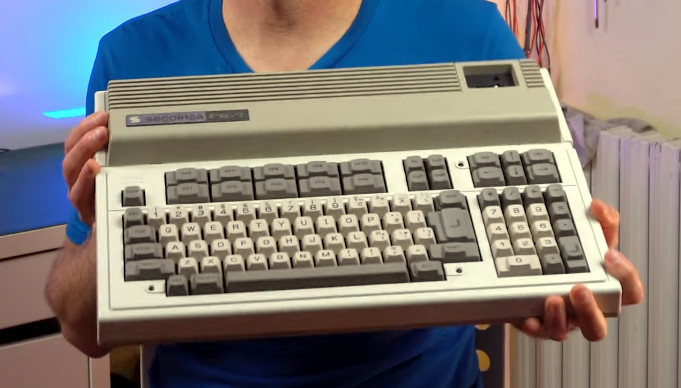
Of course, some word processors were actual hardware. If you want some cheap CP/M hardware, that’s easy enough, too.

Scorched Moon: Secret Project A119

In today’s world, it is hard to realize how frightened Americans were at the news of Sputnik orbiting the Earth. Part of it was a fear of what a rival nation could do if they could fly over your country with impunity. Part of it was simply fear generated by propaganda. While America won the race to the moon, that wasn’t clear in the 1950s. The Soviet Union was ahead in the ability to deliver bombs using planes and missiles. They launched Sputnik on a modified ICBM, while American attempts to do the same failed spectacularly. The Air Force wanted ideas about how to respond to Sputnik, and one of the most disturbing ones was project A119, a project we were reminded of recently by a BBC post.

In all fairness, the Soviets had an almost identical plan, code-named E4. Fortunately, both sides eventually realized these plans weren’t a good idea. Oh, did we forget to mention that A119 and E4 were plans to detonate a nuclear device on the moon?

Continue reading “Scorched Moon: Secret Project A119”

Retro Gadgets: I Swear Officer, I Was Listening To 45

Audio in cars has a long history. Car radios in the 1920s were bulky and expensive. In the 1930s, there was the Motorola radio. They were still expensive — a $540 car with a $130 radio — but much more compact and usable.  There were also 8-tracks, cassettes, CDs, and lately digital audio on storage media or streamed over the phone network. There were also record players. For a brief period between 1955 and 1961, you could get a car with a record player. As you might expect, though, they weren’t just any record players. After all, the first thing to break on a car from that era was the mechanical clock. Record players would need to be rugged to work and continue to work in a moving vehicle. As you might also expect, it didn’t work out very well.

It all started with Peter Goldmark, the head of CBS Laboratories. He knew a lot about record players and had been behind the LP — microgroove records that played for 22 minutes on a side at 33.3 RPM instead of 5 minutes on a side at 78 RPM. He knew that a car record player needed to be smaller and shock-resistant. Of course, in those days, it would have tubes, but that could hardly be helped.

The problem turned into one of size. A standard 10- or 12-inch disk is too big to easily fit in the car. A 45 RPM record would be more manageable, but who wants to change the record every three or four minutes while driving?

Continue reading “Retro Gadgets: I Swear Officer, I Was Listening To 45”