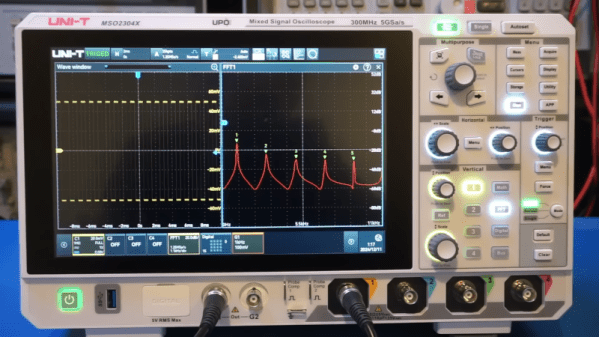
There aren’t many people who could do an hour-long video reviewing an oscilloscope, but [Kerry Wong] is definitely one of them. This time, he’s looking at a UNI-T MSO2304X 300 MHz scope. The review might be a little long, but the scope — like many modern scopes — has a lot of features for measuring power, accommodating digital signals with an add-on pod, and protocol decoding.
The scope has a touchscreen and four normal inputs, plus two frequency generator outputs. You can also use a mouse or an external display. But, of course, what you really want to know is how the scope performs when reading signals.
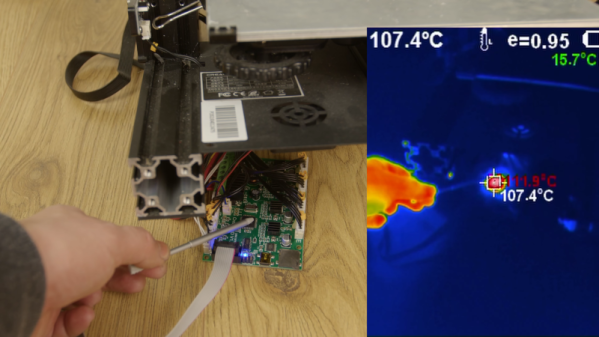
[Maker’s Fun Duck] has a recent video review of a cheap thermal camera from a company called Kaiweets, which you can see below. It checked all of his boxes: It was standalone, handheld, cheap, and not too cheap. The question is: does it work well for the kinds of things we would do with such a camera?
That’s a tricky question, of course, because everyone’s uses are different. Considering a soldering iron. A tiny one is great for working on PCBs, but lousy for soldering large coax connectors. A soldering gun works well for that purpose, but is too much for the PCB. The same goes for thermal cameras. Some are great for, for example, finding leaky parts of houses, but might not be so great at locating defective components on a PCB.
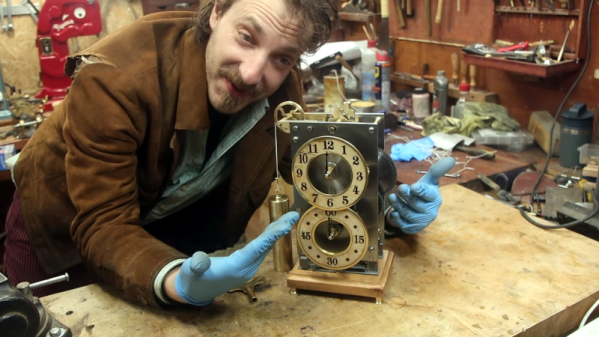
When you think of making something using a lathe, you usually think of turning a screw, a table leg, or a toothpick. [Uri Tuchman] had a different idea. He wanted to make a clock out of the gears used in the lathe. Can he do it? Of course, as you can see in the video below.
Along the way, he used several tools. A mill, a laser cutter, and a variety of hand tools all make appearances. There’s also plenty of CAD. Oh yeah, he uses a lathe, too.
Many things have combined to make very high-frequency RF gear much more common, cheaper, and better performing. Case in point: [dereksgc] is tearing apart a 20 GHz low-noise block (LNB). An LNB is a downconverter, and this one is used for some Irish satellite TV services.
The scale of everything matters when your wavelength is only 15 mm. The PCB is small and neatly laid out. There are two waveguides printed on the board, each feeding essentially identical parts of the PCB. Printed filters use little patterns on the board that have particular inductance and capacitance — no need for any components. Try doing that at 2 MHz!
The LNB is a single-band unit, so it only needs to worry about the two polarizations. However, [dereksgc] shows that some have multiple bands, which makes everything more complex. He also mentions that this LNB doesn’t use a PLL, and he’d like to find a replacement at this frequency that is a bit more modern.
After the teardown, it is time to test the device to see how it works. If you want to experiment at this frequency, you need special techniques. For example, we’ve seen people try to push solderless breadboards this high (spoiler: it isn’t easy). Maybe that’s why many people settle for modifying existing LNBs like this one.
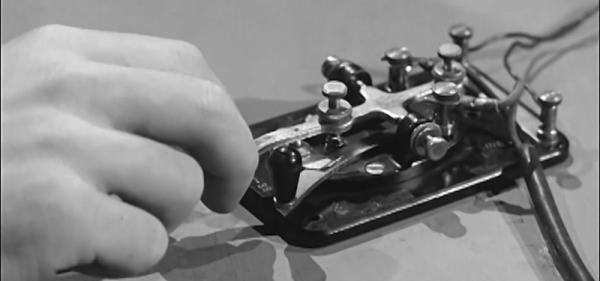
We talk about Morse code, named after its inventor, Samuel Morse. However, maybe we should call it Vail code after Alfred Vail, who may be its real inventor. Haven’t heard of him? You aren’t alone. Yet he was behind the first telegraph key and improved other parts of the fledgling telegraph system.
The story starts in 1837 when Vail visited his old school, New York University, and attended one of Morse’s early telegraph experiments. His family owned Speedwell Ironworks, and he was an experienced machinist. Sensing an opportunity, he arranged with Morse to take a 25% interest in the technology, and in return, Vail would produce the necessary devices at the Ironworks. Vail split his interest with his brother George.
By 1838, a two-mile cable carried a signal from the Speedwell Ironworks. Morse and Vail demonstrated the system to President Van Buren and members of Congress. In 1844, Congress awarded Morse $30,000 to build a line from Washington to Baltimore. That was the same year Morse sent the famous message “What Hath God Wrought?” Who received and responded to that message? Alfred Vail.
The Original Telegraph
Telegraphs were first proposed in the late 1700s, using 26 wires, one for each letter of the alphabet. Later improvements by Wheatstone and Cooke reduced the number of wires to five, but that still wasn’t very practical.
Samuel Morse, an artist by trade, was convinced he could reduce the number of wires to one. By 1832, he had a crude prototype using a homemade battery and a relatively weak Sturgeon electromagnet.
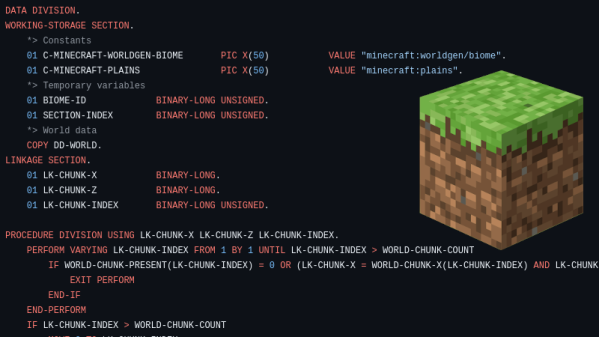
When you think of languages you might read about on Hackaday, COBOL probably isn’t one of them. The language is often considered mostly for business applications and legacy ones, at that. The thing is, there are a lot of legacy business applications out there, so there is still plenty of COBOL. Not only is it used, but it is still improved, too. So [Meyfa] wanted to set the record straight and created a Minecraft server called CobolCraft.
The system runs on GnuCOBOL and has only been tested on Linux. There are a few limitations, but nothing too serious. The most amazing thing? Apparently, [Meyfa] had no prior COBOL experience before starting this project!
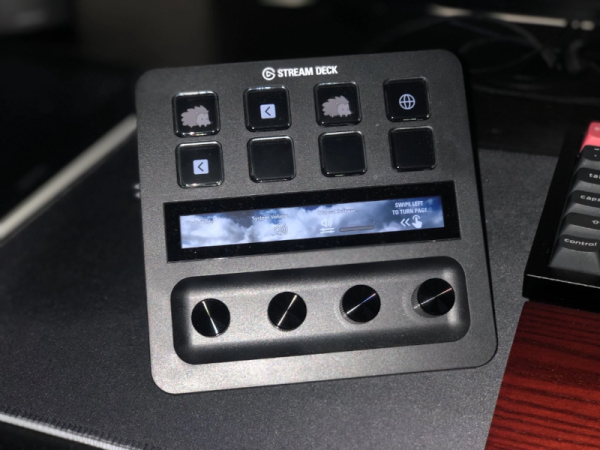
[Den Delimarsky] had a Stream Deck and wanted to be free of the proprietary software, so he reverse-engineered it. Now, he has a Stream Deck Plus, and with the same desire, he reverse-engineered it as well.
The device has eight buttons, a narrow screen, and four encoder dials. The device looks like a generic HID device to the host machine, and once it has been configured, doesn’t need any special software to function. By configuring the device using the official software in a virtual machine under the watchful eye of Wireshark, it was possible to figure out how that initial setup worked and recreate it using a different software stack.
If you’ve never done this kind of thing before, there is a lot of information about how to find USB data and draw inferences from it. The buttons send messages when pressed, of course. But they also accept a message that tells them what to display on their tiny screen. The device screen itself isn’t very big at 800×100.
[Den] packages everything up in the DeckSurf SDK, an open source project that lets you control Stream Decks. So if you just want to control the Deck, you don’t need to know all these details. But, for us, that’s where the fun is.