Exploring Soap Films

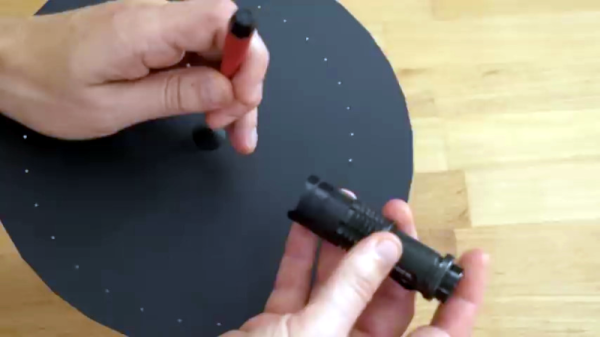
While fluid dynamics sounds like a dull topic, SoapFilmScope promises to make it fun by using your cell phone to observe the interactions between sound waves and liquid membranes. You can make your own with some PVC pipe, some 3D-printed attachments, a speaker, and a few other odds and ends.

If your PVC pipe doesn’t match [DaniloR29’s] exactly, no problem. The files are in OpenSCAD so you can easily change them to suit your needs. One end of the PVC tee dips into soap solution to form a film — think like a soap bubble before you blow it out of the bubble wand. The other ends have the speaker and the cell phone camera.

Continue reading “Exploring Soap Films”

Need A Tube? Reach For Plywood!

To be clear, when we are talking about tubes, we mean ordinary cylinders, not vacuum-amplifying elements. With that out of the way, when we need a tube like that, we usually think of PVC or some other kind of pipe product. Or maybe we’ll 3D print what we need. But not [GregO29]. He made his tubes from plywood.

You can make tubes as small as 12 inches in diameter, and [GregO29] made some that were 16 inches. The first step was to make a mold or form. In this case, he elected to make a form that the tube-to-be wraps around. The plywood is thin 2-ply white birch. This makes it easy to shape.

The basic idea is to wrap the wood around the form and glue it. You hold it together with a strap until it dries. Then, you can add more layers until it is the thickness you need.

The real problem turned out to be removing the form once it was done. Why make a tube like this? In [Greg]’s case, he’s building a telescope, which is as good a reason as any to have a tube, we suppose.

We build a lot of things, but we always forget about plywood. It even mixes well with electricity.

Making A Solid State 6AK8 Tube

[M Caldeira] had a project in mind: replacing a common vacuum tube with a solid-state equivalent. The tube in question was an EABC80 or 6AK8 triple diode triode. The key was identifying a high-voltage FET and building it, along with some other components, into a tube base to make a plug-in replacement for the tube. You can see a video about the project below.

These tubes are often used as a detector and preamplifier. Removing the detector tube from a working radio, of course, kills the audio. Replacing the tube with a single diode restores the operation of the radio, although at a disadvantage.

From there, he adds more diodes directly into the socket. Of course, diodes don’t amplify, so he had to break out a LND150 MOSFET with a limit of 500 volts across the device. It takes some additional components, and the whole thing fits in a tube base ready for the socket.

Usually, we see people go the other way using tubes instead of transistors in, say, a computer. If you want real hacking, why not make your own tubes?

Continue reading “Making A Solid State 6AK8 Tube”

An AVO 8 Teardown

AVO meters — literally amp, volt, ohm meters — are not very common in North America but were staples in the UK. [TheHWcave] found an AVO 8 that is probably from the 1950s or 1960s and wanted to get it working. You can see the project in the video below.

These are very different from the standard analog meters many of us grew up with. [TheHWcave] shows how the dual range knobs work together to set the measurement. There are three separate ohm settings, and each one has its own zero pot. We were surprised that the meter didn’t have a parallax-correcting mirror.

Other than dirty switch contacts, the voltage measurements still worked. After cleaning the contacts, most of the ranges worked well, although there were still some issues. Some of the resistor ranges were not working, either. Inside the case were an old D cell and a square battery, a B121 15 V battery. Replacing the 15 V battery with a bench supply made things better.

Some plugins are available to allow the meter to read low resistance or high currents. We thought using the soldering gun as a current source was clever. Once he gets it working, he opens the box around the 14:30 mark.

The inside was all hand-wiring and power resistors. Of course, there are also a ton of contacts for the switches. So it isn’t just an electrical design, but a mechanical one, too. The electrical design is also interesting, and an analysis of it winds the video down.

[Jenny List] has a soft spot for these meters, too. Why use an old meter? If you have to ask…

Continue reading “An AVO 8 Teardown”

Ask Hackaday: Should We Teach BASIC?

Suppose you decide you want to become a novelist. You enroll in the Hackaday Famous Novelists School where your instructor announces that since all truly great novels are written in Russian, our first task will be to learn Russian. You’d probably get up and leave. The truth is, what makes a great (or bad) novel transcends any particular language, and you could make the same argument for programming languages.

Despite the pundits, understanding the basics of how computers work is more important than knowing C, Java, or the language of the week. A recent post by [lackofimagination] proposes that we should teach programming using BASIC. And not a modern whizz-pow BASIC, but old-fashioned regular BASIC as we might have used it in the 1980s.

Certainly, a whole generation of programmers cut their teeth on BASIC. On the other hand, the programming world has changed a lot since then. While you can sort of apply functional and object-oriented techniques to any programming language, it isn’t simple and the details often get in the way of the core ideas.

Still, some things don’t change. The idea of variables, program flow, loops, and arrays all have some parallel in just about anything, so we can see some advantages to starting out simply. After all, you don’t learn to drive by trying it out in the Indy 500, right?

What do you think? If you were teaching programming today, would you start with BASIC? Or with something else? You can modernize a little bit with QB64. Or try EndBasic which just recently had a new release.

All About PNP Transistors

In the early days, PNP bipolar transistors were common, but the bulk of circuits you see today use NPN transistors. As [Aaron Danner] points out, many people think PNP transistors are “backward” but they have an important role to play in many circuits. He explains it all in a recent video you can see below.

He does explain why PNP transistors don’t perform as well as corresponding NPN transistors, but they are still necessary sometimes. Once you get used to it, they are no problem to handle at all. Common cases where you want a PNP are, for example, when you want to switch a voltage instead of a ground. There are also certain amplifier configurations that need PNP units.

Like an NPN transistor, a PNP can operate in saturation, linear operation, reverse active, or it can be cut off. [Aaron] shows you how to bias a transistor and you’ll see it isn’t much different from an NPN except the base-emitter diode junction is reversed.

As you might expect, current has to flow through that diode junction to turn the transistor on. The arrow points in the direction of the diode junction. If you want a refresher on transistor biasing, we got you. Sure, you don’t need to do it every day now, but it still is a useful skill to have.

Continue reading “All About PNP Transistors”

Working Through The Art Of Electronics Exercises

[The Engineering Experience] has an ambitious series of videos. He’s working through circuit examples from the awesome book “The Art of Electronics.” In the latest installment, he’s looking at a pulse generator that uses bipolar transistors. So far, there are 43 videos covering different exercises.

If you’ve read the book — and you should — you know the examples and exercises sometimes have little explanation. Honestly, that’s good. You should try to work through them yourself first. But once you have an idea of how it works, hearing someone give their take on it may help you out. In fact, even if you don’t have the book, we’d suggest pausing the video and looking at the circuit to see what you can figure out before playing the explanation. You’ll learn more that way.

Admittedly, some of the early videos will be cakewalks for Hackaday readers. The first few, for example, walk through parallel and series resistors. However, if you are starting out or just want a refresher, you can probably enjoy all of them. The later ones get a bit more challenging.

If you want to double-check your work, you can simulate the circuit, too. Our simulation got 4.79 V and he computed 4.8, which is certainly close enough.

We do love “The Art of Electronics.” The book’s author also enjoys listening for aliens.

Continue reading “Working Through The Art Of Electronics Exercises”