Electro Luminescent Fun With Jeri Ellsworth

[youtube=http://www.youtube.com/watch?v=ZuDZnJX5kqw]

[Jeri] got her hands on some of the DuPont Luxprint EL ink and had some fun conducting experiments. She tried different materials for the base and the display itself.  Not only does she just play with materials, she also tears apart a VFD and an LCD to see if she could use them for parts. The LCD turned out to be the most successful. We saw this stuff show up at the Bay Area Maker Faire and we’re excited to see it become more accessible.

[via Makezine]

Jeri Makes Integrated Circuits

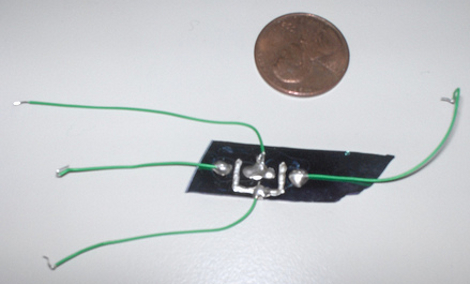
[Jeri Ellsworth] made this silicon inverter at home, by hand. It took her two years to get the process figured out and achieve something we didn’t think was possible. The complexity of manufacture, and the wide range of tools and materials needed seem insurmountable but she did it anyway. Her home chip fab Flickr set is well commented and details her work area and part of the processing. If you’re hurting for more check out her 40 minute Metalab talk which we’ve embedded after the break.

If her name sounds familiar but you just can’t place it you may know her from The Fatman and Circuit Girl. We’ve also featured some of her hacks, such as her Pinball challenge against [Ben Heckendorn], and her giant Etch-a-Sketch.

Continue reading “Jeri Makes Integrated Circuits”

Making A CRT Spin Right Round, Round, Round

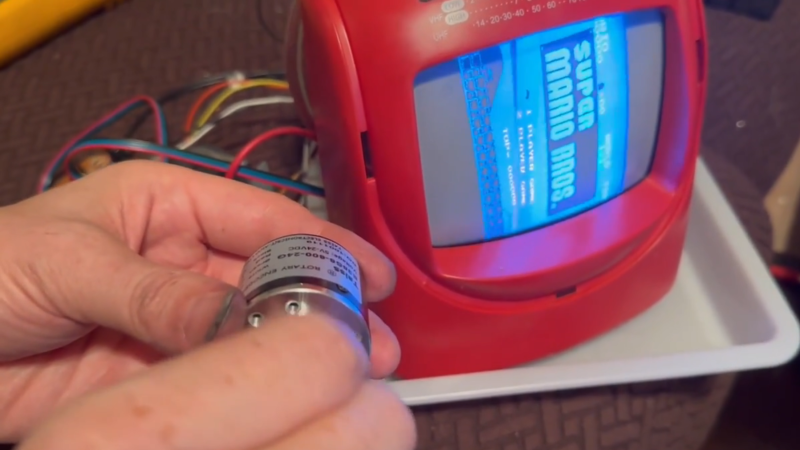
If you’ve got a decent CRT monitor, you can usually adjust the settings to make sure the image scans nicely across the whole display. But what if you could rotate the whole image itself? [Jeri Ellsworth] has shown us how to achieve this with an amusing mechanical hack.

The trick behind this is simple. On a standard CRT, the deflection yoke uses magnetic coils to steer the electron beam in the X and Y axes, spraying electrons at the phosphors as needed. To rotate the display as a whole, you could do some complicated maths and change how you drive the coils and steer the electron beams… or you could just rotate the entire yoke instead. [Jeri] achieves this by putting the whole deflection yoke on a custom slip ring assembly. This allows it to receive power and signal as it rotates around the neck of the tube, driven by a stepper motor. Continue reading “Making A CRT Spin Right Round, Round, Round”

A PLL For Perfect Pitch

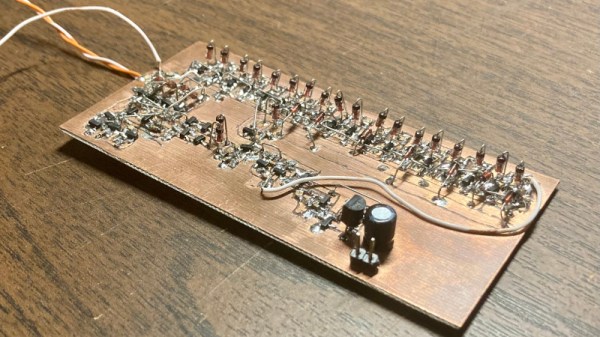
When Hackaday runs a contest, we see all manner of clever projects. But inevitably there are some we don’t see, because their builders didn’t manage to get them finished in time. [Park Frazer]’s phase-locked loop is one of them. The circuit is an all-discrete PLL that derives a 440 Hz output from a 1 Hz input, and it arrived just too late for our 1 Hz contest.

If you aren’t familiar with a phase-locked loop, in this context you can think of them as a programmable frequency multiplier. A voltage-controlled oscillator is locked to an input frequency by comparing the two with a phase detector. Multiplication can be achieved by putting a frequency divider between the oscillator and the phase detector. It’s at the same time a complex and easy to understand circuit. In this case, when broken down into a set of multivibrators, it makes sense. The charge pump phase detector is a little different from the XOR gate we were expecting, but as he explains, it’s better.

If PLLs are a mystery, have a look at this video from a [Jeri Ellsworth] and [Bil Herd].

Two pictures of the same black dog, wearing two separate pairs of the AR glasses reviewed in these two articles

A Master-Class On Reverse-Engineering Six AR Glasses

Augmented reality (AR) tech is getting more and more powerful, the glasses themselves are getting sleeker and prettier, and at some point, hackers have to conquer this frontier and extract as much as possible. [Void Computing] is writing an open source SDK for making use of AR glasses, and, along the way, they’ve brought us two wonderful blog posts filled with technical information laid out in a fun to read way. The first article is titled “AR glasses USB protocols: the Good, the Bad and the Ugly”, and the second one follows as “the Worse, the Better and the Prettier”.
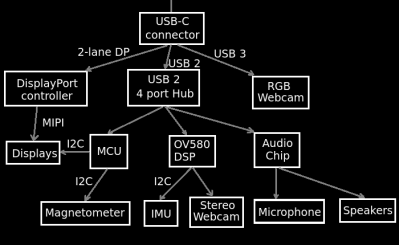
Have you ever wanted to learn how AR glasses and similar devices work, what’s their internal structure, which ones are designed well and which ones maybe not so much? These two posts have concise explanations, more than plenty of diagrams, six case studies of different pairs of AR glasses on the market, each pair demonstrated by our hacker’s canine assistant.

[Void Computing] goes in-depth on this tech — you will witness MCU firmware reverse-engineering, HID packet captures, a quick refresher on the USB-C DisplayPort altmode, hexdumps aplenty, and a reminder on often forgotten tools of the trade like Cunningham’s law.

If reverse-engineering lights your fire, these high-level retrospectives will teach you viable ways to reverse-engineer devices in your own life, and they certainly set a high bar for posts as far as write-ups go. Having read through these posts, one can’t help but think that some sort of AR glasses protocol standard is called for here, but fortunately, it appears like [Void Computing]’s SDK is the next best thing, and their mission to seize the good aspects of a tentative cyberpunk future is looking to be a success. We’ve started talking about AR glasses over a decade ago, and it’s reassuring to see hackers catching up on this technology’s advancements.

We thank [adistuder] for sharing this with us on the Hackaday Discord server!

The Taylor and Amy Show

The Avon Computer Goth Challenge

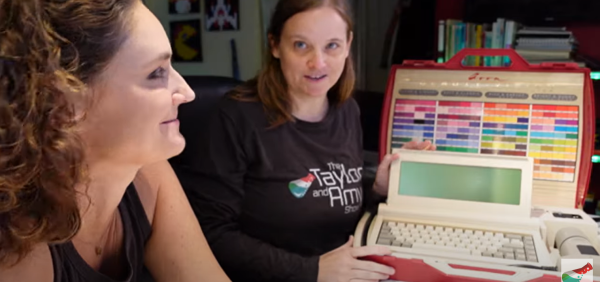
Hot off the heels of their musical debut 6502 song the good folk at the Taylor and Amy Show are at it again. This time instead of assaulting our auditory senses, they play with our perception of color all while keeping the spirit of retro computing alive.

To back up a bit, I had the pleasure of witnessing the discovery of the Avon Beauty Vision Computer while at the Vintage Computer Festival Mid-West (VCFMW) this past September. We had visited the home of our friend [Jim W] from VCFMW who nonchalantly pulled down from the shelf the reddest computer I have ever seen.

A crowd quickly gathered at this newfound treat, designed and built before the invention of the Blue LED, was fallen upon and the process of prying out its secrets began. I was not privy to the negotiations, but I did notice a brightly colored red suitcase being exfiltrated by highly trained operatives later that night.

Continue reading “The Avon Computer Goth Challenge”

Celebrating The 6502 With Song

In a wonderful ode to tech nostalgia, The Taylor and Amy Show, comprised of YouTubers [Taylor] and [Amy], have released a new video “THE 6502 SONG”. This song had me singing along in roughly six clock cycles, possibly a little dancing around may have occurred as well. This isn’t just any chip they’re singing about; it’s the venerable 6502 microprocessor, the silicon heart behind iconic machines like the Apple II, Commodore 64/128, and the Atari 2600.

Their lyrics reminds me of when I lived for assembly language mnemonics and counting clock cycles, the “feeling” of a processor coming out of tristate to pronounce what it had learned in the last 500ns, and the undulations of the DRAMs like speed bumps. To top it off, portions of the song were actually recorded live at the Vintage Computer Festival Midwest 2023, where fans and computing history aficionados alike were treated to an impressive display of vintage tech.

What sets “THE 6502 SONG” apart isn’t just its catchy, melodic tune; it’s the expert blend of historical detail and genuine enthusiasm that resonates with everyone from grizzled assembly-language programmers to youngsters newly fascinated by the allure of 8-bit computing. With guest appearances from other female tech YouTubers like [Veronica Explains] and [Evie’s Revue], [AJ], [Jeri and Amy- Tilt5] and [FuzzyBad].

I believe [Chuck Peddle] father of the 6502, would be proud to see his creation live on and be appreciated so.

Continue reading “Celebrating The 6502 With Song”