Custom Electronics And LED Panels Brighten Up A Nightclub

ledPanels

When [Robert] is presented with a challenge, he doesn’t back down. His friend dreamed of reusing some old LED panels by mounting them to the ceiling of the friend’s night club. Each panel consists of a grid of five by five red, green, and blue LEDs for a total of 75 LEDs per panel. It sounded like a relatively simple task but there were a few caveats. First, the controller box that came with the panels could only handle 16 panels and the friend wanted to control 24 of them. Second, the only input device for the controller was an infrared remote. The friend wanted an easy way for DJ’s to control the color of the panels and the infrared remote was not going to cut it. Oh yea, he also gave [Robert] just three weeks to make this happen.

[Robert] started out by building a circuit that could be duplicated to control each panel. The brain of this circuit is an ATtiny2313. For communication between panels, [Robert] chose to go with the DMX protocol. This was a good choice considering DMX is commonly used to control stage lighting effects. The SN75176 IC was chosen to handle this communication. In his haste to get this PCB manufactured [Robert] failed to realize that the LED panels were designed common cathode, as opposed to his 25 shiny new PCB’s which were designed to work with a common anode design. To remedy this, he switched out all of the n-channel MOSFET with p-channel MOSFET. He also spent a couple of hours manually cutting through traces and rewiring the board. After all of this, he discovered yet another problem. The LED’s were being powered from the same 5V source as the microcontroller. This lead to power supply issues resulting in the ATtiny constantly resetting. The solution was to add some capacitors.

Click past the break for more on [Robert’s] LED panels.

Continue reading “Custom Electronics And LED Panels Brighten Up A Nightclub”

PirateBox, For All Your Wireless Dead Drop Needs

piratebox

Here’s an interesting idea: get a router, Android device, or Raspberry Pi, put it on its own wireless network, and allow anyone to upload and download files. That’s a PirateBox, a small node in the web of digital culture and also a really great way to distribute files at a LAN party.

We’ve seen these type of things before, but now, thanks to [David] and [Matthias], and a bunch of other people, there’s now an easy way to turn a Raspi, Android, or anything that runs OpenWrt into a wireless dead drop. Also included in the software is an image board (think chan) a chat room, UPnP media server, and a browser-based file sharing system. Want to share a “linux distro”? Just upload it to the box over WiFi and it’s available to anyone in range.

Installers are available for devices you probably have sitting around in a junk drawer. Great for that Pi you’re trying to find a use for, and figuring out how to run one of these completely off the grid is an interesting challenge, to boot.


[Furze] Sets Fire To Everything With Pyro Gloves

Pyro Build

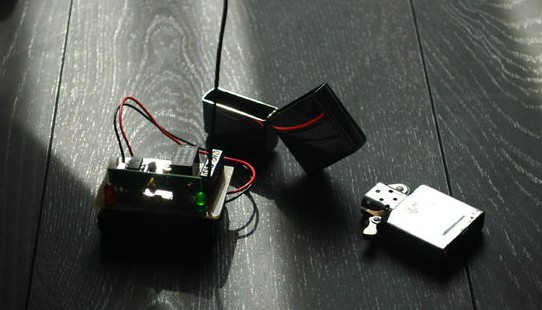
Crazyman [Colin Furze] is back, and this time he’s setting everything on fire with his Pyro gloves. Though Hackaday readers are already a discerning bunch, this is a build we get submissions for all the time and feature fairly often. It would take an exceedingly impressive build to outshine the other fire hazards. But, as with his pneumatic Wolverine claws and his electromagnetic boots, [Furze] knows how to build the insane and then put on a good show.

The Pyro build is part of [Furze’s] 3-part celebratory X-Men extravaganza, a nod to the realm of superheroes coinciding with the release of the new X-Men film. [Furze] began with a custom reservoir cylinder that fitted with two solenoid valves: one for a pilot light and another for the big blasts. He’s also affixed a Piezo element and a AA battery, which sits in a cozy little container. The bulkier bits of the assembly sit in a backpack, hooking up, as expected, to the wrist-mounted devices. This flame cannon, however, is unique among the ones we’ve encountered here.

Continue reading “[Furze] Sets Fire To Everything With Pyro Gloves”

Analog Shield And PCB Quadcopter

[youtube=https://www.youtube.com/watch?v=gXW76ESIv6k&w=580]


We spent a little bit of time at the TI booth at Maker Faire to film a pair of interviews. The first is with [Bill Esposito] who is grinding away on his PhD. at Stanford. He’s showing off an Analog Shield for Arduino. He describes it as “an attempt to bring the analog bench to an Arduino shield”. We think this is a fantastic idea as most who are learning digital electronics through Arduino have little or no experience with analog circuitry. This is a nice gateway drug for the concepts.

The analog shield has a supply good for +/- 7.5 volts, 4-channel ADC, 4-channel DAC, and gets 100k samples at 16-bits. He showed us a spectrum analyzer using Fast Fourier Transform on the incoming signal from a microphone. He also built a function generator around the shield. And finally a synthesizer which plays MIDI files.

In the second half of the video we take a look at [Trey German’s] work on a PCB-based quadcopter. His goal is to reduce the power consumption which will equate to longer flying times. To this end he chose the DRV8312 and a Piccolo to control each sensorless, brushless DC motor. The result should be 10% lower power consumption that his previous version.


Bare Bones Arduino IR Receiver

TV Remote

Old infrared remote controls can be a great way to interface with your projects. One of [AnalysIR’s] latest blog posts goes over the simplest way to create an Arduino based IR receiver, making it easier than ever to put that old remote to good use.

Due to the popularity of their first IR receiver post, the silver bullet IR receiver, [AnalysIR] decided to write a quick post about using IR on the Arduino. The part list consists of one Arduino, two resistors, and one IR emitter. That’s right, an emitter. When an LED (IR or otherwise) is reverse biased it can act as a light sensor. The main difference when using this method is that the IR signal is not inverted as it would normally be when using a more common modulated IR receiver module. All of the Arduino code you need to get up and running is also provided. The main limitation when using this configuration, is that the remote control needs to be very close to the IR emitter in order for it to receive the signal.

What will you control with your old TV remote? It would be interesting to see this circuit hooked up so that a single IR emitter can act both as a transmitter and a receiver. Go ahead and give it a try, then let us know how it went!

Using Pulleys And Weights To Explain Binary Logic Gates

pulley computer

To demonstrate how computers work, [Alex Gorischek] has made a physical example of how binary logic gates work using pulleys and weights.

For anyone who doesn’t know much about logic gates (Wikipedia), it’s a great lesson in one of the fundamentals of circuitry. Using an old chessboard, eyelets, rings, weights, and string, [Alex] has designed a system that can show off all of the logic gates. This includes: NOT, BUFFER, NAND, AND, OR, NOR, XOR, XNOR. He’s also included a gallery of all his examples here.

The neat thing about this demonstration is it is shown in a way that anyone can understand, heck, it’s also something anyone can play with in order to learn! Stick around after the break and see for yourself.

Continue reading “Using Pulleys And Weights To Explain Binary Logic Gates”

Robot-Army IRL Plus A Massive Build Log

We went to “the dark room” at Maker Faire once more for an interview with [Sarah] of Robot-Army. She and [Mark], who handles software development for the project, were showing off 30 delta robots who know how to dance. Specifically they’re dancing in unison to the movements of another faire-goer. A Kinect sensor monitors those movements and translates them to matching motions from the deltabots.

You should remember seeing this project back in November. Now that the standards for this model have been worked out it was just a matter of sinking about three-weeks into assembling the army. We’re happy to see that the Kickstarter made it to 250% of the goal at the beginning of March, and with that there are even bigger plans. [Sarah] says the goal remains to fill a room with the robots and a we may even see a much larger version some day.

The interview is a bit short since the Robot-Army booth was right next to Arc Attack (hence the noise-cancelling headphones) and we had to try to get in and out between their ear-drum-shattering interruptions. But you can see a ton more about the project in this huge build log post over on Hackaday.io. Also check out the Robot-Army webpage. There’s a nice illustration of their adventures at MFBA and the foam Jolly Wrencher made it into the piece!