Making 3D Printing Easy At The Staples Copy Center

Mcor Technologies and Staples are teaming up to provide 3D printing services via the online Staples Office Center service.

This announcement comes from Mcor, the company behind the Iris 3D printer. Unlike just about every other 3D printer, the Iris doesn’t squirt plastic onto a bed or glue powder together – it makes its models out of sheets of paper. You probably won’t be ordering working steam engines or other heavy-duty engineering models from the Staples copy center, but this system does allow for high-quality full-color models to be created very, very easily. You can see a few examples of what the Mcor Iris can print after the break.

Unfortunately, unless you live in Belgium or The Netherlands, your local Staples won’t be installing a 3D printer in their copy center anytime soon. For those of us outside these countries, we’ll have to wait until services like Shapeways and Ponoko figure out how to make their business model include a brick and mortar presence.

Continue reading “Making 3D Printing Easy At The Staples Copy Center”

Printing Puzzles With Plastic Parts

A decade or so ago, a line of jigsaw puzzles called Puzz3D brought the joys of fitting pieces of cardboard together into three dimensions. If you’ve ever put one together, you’ll remember being slightly disappointed at these 3D puzzles – they were made of two-dimensional foam board and only lived up to their expectations on the vertices of their 3D objects. Now that just about every hackerspace in the land has a 3D printer, it might just be time to create better 3D puzzles, and [Rich Olson]’s OpenSCAD library is up to the task.

There are a few other tools that cut 3D models up into smaller objects, but none of these had the features [Rich] wanted. He created a library that is able to position the puzzle cuts anywhere on the X and Y axes, adjusts the kerf for a tighter or looser fit, and exports one piece at a time for 3D printers with a smaller build area.

Right now the library is limited to generating up to four interlocking pieces, but [Rich] says the code should be easy to modify for a truly absurd 500-piece puzzle of the Taj Mahal,

Conductive Filament Means Printable Sensors

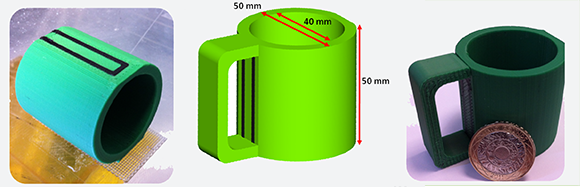
The 3D printer world has the creation of plastic trinkets pretty much down pat. The next step, obviously, is the creation of multi-material models, whether they be made of two different colors of plastic, or completely different materials entirely. A few folks from the University of Warwick and GKN Aerospace in Bristol, UK have come up with a way of putting electronic sensors directly into 3D printed objects.

These new sensors rely on a conductive filament custom-made for this study. So far, the researchers have created flex sensors, capacitive buttons, and a ‘smart’ mug that can sense how much water is contained within.

To produce their ‘carbomorph’ filament, the researchers stirred regular old carbon black to a sample of polycaprolactone dissolved in a solvent. After shaking well, the mixture was laid out on a piece of glass for an hour resulting in a thin film that could then be rolled into a 3mm filament. While this is a great way of producing small quantities of carbomorph filament, we’re sure a few Hackaday readers can come up with an easier way of rolling their own conductive filament. Send us a link if you’ve figured out a better way.

Tip ‘o the hat to [Evan] for this one

[Prusa]’s Nozzle Prints Polycarbonate, PEEK, & Nylon

Oh, we’ve been sitting on this one for a while.

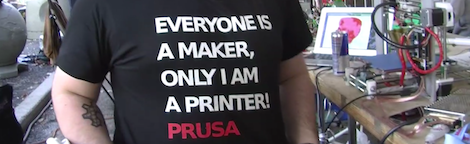
[Josef Prusa], brainchild behind what is probably the most popular 3D printer, has just unleashed a new hot end that is capable of printing objects in polycarbonate, PEEK, and nylon.

This new hot end is completely made out of stainless steel – there are no plastic parts made out PTFE or PEEK to keep the heat from transferring up to the extruder. Because the Prusa Nozzle can print these plastics, it’s also now possible to print parts for other hot ends such as the J Head and the Budaschnozzle.

We ran into [Prusa] at NYC Maker Faire a few months ago, and he was kind enough to go over the advancements in his new nozzle and new i3 printer. So far, it looks like the lack of a PEEK insulator isn’t doing the new hot end any harm – [Prusa] has left molten plastic in the nozzle for a few hours and nothing bad has come of it.

You can check out the interview below.

[youtube=www.youtube.com/watch?v=fzFpMZE366Q]

Again, thanks to [Prusa] for granting us an interview and providing some free advertising for Hackaday’s hosts for the NYC Maker Faire. Before you complain about the delay in getting this interview out to you, don’t worry; I slapped a few Makerbot stickers on the back of [Prusa]’s jacket. Everything’s cool.

Let The 3d Printing Patent Wars Begin!


If you and your friends were gathering a pool of bets together as to when the first patent case would happen in 3d printing, someone just won the pot. 3D systems has filed suit against formlabs for possible patent infringement.

In a press release by 3D systems, they state that not only are they going after form labs, but also Kickstarter for selling the device.

Although Formlabs has publicly stated that certain patents have expired, 3D Systems believes the Form 1 3D printer infringes at least one of our patents, and we intend to enforce our patent rights

It is worth noting that the “cube” printer that Make magazine recently named the most reliable and easiest to use, happens to be made by 3D systems. Note that this one appears to be a typical rep-rap derivative.

[via Adafruit]

Blending Real Objects With 3D Prints

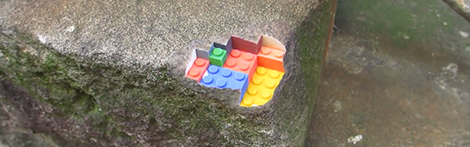
It’s very subtle, but if you saw [Greg]’s 3D printed stone to Lego adapter while walking down the street, it might just cause you to stop mid-stride.

This modification to real objects begin with [Greg] taking dozens of pictures of the target object at many different angles. These pictures are then imported into Agisoft PhotoScan which takes all these photos and converts it into a very high-resolution, full-color point cloud.

After precisely measuring the real-world dimensions of the object to be modeled, [Greg] imported his point cloud into Blender and got started on the actual 3D modeling task. By reconstructing the original sandstone block in Blender, [Greg] was also able to model Lego parts.After subtracting the part of the model above the Lego parts, [Greg] had a bizarre-looking adapter that adapts Lego pieces to a real-life stone block.

It’s a very, very cool projet that demonstrates how good [Greg] is at making 3D models of real objects and modeling them inside a computer. After the break you can see a walkthrough of his work process, an impressive amount of expertise wrapped up in making the world just a little more strange.

Continue reading “Blending Real Objects With 3D Prints”

NASA Is 3D Printing Rocket Engine Parts

In case you haven’t heard, NASA is building a new rocket – a replacement for the shuttle – that will eventually take crews again outside low Earth orbit. It’s called the Space Launch System and looks surprisingly similar to the Saturn V that took men to the moon. Manufacturing technology is light years ahead of what it was in the mid-60s, and this time around NASA is printing some rocket parts with selective laser melting.

Teams at the Marshall Space Flight center are melting metal powder together with lasers to produce parts for the new J-2X engine intended for use in the earth departure stage of the Space Launch System. While the 3d-printed parts haven’t seen a use in any live fire tests of the J-2X, the goal is to test these parts out later in the year and eventually have them man-rated, to carry astronauts to the moon, asteroids, or even Mars.

This isn’t the first time 3d printing has been used to make rocket engines. Earlier this year we saw [Rocket Moonlighting] build an entire rocket engine, powered by propane and NO2, using the same technology that NASA is using. [Moonlighting]’s engine is quite small, too small to lift itself off the ground, even. Still, it’s awesome to see 3D printing that will eventually take people into solar orbit.