The Trials Of Digital Design Class

Late last week, we saw a rather clever combination lock build that used only a single 74xx logic chip. [J. Peterson] read this post, and in a battle royale of geek one upmanship sent us a write up of the logic chip computer he built nearly 30 years ago at the University of Utah.

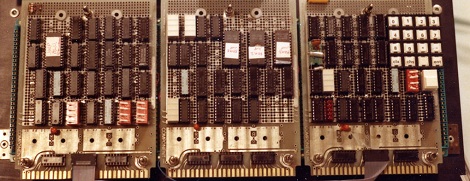
Around 1982 or 1983, [J. Peterson] took the Digital Hardware Lab at the University of Utah. The class was split into two semesters; during the fall semester, students would build a four digit, stack-based calculator that could add and subtract. That may sound easy, but everything – including reading the keyboard, multiplexing LEDs, and performing the mathematical operations – was done with gates and latches.

After Christmas break, the poor souls who had just finished their calculator were presented with another challenge due in four short months. The calculator built during the fall would turn into a full-blown computer, functionally similar to a PDP-8.

After months of work, and seeing the 70 people who showed up on the first day of class in September dwindle down to a handful in late April, [J. Peterson]’s computer was complete. The test program ran through a couple iterations, and the computer was immediately disassembled.

An awesome tale of digital design from only a generation ago. And you thought Verilog was hard.
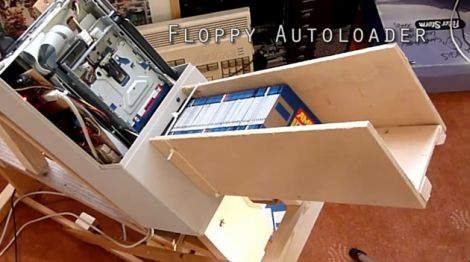
Floppy Autoloader Takes The Pain Out Of Archiving 5000 Amiga Disks

floppy-autoloader

Archiving data from old floppy disks can be a tedious process at best. Poorly labeled disks combined with slow transfer speeds put it high on the list of things we would rather not do, and it turns out that [Dweller] was of the same opinion. With an estimated 5,000 floppies in his collection, he finally decided it was time to clean house.

With no idea of what was stored where, he decided the best way to go about the process was to read all of the disks, archiving everything, saving the sorting process for later. He originally started by building a floppy autoloader out of Lego Mindstorm parts, which looked good on paper, but performed pretty poorly.

He came across an old floppy duplicator on eBay and figured that since the machine was built for handling gobs of disks, that it was the perfect base for his autoloader. He pulled the mechanical bits from the machine, incorporating them into the rig you see above. He swapped out the duplicator’s brains for an Arduino, which allows him to batch copy his disks and save a picture of each label with little effort.

He says that the system works great, making his life a lot easier (and less cluttered!)

Check out the video below to see his floppy autoloader in action.

Continue reading “Floppy Autoloader Takes The Pain Out Of Archiving 5000 Amiga Disks”

Press Play On Tape For Your Fignition

[Julian Skidmore] has been busy improving the Fignition, a tiny AVR-powered educational computer, to support loading programs from a cassette tape.

We first saw the Fignition after the BBC decided to cover an old-school hacker dedicated to improving computer education with a simple ‘bare-metal’ computer. [Julian]’s Fignition harkens back to the days of very simple computers like the BBC Micro and the TRS-80, and encourages students to work with PEEKs and POKEs instead of the decades of cruft that have accumulated on our laptops and desktops.

Because the Fignition is designed to hacker and student-friendly, it’s entirely possible to build a keyboard, or even build a Fignition on stripboard. Now, these students have much improved hardware that allows for saving and loading programs to tape (or any audio recorder) , and even a graphic video mode with 160×160 resolution.

We know it seems a little weird, but kids graduating High School this year were born in 1994, and in all probability have never laid their eyes on a Commodore 64, Sinclair Spectrum, or the other 1980s microcomputers an entire generation learned on. The Fignition is an attempt to stem the tide of ignorant masses unaware of how far the computer has progressed in the last 30 years, and we love it for that.

Antique Electromechanical Calculating Machines

electromechanical calculator Hamann 505

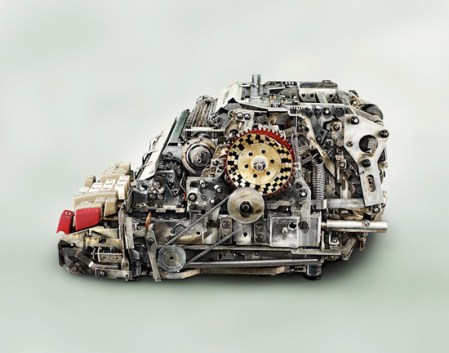
The decision to use electronics for our calculating machines has long been decided.  However, that doesn’t mean that mechanical engineers didn’t put up a valiant, if ultimately futile, fight. [Dvice.com] has an interesting article comparing the calculating technology of the 1960s, such as the [Haman 505], to today’s iPad.

This comparison and pictures were made possible by [Mark Glusker]’s excellent collection.  These models can be divided into two categories, rotary calculators, and printing calculators. According to [Mark]‘s site, the printing calculators stayed on the market a few years after the rotary calculators, which were off the market by 1970.

Although we may never see machines like these made again, anyone even a little bit mechanically inclined would be hard pressed not to be inspired by this collection. Be sure to check out the video of a [Madas 20BTG] calculator after the break to see what one of the rotary models looks like in action! Continue reading “Antique Electromechanical Calculating Machines”

Getting A Home Built Scanner From ’92 Up And Running Again

In 1992, [Arpi] didn’t have much time for Ninja Turtles, Nintendos, and other wonderful wastes of time his fellow geeks were raised on. He was busy building a scanner for his Commodore 64. Although this very impressive build could have been lost to the sands of time, he pulled his project out of the attic for a “Try to use it again” party. Although this party is not a formal competition, we’re going to say that [Arpi] walked home that night with the most geek cred.

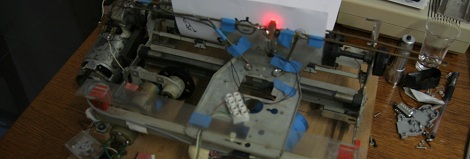
While there are no build details, there is a bunch of info to be gleaned from the gallery about how this machine was built. We’re pretty sure a good majority of the build was a typewriter at one point, and it looks like there’s a windshield wiper motor in there somewhere. Like this completely unrelated but similar build, [Arpi]’s scanner uses a photoresistor and a few LEDs to transfer image data to the custom software. In case you were wondering, yes, the ancient 5 1/4 floppy disk was still readable – one of the few advantages of the huge sectors on these disks.

Check out the videos of this scanner in action after the break, and if you’ve got a decades-old hack sitting in your attic (remember that acoustic modem you built?), send it in on the tip line.

Continue reading “Getting A Home Built Scanner From ’92 Up And Running Again”

Twittertape Machine Keeps Track Of Your Social Media Stock.

During the gilded age, oil magnates, entrepreneurs, and robber barons would have a ticker tape machine in their study. This machine would print stock and commodity prices and chart these men’s assets climbing higher and higher. A lot has changed in 100 years, as now [Adam] can be kept apprised of what @KimKardashian, @BarackObama and @stephenfry ate for breakfast with his Twittertape machine.

Interestingly, [Adam]’s build didn’t start off as a tarnished lump of 100-year-old brass; he built his beautiful ticker machine out of old clock movements he picked up on eBay. Even though the shiny part of the build only holds the roll of paper, it’s still a wonderful build. Right now the machine is connected to Ethernet, but he’s planning on adding WiFi and a few batteries for a completely wireless build.

Unlike the other ticker tape machine we saw this week, [Adam] did away with the loud clashing of gears and solenoids found in 100-year-old ticker machines. This ticker machine prints on cash register receipt paper and a very small thermal printer in the base. Although [Adam]’s build doesn’t sound like two robots trading blows, there’s no ink needed and no danger of the letter wheel becoming misaligned and misspelling everything.

Check out [Adam]’s build in action after the break.

Continue reading “Twittertape Machine Keeps Track Of Your Social Media Stock.”

CRT Vector Graphics Arcade Game Built From An FPGA Board

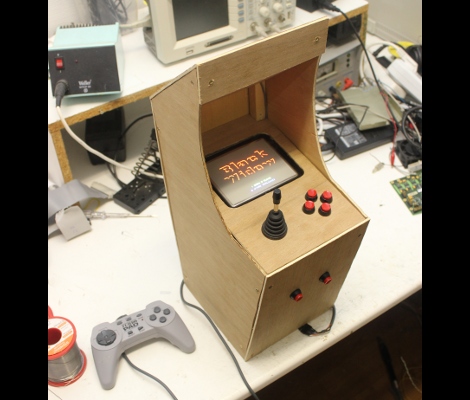
[Sprite_TM] wanted to challenge his VHDL skills, and there’s no more satisfying way of doing this than making something that will be playable when you’re done. He decided to try his hand at creating a vector-based CRT arcade. The distinction here is that vector-based games take control of the magnetic ring that guides the electron path toward the screen. This technique allows point-to-point graphic generation rather than the pixel-based scanning that CRT televisions use.

He had a small color CRT on hand and decided to grab a VHDL version of asteroids from the Internet to see if he could get it to work. But upon further inspection of the source he found that it had a chunk of code which rasterized the vectors for use with a scanning monitor. After removing that chunk, and giving it a spin he had enough confidence that he knew what he was doing to start implementing his own game. The choice of what title really came down to the hardware the original arcade cabinets used. He was not interested in implementing a soft-process for the math chips used in games like Star Wars and Tempest. In the end he got a version of Black Widow up and running, and even built a miniature cabinet for the thing. Check out some of the gameplay in the clip after the break.

Continue reading “CRT Vector Graphics Arcade Game Built From An FPGA Board”