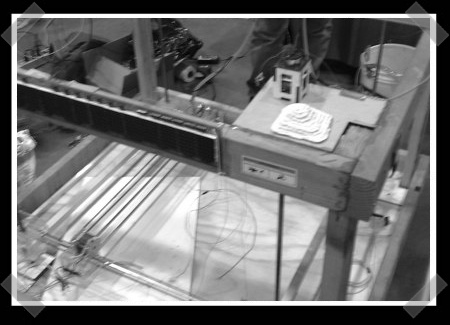
[Cliff Miller] pointed out this incredible project from 2004. [John Pultorak]’s journey began in late 2000 when he decided to build a 60’s or 70’s era minicomputer. While gathering technical documentation, he found some interesting information on the Apollo Guidance Computer and felt that was the way to go. The AGC was the first integrated circuit computer ever built. Designed by MIT in 1964 it was constructed from ~5000 ICs, almost all 3-input NOR gates. [John]’s version uses late 1960’s 74LS TTL logic which gains him a 10 to 1 reduction in the number of ICs. A good thing when you have to do ~15K wirewrap connections. He also used flipflops and register chips instead of building everything from NOR gates. [John] essentially built the AGC three times: First, he coded a simulator in C++. Then, he imported the logic design into CircuitMaker to verify that it would actually work. Finally, he built the 3 by 5foot machine. He’s provided an amazing amount of documentation for anyone that wants to explore this device and the overview alone is well worth a look.
classic hacks2811 Articles
Modular Portable System

Reader [John Grayson], known for his multiconsole portable, has constructed a brand new portable. Not liking the controls or the tethered nature of retro TV games he decided to build a modular portable system. He built a custom system that uses cartridges created from TV game systems. The device has a 5.4″ screen and two Canon batteries for 4.5 hours of play.
Hacking A Scale To Test Rocket Motors

[David Steeman] sent us this project. He uses a consumer scale to measure rocket engine thrust. He wanted to be able to map the thrust curve of his homemade rocket motors to determine whether they are meeting the design goals. It does this by measuring the force applied by the rocket engine via a microcontroller that records it in a text file on a computer. He then analyzes this data in an Excel spreadsheet.
The sensors were harvested from a consumer scale while the rest of the electronics were built by hand. He’s using a PIC 18F2550 microcontroller which has a built in USB interface. He has breakdowns of each piece with detailed information on how it works as well as some nice pictures. There is also a list of future improvements that he would like to do such as increasing sample speed, integrating it with the ignition, and decreasing the physical size. Files for the schematic, firmware, and excel spreadsheet are available for download at the bottom of the page, so keep scrolling down.
Wifi Robot : A Hacked WRT54GL Rover
[Jon Bennett] sent us this link to his Wifi Robot. After playing with a Linksys WRT54GL router, he was inspired to build something that would utilize this embedded Linux system. Using a thrift store R/C truck, he built a wireless robot rover. This thing can be controlled over the internet, or by laptop with a range of about 500 meters.
The router has been modified to have 2 Serial ports and a 1GB SD Card. It connects to a micro controller, which could be an Arduino or AVR Butterfly. He has supplied information for both. The truck has been mostly gutted, leaving only the chassis and electronics. He had to beef up some of the truck electronics when they fried under the load. The entire unit is powered by a pair of 7.2 Volt 3800 mAh battery packs. The most important thing on the list though, is the horn. You can honk the horn while you are driving this thing around.
The site supplies tons of information including pictures of his build, videos of it in action, speed tests, schematics, software downloads, and resource links. Great job [Jon].
Quick AVR

[Kyle Stewart] sent us this quick AVR project. He designed it to sit vertically on his breadboard to take up less space. It doesn’t use any surface mount components, to make the assembly easier. You can download the schematic, parts list, and eagle files for the project on his blog.
RC Plane Sequence Caller

Reader [Kelly Regan] flies large scale RC planes, but would often need someone call out flight sequences while rehearsing. Not wanting to impose on fellow club members, [Kelly] built a sequencer caller from a cheap MP3 player. It just required extending the FWD key to a pin header. Those pins are connected to a custom switch on the back of the controller. Each maneuver is recorded with 30 seconds of padding and then added to a playlist. Once the maneuver is complete, a quick press of the button moves on to the next track. It’s always nice to see people building devices that the consumer electronics industry probably wouldn’t.
Ruckingenur II: Reverse Engineering Video Game

[Zach Barth] has released Ruckingenur II, the game of reverse engineering. The latest in his Games for Engineers series, it is a full game with multiple levels and live action cut scenes. Set with a military theme, the goal is to reverse engineer enemy items. Pictured above is a lock to a weapons cache.
The pixelized style is consistent throughout. Even the cut scenes have the effect. The reverse engineering is fun enough to keep you interested while you learn. There is an in game help system that keeps you on track as well. Our only suggestion is that he get some better costumes next time!