New Contest: Halloween Hackfest

It’s as if Halloween was made for hardware hackers. The world is begging us to build something cleaver as we decorate our houses and ourselves for the big day. And one thing’s for sure: the Hackaday crowd never disappoints. This year we’re fully embracing that with the Halloween Hackfest, our newest contest beginning today along with the help of our sponsors Digi-Key and Adafruit.

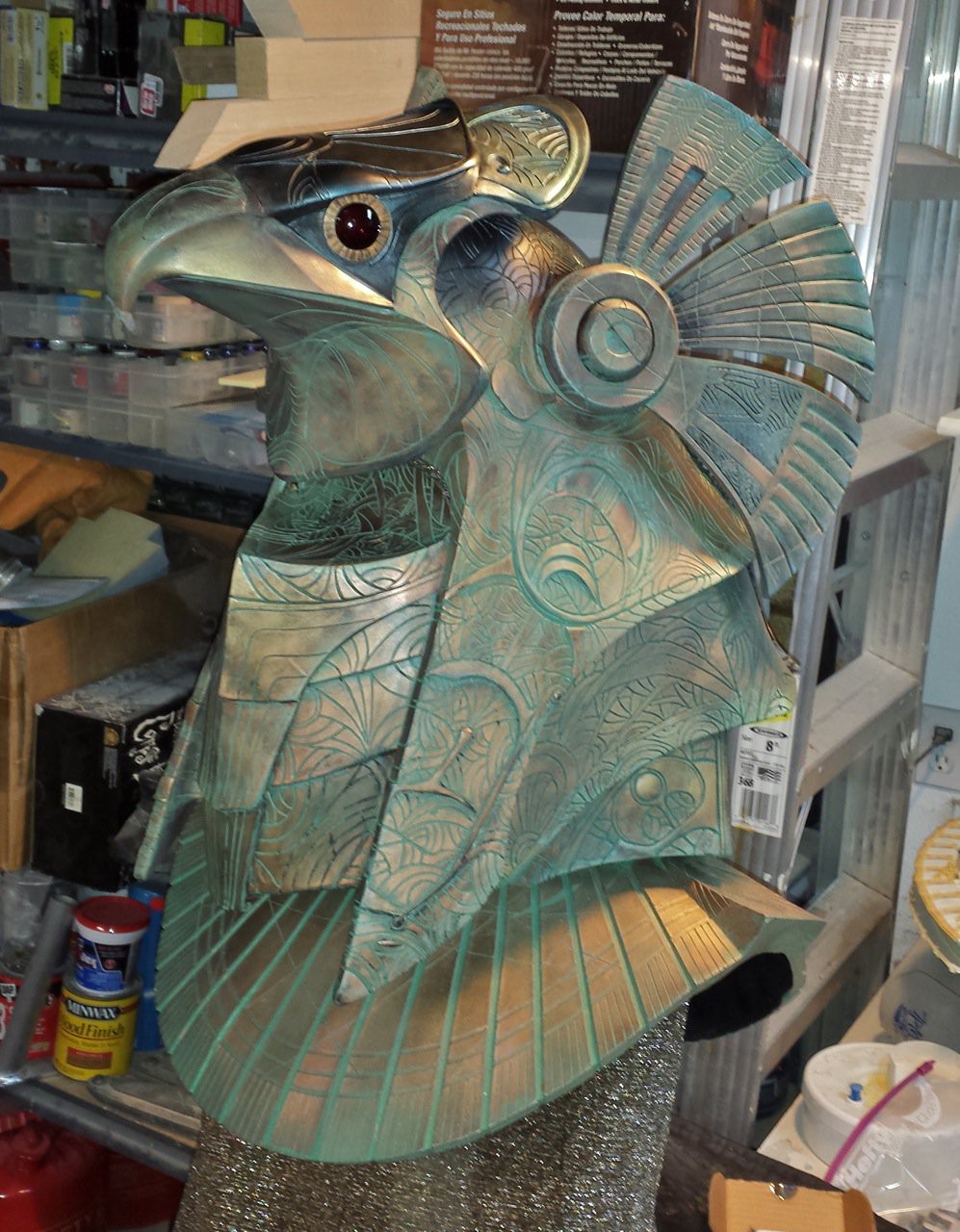
The animated video combined with the 3D-printed prop makes for an excellent effect.

Wait, isn’t it the beginning of August? Why are we talking about Halloween? The procrastinator’s dillema, that’s why! Start working on your build now and it will be epic by the time the day actually rolls around. Decorating for trick-or-treaters is a good place to start. For our money, projected heads are a really cool party trick, like these singing Jack-o-laterns, or these disembodied heads inspired by Disney’s Haunted Mansion. Or maybe you’re more of a flamethrower-hidden-in-pumpkin type of person?

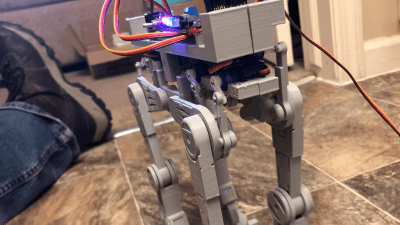
It doesn’t take much tech to bring a good costume to life — a few LED strips make a plain old princess dress light up the night and builds some permanent memories for the lucky little one who’s wearing it. Speaking of memories, we doubt the little one will remember this mechwarrior family costume, which is why you’ve always got to make a video of these things.

Over the year’s we’ve seen claw machines for candy delivery, and even a pumpkin piano. Of course pumpkin carving is an entire category unto itself where five-axis CNC machines are fair game. Look around, get inspired, and build something!

Three top winners will receive $150 shopping sprees in Digi-Key’s parts warehouse. If your build happens to use an Adafruit board, your prize will be doubled. We’ll also be awarding some $50 Tindie gift cards to the most artistic projects.

Get started now by creating a project page on Hackaday.io. In the left sidebar of your project page, use the “Submit Project To” button to enter in the Halloween Hackfest. You have from now until October 11th to spill the beans pumpkin seeds on what you’ve made.

Ten Projects Won The Refresh Work-From-Home-Life Round Of The Hackaday Prize

Here we are, a year and change into this pandemic, and if you were new to working-from-home every day at the start, surely it has lost its luster by now. We asked you to stand back and assess what can be better about WFH life and you took it from there, building incredibly useful things we couldn’t have dreamed of. From a pool of more than one hundred entries, the judges have selected ten projects whose creators have each been awarded a $500 prize, and will advance to the final round of the 2021 Hackaday Prize in October.

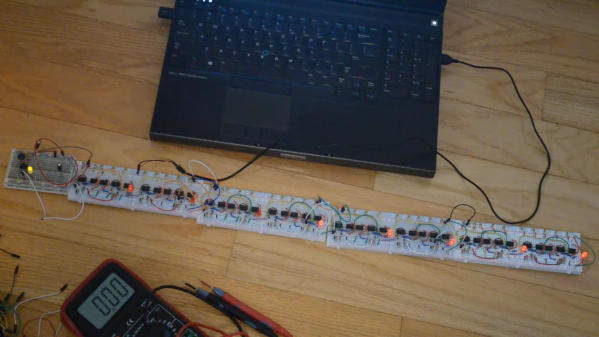
Are your prototypes a mess of wires? Or do you spend way too much time making sure each jumper is cut to the perfect length? Either way, you’re better off using breadWare, which takes a standard breadboard and changes the connection process into a software solution. That’s right — any rail including the power rails can connect to any other thanks to a handful of analog CMOS switch chips.

Maybe you’d love to build the perfect keyboard to grace your battlestation, but are afraid of all that hand wiring. Make it easier on yourself by soldering each key switch to its own little PCB.

If your home office is sometimes overrun by little humans that need immediate attention, you’ll no doubt appreciate the value of a device that can deactivate your web camera and mic automatically when it no longer senses your presence.

You may have left that awful office lighting behind, but you’re still getting plenty of prolonged exposure to blue light. This project aims to head that off a bit by replicating the current outdoor light temperature with indoor lighting. And don’t forget — air quality is just as important, so crack open a window once in a while and build yourself a smart lamp that can give you hard numbers.

This was the second of five challenges in the 2021 Hackaday Prize, which means that the ten finalists linked below will have until the end of October to flesh out and polish their projects before the final round of judging. Meanwhile, we’ve kicked off the next round with the Re-imagine Supportive Tech challenge. Show us how you would make electronics and devices more accessible, as in more modular, hackable, or affordable.

Ten Finalists from the Refresh Work From Home Challenge:

If you like these, take some time to kick back and peruse the entire list of entries in this challenge. You deserve it.

Reimagine Supportive Tech For The Newest Hackaday Prize Challenge

Beginning right now, the 2021 Hackaday Prize challenges you to Reimagine Supportive Tech. Quite frankly, this is all about shortcuts to success. Can we make it easier for people to learn about science and technology? Can we break down some barriers that keep people from taking up DIY as a hobby (or way of life)? What can we do to build on the experience and skill of one another?

For instance, to get into building your own electronics, you need a huge dedicated electronics lab, right? Of course that’s nonsense, but we only know that because we’ve already been elbow-deep into soldering stations and vacuum tweezers. To the outsider, this looks like an unclimbable mountain. What if I told you that you could build electrics at any desk, and make it easy to store everything away in between hacking sessions? That sounds like a job for [M.Hehr’s] portable workbench & mini lab project. Here’s a blueprint that can take a beginner from zero to solder smoke while having fun along the way.

What about breaking down complex topics into something us newbies can swallow? Radio signals are all around us, but again the barriers to getting into SDR are many and varied. A great bit of supportive tech would be a project that shows simple hardware and shares a virtual machine with the open source software toolchain already set to go. A beginner could pick something like this up and be listening for transponders from airplanes passing by in a matter of hours.

If you’re reading this, chances are you’ve spent countless joyful hours learning how to do some difficult and fascinating stuff. Share the wealth!  Take an existing hardware concept and make it modular and easy to use. Refine an existing design to make it more approachable for users with any range of mobility challenges. Or pull together a beginner-friendly project to move STEM education forward.

Ten finalists from this round will win $500 and be shuttled onto the final round judging in October for a chance at the $25,000 Hackaday Prize and four other top prizes. Start your project page on Hackaday.io and use the dropdown in the left sidebar to enter it into the 2021 Hackaday Prize.

Reinvented Retro Contest Winners Announced

Good news, everyone! The results of the Reinvented Retro contest are in, and the creators of these three groovy projects have each won a $200 online shopping spree to Digi-Key. We asked you to gaze deeply into your stuff piles and come up with a way to modernize a cool, old piece of hardware, and we left it up to you to decide how cool and how old.

No matter your personal vintage, you have probably used or even built an educational computer like [Michael Wessel]’s next-generation Microtronic. This is a re-creation of an early 1980s West German 4-bit microprocessor trainer called the Busch 2090 Microtronic Computer System. You may have never heard of it, but [Michael] swears it’s one of the best ever made. Years ago, [Michael] made a talking Arduino-based Microtronic emulator and has grown the concept into a prize-winning system that uses an ATMega2560 Pro Mini and a Nokia 5110 display. As a bonus, it doubles as a cassette interface emulator that plugs into the 2090’s expansion port. Take some time to dive into the YouTube videos or go straight for the gerbers and make your own.

Retrocomputing fans will love EBTKS, a project that seeks to circumvent the disintegrating tape drives in HP85A and other early 1980s HP computers by emulating them and delivering 20,000 virtual tapes via SD card. The project began as a solid state replacement using a Teensy and an ESP32, but [Philip] and the team realized they could do a whole lot more than that. The full list of features includes 70 new keywords and both disk and tape drive emulation. Everything is explained in detail on the project’s main documentation site, where you’ll also find a handy user guide.

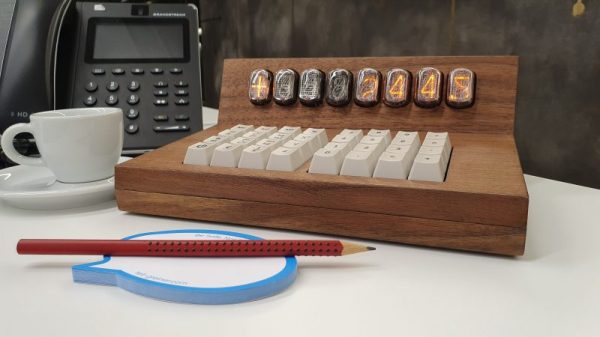
If you have a soft spot for old Soviet gear, check out [ptrav]’s MK-52 Resurrection. [ptrav] took an early 90s-vintage calculator with a busted vacuum fluorescent display and breathed new life into it with an ESP32 and a 320×240 TFT screen. The point isn’t to merely resurrect the MK-52, but rather to create a phoenix of programmable Soviet calculating power that rises from the ashes and realizes its hardware unleashed potential. As part of the software development path, [ptrav] also built a fully-functional simulator in C# which you can check out on GitHub.

A Most Honorable Mention

It’s always so difficult to pick winners from among all the amazing projects we see. For this contest, we’ve chosen [Michael Gardi]’s WDC-1 — aka the Paperclip Computer — for an honorable mention. And that means more than just a published pat on the back — [Michael] has won a $25 gift card for Tindie. Way to go, [Michael]!

This WDC-1 is a bit of an inverse take on the reinvented retro concept. Instead of new tech in an old box, [Michael] employed modern PCB fabrication and 3D printing to house the upgraded homebrew guts of this 50+ year-old computer design.

Congratulations to all the winners, and a big thank you to all 138 entrants for your faux nostalgia-inspiring builds. Take some time this weekend to check them out, and get your alternate reality on.

Ten Projects Won The Rethink Displays Round Of The Hackaday Prize

We asked you to rethink what displays can look like and you didn’t disappoint. From almost 150 entries the judges have winnowed the list down to ten projects which are awarded a $500 prize and will go on to the final round of the 2021 Hackaday Prize in October.

In a world where there’s an HD (or better) display in every pocket, it is the oddball ideas that tend to turn heads. High on that list is a volumentric display that levitates a tiny foam ball on ultrasonic transducers to draw 3D color patterns before your eyes, or the volumetric display shown above that works with a sheet of film and motors. Or how about a take on a laser projected display that uses a phosphorescent screen so that the path of the laser persists, fading in time for the next infrequent update.

Mirrors are a part of everyday life but they’re all limited to the visable spectrum. One of today’s finalists flipped the script and turned the mirror into one the visualizes heat. And we’ll be watching with keen interest as this holographic display project seeks to turn a tube of perspex into a 3D display that can be viewed from any side!

This was the first of five challenges in the 2021 Hackaday Prize and the great news is that these finalists — all of which are listed below — will have until the end of October to refine their designs for the final judging round. Meanwhile the next round has already begun with the Refresh Work-From-Home Life challenge. Show off your solutions to being productive when working (or studying) from home while still preserving your personal life and your health.

Ten Finalists from the Rethink Displays challenge:

If you like these, you’ll love browsing through the entire field of entries in this challenge.

Today’s Challenge Is All About Work-From-Home Life

You sure do learn a lot when life suddenly makes it impossible to go into the office and asks that you instead do the same work remotely. Sure, there are the obvious challenges like needing a device to do the work on and an internet connection that’s not going to melt down when family or roommates are trying to Zoom at the same time as you one-on-one with the boss. But there’s way more to it. The Refresh Work-From-Home Life challenge takes this on as the next phase of the Hackaday Prize gets under way this morning.

If the global pandemic caused you to find yourself working from home, I’m sure it’s been quite a ride. Maybe you learned what your spine feels like after hunching over a MacBook in bed for 40 hours. Others discovered that the commute had been silently serving as a power-down sequence for your “work brain” — without it you never stopped thinking about, or more likely worrying about, work. And without that change in venue, it’s far too easy to feel like you were now living at work. So let’s invent the things that can make us productive from home while maintaining physical health and preserving our sanity.

Ten entries in this challenge will be awarded with $500 and ushered into the final round where the grand prize of $25,000 and four other top prizes await. What kind of things are we looking for? The best ideas are the ones we haven’t had yet, but I can spitball a bit to get things rolling.

Mirror with a bracket turns a laptop webcam into an overhead project for Zoom classrooms

Furniture and other infrastructure can be a real sore-spot when not a good fit. We’d love to see your design that uses a single sheet of plywood (I know, those cost a bazillion dollars these days but just go with it) to build an adjustable workspace that fits your chair height and needs. Bonus points for one that folds away at quitting time to reassure you that work is done!

Office interruptions from co-works sometimes feel like a distraction. But without them you might not get your body moving for hours on end… not good for you! Design an assistant that watches for your poor sedentary habits and sasses you until you take some time to stretch your old bones. Or show off the gadgets that make living the digital nomad life easier like the awesome document camera hacks we saw from teachers when classrooms were closed last year.

Show off your proof of concept by starting a project page on Hackaday.io and using the dropdown in the left sidebar to enter it into the 2021 Hackaday Prize. You can continue to update it until judging begins at the end of July.

We’re already living in the future. Working or learning remotely is a big part of that. Let’s bend our homes and our habits to find a better way to do it!

2021 Hackaday Prize: Rethink, Refresh, And Rebuild

The 2021 Hackaday Prize begins right now. Tap into your creativity and build your piece of a better future on the topics of supportive technology, everyday robotics, imaginative displays, and work-from-home innovations.

Now in its eighth year, the Hackaday Prize is a global engineering initiative that seeks out new and interesting uses of electronics and other technologies with an eye toward open source/open hardware and a goal of getting your creations out into the world.

The grand prize winner will receive $25,000 and a residency at the Supplyframe Design Lab. In addition to top prizes for the second through fifth place winners, 50 finalists will each receive a $500 prize. But you don’t need to win the Hackaday Prize to take something away. This is your calling: spend time working on those abstract ideas and figuring out how they will fit into life tomorrow, next month, or next decade. Whether it changes peoples’ lives or just brings a smile to a few faces, every interesting step forward is an example where people had ideas so crazy they actually worked. Let’s get in on that!

There are five categories to target with your builds. If you have an idea kicking around, you can probably enter it this year.

Continue reading “2021 Hackaday Prize: Rethink, Refresh, And Rebuild”