Building A Smart Speaker Outside The Corporate Cloud

If you’re not worried about corporate surveillance bots scraping your shopping list and manipulating you through marketing, you can buy any number of off-the-shelf smart speakers for your home. Alternatively, you can roll your own like [arpy8] did, and keep your life a little more private.

The build is based around an ESP32 microcontroller. It connects to the ‘net via its inbuilt Wi-Fi connection, and listens out for your voice with an INMP441 omnidirectional microphone module. The audio data is trucked off to a backend server running a Whisper speech-to-text model. The text is then passed to Google’s Gemini 2.5 Flash large language model. The response generated is passed to the Piper Neural Voice text-to-speech engine, sent back to the ESP32, and spat out via the device’s DAC output and a speaker attached to an LM386 amplifier. Basically, anything you could ask Gemini, you can do with this device.

By virtue of using a commercial large language model, it’s not perfectly private by any means. Still, it’s at least a little farther removed than using a smart speaker that’s directly logged in to your Amazon/Google/Hulu/Beanstikk account. Files are on Github for those eager to dive into the code. We’ve seen some other fun builds along these lines before, too. Video after the break.
Continue reading “Building A Smart Speaker Outside The Corporate Cloud”

The Simplest Ultrasound Sensor Module, Minus The Module

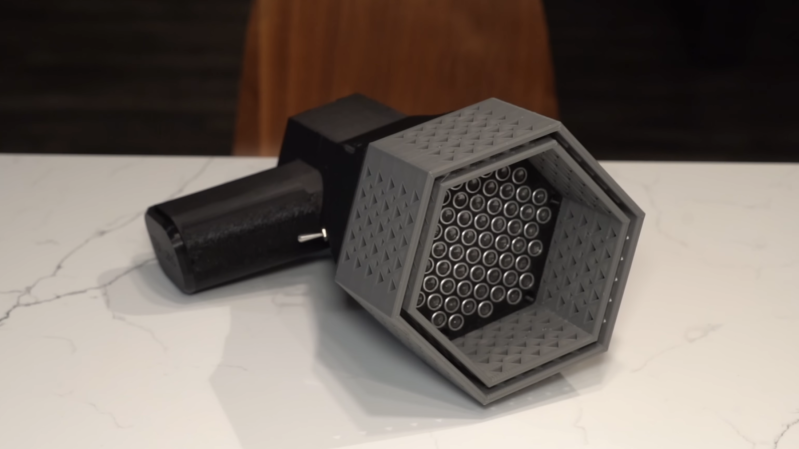
Just about every “getting started with microcontrollers” kit, Arduino or otherwise, includes an ultrasonic distance sensor module. Given the power of microcontrollers these days, it was only a matter of time before someone asked: “Could I do better without the module?” Well, [Martin Pittermann] asked, and his answer, at least with the Pi Pico, is a resounding “Yes”. A micro and a couple of transducers can offer a better view of the world.

The project isn’t really about removing the extra circuitry on the SR-HC0, since there really isn’t that much to start. [Martin] wanted to know just how far he could push ultrasound scanning technology using RADAR signal processing techniques. Instead of bat-like chirps, [Martin] is using something called Frequency-Modulated Continuous Wave, which comes from RADAR and is exactly what it sounds like. The transmitter emits a continuous carrier wave with a varying frequency modulation, and the received wave is compared to see when it must have been sent. That gives you the time of flight, and the usual math gives you a distance.

Continue reading “The Simplest Ultrasound Sensor Module, Minus The Module”

An Audio Brick For Your Smart Home

If you’ve ever wanted to pump sound to all the rooms of your house, you might use any one of a number of commercial solutions. Or, you could go the more DIY route and whip up something like the Esparagus Audio Brick built by [Andriy]. 

The concept is simple—it’s a small unit, roughly the size of a brick, which streams high-quality audio. It’s based around an ESP32, which pulls in digital audio over Wi-Fi or Ethernet. The microcontroller is hooked up to a TAS5825M DAC, which comes with a built-in amplifier for convenience. The Esparagus is designed for integration with Home Assistant, allowing for easy control as part of a smart home setup. It’s also compatible with Spotify Connect, AirPlay, and Snapcast—the latter of which provides excellent sync when using multiple units across several rooms.

Design files are available on Github for the curious. We’ve seen other neat projects in this space, before, too—like the charmingly-named OtterCast. Video after the break.

Continue reading “An Audio Brick For Your Smart Home”

Know Audio: Lossy Compression Algorithms And Distortion

In previous episodes of this long-running series looking at the world of high-quality audio, at every point we’ve stayed in the real world of physical audio hardware. From the human ear to the loudspeaker, from the DAC to measuring distortion, this is all stuff that can happen on your bench or in your Hi-Fi rack.

We’re now going for the first time to diverge from the practical world of hardware into the theoretical world of mathematics, as we consider a very contentious topic in the world of audio. We live in a world in which it is now normal for audio to have some form of digital compression applied to it, some of which has an effect on what is played back through our speakers and headphones. When a compression algorithm changes what we hear, it’s distortion in audio terms, but how much is it distorted and how do we even measure that? It’s time to dive in and play with some audio files. Continue reading “Know Audio: Lossy Compression Algorithms And Distortion”

Live Coding Techno With Strudel

The super talented [Switch Angel] is an electronic music artist, with a few cool YouTube videos to show off their absolute nailing of how to live code with Strudel. For us mere mortals, Strudel is a JavaScript port of TidalCycles, which is an algorithmic music generator which supports live coding, i.e. the music that is passed down to the synthesizer changes on-the-fly as you manipulate the code. It’s magical to watch (and listen!) to how you can adapt and distort the music to your whims just by tweaking a few lines of code: no compilation steps, hardly any debugging and instant results.

The traditional view of music generators like this is to create lists of note/instrument pairs with appropriate modifiers. Each sound is specified in sequence — adding a sound extends the sequence a little. Strudel / Tidalcycles works a little differently and is based on the idea of repeating patterns over a fixed time. Adding an extra sound or breaking down one sound slot into multiple sounds squeezes all the remaining slots down, causing the whole pattern to repeat in the same period, with the sounds individually taking up less space. This simple change makes it really easy to add layer upon layer of interest within a sequence with a few extra characters, without recalculating everything else to fit. On top of this base, multiple effects can be layered—more than we can mention here—and all can be adjusted with pop-in sliders directly in the code.

Continue reading “Live Coding Techno With Strudel”

Bose SoundTouch Smart WiFi Speakers Are About To Go Dumb

Bose SoundTouch speakers were introduced in 2013, offering the ability to connect to online streaming services and play back audio on multiple speakers simultaneously using the accompanying mobile app. Now these features are about to be removed, including the mobile app, as Bose is set to discontinue support on February 18, 2026. From that point onwards, you can only use them via Bluetooth or physical connectors that may be present, like an audio jack or HDMI port. This includes fancy home theater system hardware like the above SoundTouch 520.

That is the official line, at least. We have seen the SoundTouch on Hackaday previously, when it was discovered how to gain root shell access to the Linux OS that powers the original SoundTouch system with Telnet access on port 17,000 to pass the listening service the remote_services on command before connecting with Telnet as usual, with root and no password. A quick glance at the comments to that post suggests that this is still a valid approach for at least certain SoundTouch devices.

The fallout from this announcement appears to be twofold: most of all that ‘smart’ features like WiFi-based streaming can be dropped at any time. But it also makes us realize that hardware hackers like us will never run out of new and suddenly obsolete hardware that need our rescue.

Know Audio: Distortion Part Two

It’s been a while since the last installment in our Know Audio series, in which we investigated distortion as it applies to Hi-Fi audio. Now it’s time to return with part two of our look at distortion, and attempt some real-world distortion measurements on the bench.

Last time, we examined distortion from a theoretical perspective, as the introduction of unwanted harmonics as a result of non-linearities in the signal path. Sometimes that’s a desired result, as with a guitar pedal, but in a Hi-Fi system where the intention is to reproduce as faithfully as possible a piece of music from a recording, the aim is to make any signal path components as linear as possible. When we measure the distortion, usually expressed as THD, for Total Harmonic Distortion, of a piece of equipment we are measuring the ratio of those unwanted harmonics in the output to the frequencies we want,  and the resulting figure is commonly expressed in dB, or as a percentage. Continue reading “Know Audio: Distortion Part Two”