Southwest Tour: Xerocraft In Tucson Arizona

Traveling further south through Arizona, we ended up in Tucson to meet up with [Connor] at Xerocraft. [Connor] immediately apologized for the slightly disheveled state of the shop, but as I told him, I prefer a shop that has been used. Xerocraft was an interesting stop in our southwest tour. There was a workshop area in the front foyer that was nearly outdoors, something I’m not used to seeing in Missouri. The indoor areas included their electronics, library, 3d printing, and kitchen area. A nice little back yard allowed for some larger work to get done, like an electronic conversion that is currently in process on that car you can see in the video.

If you’re ever in the area, you should definitely swing by and at least attempt to de-throne [Connor] in Super Smash Bros.
Southwest Tour: Heatsync Labs In Mesa Arizona

With temperatures rising to around 117degrees, we arrived in Mesa Arizona to visit Heatsync Labs as part of our Southwest Tour.  We have actually seen a tour of Heatsync in the past, and you should probably refer back to it for the quick run-through of the facility. When I was there, there was simply so much to see and talk about that the video ended up running over 10 minutes and I feel we barely scratched the surface of what was going on.

Continue reading “Southwest Tour: Heatsync Labs In Mesa Arizona”

Southwest Tour: Quelab In Albuquerque New Mexico

Our travels brought us to Quelab in Albuquerque New Mexico for the 2nd stop on our southwest tour. [Adric] agreed to give us a tour of this really cool space and a few other folks were there working on various projects. There were several things I really enjoyed that will hopefully be gracing our pages soon with full writeups.

The Quelab hackerspace has a small machine shop area as well as a few collaborative spaces. They occasionally hold events where you can come and learn different skills as well. While I was there, I saw some cool high altitude balloon projects, a teletype playing Zork, and a 3d printer spitting out some custom Quelab tokens.

The group seemed to be very a really cool bunch. Everyone was enthusiastic about their projects and their space. They even tried to feed us (but the timing just wasn’t right). If you ever make it by, be sure to go play with the phosphorescent wall in their bathroom. Easily one of my favorite simple projects.

Southwest Tour: OhmSpace In Oklahoma City, Oklahoma

OhmSpace in Oklahoma City is the very first stop on our southwest tour.

When we arrived it was around 2 in the afternoon and the temperature outside was nearly 110 degrees. It was HOT. [Stan] met up with us to give us a tour of the space.  As you can see, the facility is huge. While at first glance it may appear somewhat disheveled, there is order to the madness. There is a nice community work area set up in the middle as well as several different stations throughout. Since the facility is almost just one giant room, storage is out in the open giving the illusion of a mess. We were there in the early afternoon, so there wasn’t anyone around working on anything, but you can see projects in various states of progress throughout the tour.

Continue reading “Southwest Tour: OhmSpace In Oklahoma City, Oklahoma”

A Mixer (re)built To Travel

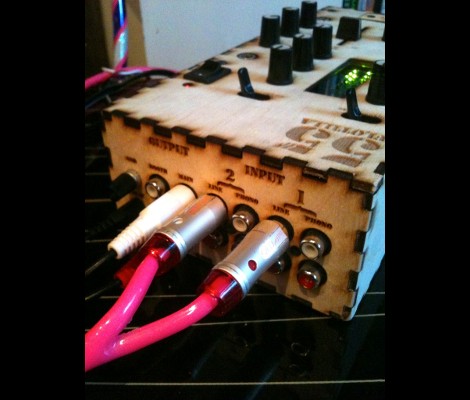
[Toby Cole] likes to mix tunes whenever he gets a chance. But the size of his DJ equipment made it a real bother to lug around with him. He does own a Behringer portable mixer but without cross faders it’s not really all that usable, and most of the other offerings don’t get good reviews. He ended up replacing the enclosure of a proper mixer in order to make it light and small. The growing availability of affordable laser-cut parts made this project possible.

Build Brighton, [Toby’s] local Hackerspace, has a laser cutter. So he knew that if he could figure out a smaller case design it would be a snap to get his parts made. He cracked open the heavy metal case on the KMX 100 mixer and found it had a ton of extra room inside. He designed all of the plates using a digital calipers to properly space the holes and text labels. These designs were combined with BoxMaker to produce the files the laser cutter needed. The first prototype was cut from cardboard, with the finished product cut from 3mm plywood.

Task Scheduler For Arduino

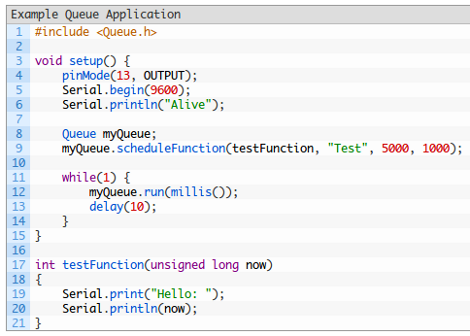
For their recent high altitude balloon project LVL1 member [Brad] programmed a pretty complicated brain based on an Arduino. It was responsible for collecting data from all of the sensors, and reporting back in a few different ways. One of the things he did to simplify the project was develop a task scheduler for the Arduino board. It lets you add functions to a queue of jobs, along with data about when they should be run.

The task scheduler does make coding a bit easier, but where it really shines is in situations like this where you don’t have access to the hardware if there’s a problem. In his description of the scheduler [Brad] mentions the possibility that one of the sensors could fail as the cold of the upper atmosphere takes its toll. This could leave the whole system stuck in a subroutine, and therefore it will stop sending reports back to the team on the ground. Since he was using the task scheduler it was a snap to add watchdog timer servicing to the mix. Now if program execution gets stuck the watchdog will reset the chip and all is not lost.

[Thanks  JAC_101]

LVL1 Has A Rocketeers Group, Is Not Working On ICBMs.

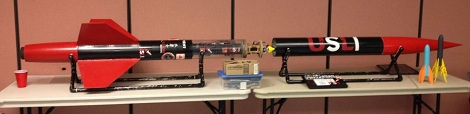
We’re very familiar with the Louisville Hackerspace LVL1 here at Hackaday. From their GLaDOS-inspired sentient overlord, an evil box to filter the Internet, and a friggin’ moat, LVL1 is the closest we’ve got to a mad scientist heard cackling from a wind-swept castle on a stormy night. It turns out they also have a rocketry program. Now we’re just waiting for confirmation of their subterranean complex of missile silos.

The rocketery-oriented part of LVL1 spawned from a University of Louisville’s group. The goal of the group is to compete in the NASA University Student Launch Initiative, dedicated to competing against other teams to launch a scientific payload to 1 mile AGL. At the competition last May, the team placed 5th out of 42 teams and won the award for best website. We can’t wait to see what they come up with next year.

Even though the team is out of school for the summer, they’re still cooking up a few rocketry hacks. They’ve built a test stand to measure the thrust of off-the-shelf motors, kitbashed a few Estes Baby Berthas (very awesome and very easy if you have a laser cutter), and are starting a pulse jet project.

We’re assuming the LVL1 Rocketeers group is just a front for their yet to be unveiled moon-based “laser” project, but you can check out a few videos from the ULSI competition after the break.

Continue reading “LVL1 Has A Rocketeers Group, Is Not Working On ICBMs.”