Pep Up Your House Cat’s Boring Wintertime Life

With winter upon us, and all the windows shut, [Garfield] and [Socks] can get a little restless. But [Dino] is determined to keep his furry friends entertained through the cold dark months. He hit the junk box, and used some interesting fabrication techniques to build the Chase-a-Mouse motorized cat toy.

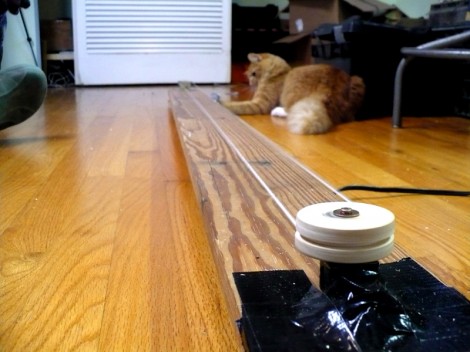
The toy is popular with the cats because it incorporates two traditionally satisfying features; something to chase, and an obstacle to chase it around. The base of the unit is a long plank which is held up from the floor by a couple of inches. The loop of rope which spans the board’s length has a mouse attached to it with about six inches of string. When the motor is flipped on it bounces and jerks its way around the circuit, darting in and out of the space below the base.

As you can see in the video after the break the motor is a bit loud. [Dino] used the sweeper motor from a Roomba for this. It might freak the kitties out at first, but curiosity will get the better of them eventually. It’s a quick build, and we love the drill-turned-lathe that is used make the wooden pulley for the system.

Continue reading “Pep Up Your House Cat’s Boring Wintertime Life”

Video Series Shows How To Build Your Own Solar-charged R/C Lawnmower

rc-solar-lawnmower

As winter is officially upon us, we’re pretty sure that the last thing most of you are thinking about is mowing your lawn. We would argue that it’s actually the ideal time to do so – that is, if you are interested in automating the process a bit.

[Robert Smith] has spent a lot of time thinking about his lawn, wanting a way to sit back and relax while doing his weekly trimming. He set off for the workshop to build an R/C electric lawnmower, and thoroughly documented the process in order to help you do the same.

On his web site, you will find a series of videos detailing every bit of the solar charged R/C lawnmower’s construction, taking you through the planning phases all the way to completion. [Robert] has provided just about anything you could possibly need including parts lists, schematics, code, and more.

If the short introductory video below has you interested, be sure to swing by his site for everything you need to build one of your own.

Continue reading “Video Series Shows How To Build Your Own Solar-charged R/C Lawnmower”

Leaking Water Detector From An Old Smoke Alarm

[Thomas Clauser] had his basement flood last year when a hurricane swept over New England. The problem with flooding or leaking water is that chances are you won’t notice until it’s too late. He decided to protect against this in the future by building his own leaking water detector. It’s a simple device that sits on the floor of his basement and triggers an audio alarm if water begins to cover the floor.

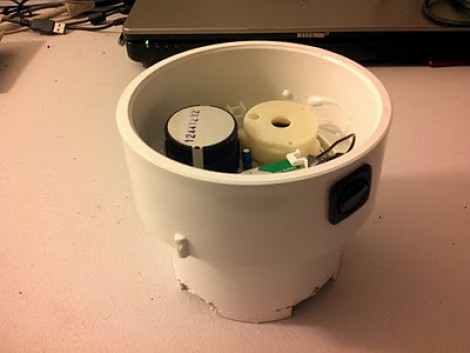
He used an old smoke detector for the build; a nice choice since it’s loud, and designed for long-term battery operation. It also has a button for testing if the detector is working. [Thomas] removed the PCB from the smoke detector case and soldered wires onto the test button contacts. He cut a sponge to squeeze it inside of a PVC pipe connector housing. That sits against the floor, with the wires for the test button contacts placed through the sponge. If water is soaked up by the sponge it completes the circuit and triggers the alarm.

A few other design features really make this a nice setup. He notched out the bottom of the PVC connector so that water can flow freely, and added a switch to one of the probe wires lets him kill the alarm when inspecting the damage.

How To Grow Your Own EL Wire DNA Helix Lamp

el-wire-helix-lamp

[LucidMovement] was looking for some crystal-based artwork and just couldn’t seem to find anything that fit the bill, so he decided to build something himself.

The inspiration for his desk lamp came from something we’re all familiar with, a DNA double-helix. To grow the crystals he built a helix-shaped growing substrate out of nichrome and EL wires, submerging them in a warm alum solution. Once he had a nice set of crystals, he mounted it in an acrylic tube, filling the air space with clear silicone to seal off the display. He then mounted the silicone-filled tube on top of a rotating acrylic stand that he had cut for the project. The stand is made from several sheets of acrylic and contains both the gearing for movement as well as RGB LEDs to light the display from the bottom.

The lamp looks great when sitting idle, but when he powers it on it really shines (no pun intended). [LucidMovement] put a ton of work into the lamp, and offers up all sorts of tips, tricks, and considerations for anyone looking to build their own. Be sure to check out his writeup for plenty more details, and stick around to see a short video of the lamp in action.

Continue reading “How To Grow Your Own EL Wire DNA Helix Lamp”

Keeping Axolotl Healthy And Cool

The real life Mudkip Wooper Pokemon seen above is an axolotl, a salamander-like animal that lives in only one lake near Mexico City. These adorable animals can be bred in captivity, but keeping them is a challenge. [LRVICK] decided he didn’t want to throw down hundreds of dollars for an aquarium cooler so he built his own out of parts usually used for keeping computers nice and cold.

Commercial aquarium coolers that would meet the requirements start around $300 and go up from there. Not wanting to spend that much, [LRVICK] found a 77 Watt Peltier cooler for $5 and figured he could make it work. Off-the-shelf parts for water cooling CPUs were used to construct the aquarium cooler – a water block on the cold side, a huge heat sink and fan for the hot side, and a bunch of tubing goes up to the tank.

Now [LRVICK] has an axolotl housed in a very professional-looking aquarium that is a steady 65 degrees. He’s got a very nice build, and the axolotl looks very happy.

DIY Clapper Is The Ideal Gift For The Laziest Person In Your Life

diy-clapper

If you haven’t yet wrapped up your Christmas shopping, you may want to consider building [AlanFromJapan’s] implementation of the ever-classic “Clapper”. With its theme song burned into the brain of anyone old enough to remember the 80s, the clapper was a wonderful device that certainly put the “L” in laziness.

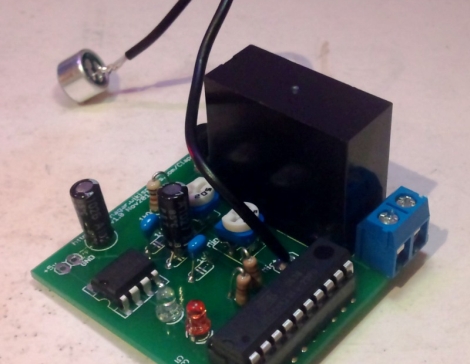
Looking for an excuse to play around with an opamp and microphone [Alan] decided to build his own version of the Clapper based off this similar circuit, which he calls the ClapClap. He built the device using an electret mic that feeds a signal through a small amplifier on the way to the ADC of an ATmega328 microcontroller. The mcu constantly polls the ADC looking for the sound of clapping hands, a solution that works, but isn’t as clean as [Alan] wanted.

He went back to the drawing board, this time building a circuit around an ATtiny2313 microcontroller. Most of the other components remained the same, though the new, smaller design sports some nice PCBs he had made at Seeedstudio. Rather than constantly polling the ADC, this version of the ClapClap looks for peaks in the signal coming from the mic to identify the clapping of hands.

He says that the newer version works great, though he still has a software bug or two that need fixing before he parks himself on the couch for all eternity.

Controlling Your Christmas Lights Without Ever Getting Off The Couch

remote-xmas-tree-light-switch

14 year-old [Connor Smith] has been busy this holiday season, thinking up ways to improve the lighting situation at home.

A few weeks ago he put together this 3-channel light controller to toggle his parents’ external lights, incorporating an Arduino for control. The Arduino was used to switch the channels on and off at specified intervals in order to create a simple light show on the house’s exterior. Not satisfied with just a few strings of blinky lights, he took his controller back inside for some additional modifications.

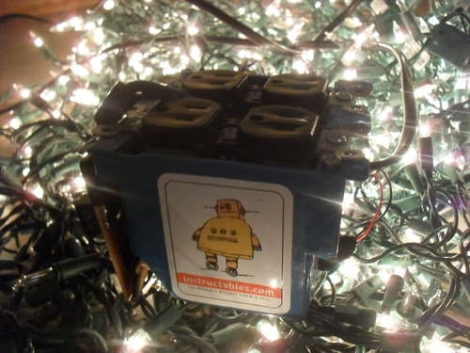
He had grown tired of crawling behind the Christmas tree to plug and unplug it every day, and decided to make things easier on himself. He stripped the IR receiver out of an old VCR and interfaced it with the Arduino in his light controller using the IRremote library. After taking a bit of time to decode the values for two infrequently used buttons on his TV remote, he had himself a Christmas tree light switch that he could activate from across the room.

Check out the short video below to see his remote switch in action.

Continue reading “Controlling Your Christmas Lights Without Ever Getting Off The Couch”