Automated Hose Keeps Cats From Watering You

Commenter [TheCreator] reminded us of this fantastic video from [Craig Turner] who you may recognize from SBS’s Top Gear Australia Video Competition.  You see, [Craig] has been struggling for some time with the problem of neighborhood cats relieving themselves pretty much all over his stuff. Through surveillance he identified (and named) around 9 separate cats sauntering into his yard during the wee hours of the night.  The only issue now was to humanely discourage them from entering his yard.

The best solution, in this case, was a simple spray from the garden hose, but who is going to stay up all night to watch for cats? [Craig]’s ’75 Galant happens to have aftermarket door locks. These typically contain a simple powerful 12V actuator that will push or pull when given current. The actuator is strong enough, and has enough travel, to depress your typical garden sprayer handle. The lock actuators even include enough mounting hardware to tack everything together.  The only irreversible part of the hack appears to be the hole drilled into the sprayer’s handle.

The job of cat detection is handled with a PIR sensor (sourced from his home security system) and a paper towel tube to narrow the detector’s field of view. Placed at animal height the PIR detector works like a trip line, and flips a relay connected to an array of devices:  A bright LED lamp, a DSLR set to take several quick photos of the victim, An HD video camera, and the sprayer solenoid.  This whole rig is placed at a convenient choke point and hilarity ensues! A schematic is included in the video but is pretty difficult to interpret, we transcribed it for you. Some details are unclear but essentially a few relays are stapled together to provide either high or low switching signals.

Check out the video, [Craig]’s schematic, and our interpretation of [Craig]’s schematic after the jump!

Continue reading “Automated Hose Keeps Cats From Watering You”
The Ins And Outs Of Lithium-based Battery Packs

lithium_batteries

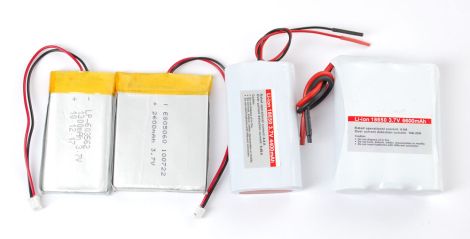
So, you’ve got your awesome project built and are ready to take it on the go, but how are you going to power it? You could use a couple alkaline cells or perhaps swipe a Litihium battery pack from some infrequently used portable device – however before you do that, why not check out what [Lady Ada] has to say on the subject?

The detailed tutorial on her site discusses the different types of Lithium-based batteries and their form factors, as well as the strengths and weaknesses of each type. Voltage ratings are covered, as well as why it is important to choose a Lithium battery pack that fits the task at hand. The dangers of improperly handling batteries are clearly noted, highlighting the importance of selecting a proper charger and resisting the urge to ever wire Lithium batteries together to increase capacity.

While the bulk of the information presented is nothing new to most of our readers, it’s definitely a worthwhile read for those just starting to use Lithium battery technology in their projects.

We Know “Mario’s Early Years” Was A Let Down, But This Takes It A Bit Too Far.

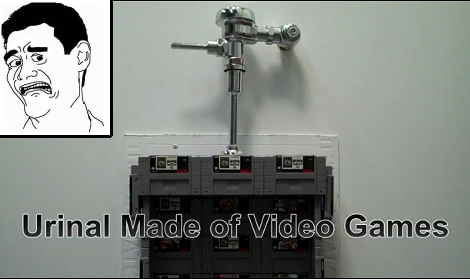
[JJ Hendricks] wrote in to tell us about his SNES cartridge urinal. The fully functional urinal is constructed with 40 SNES cartridges and sealed up with polyurethane. The base of the whole operation is actually not a puddle of festering urine, but instead poured polyurethane that ensures proper flow through the drain. You heard right, this urinal actually flushes! As a bit of consolation [Hendricks] plainly states in the directions:No good games were damaged in the making of this video. All the video games used in this urinal were already broken or worthless sports games”. We have featured some SNES cartridge readers before, so now you have something to do with all the leftover hardware! Gross.

Continue reading “We Know “Mario’s Early Years” Was A Let Down, But This Takes It A Bit Too Far.”

Introduction To The H-bridge Motor Controller

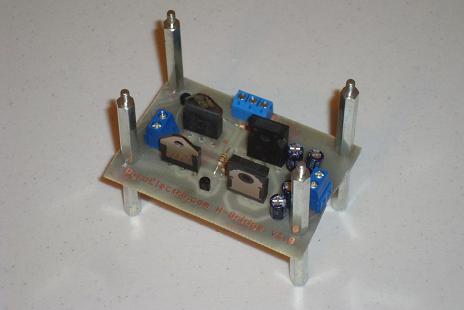
[Chris] sent us this fantastic tutorial, introducing beginners to H-bridge motor drivers. While many of you will consider this stuff basic, those who are trying to expand from building only things the arduino board can handle to bigger more expansive (and powerful) projects will find this quite helpful.  [Chris’s] tutorial is very in depth, not only going through the construction of the basic circuit but also showing you how to make your own PCB.  Pop on over there and learn some theory and some practice. Then you can build that battle bot you’ve always been dreaming of!

Chemical Wood Burning

Make: Projects has posted an interesting way to burn designs into wood. Instead of doing the traditional method of using a hot iron to hand draw or trace patterns on the wood, they show us how to use a chemical process to make things easier. They are using a solution of Ammonium Chloride, applied with a foam stamp, then heated. When it is heated it breaks down to ammonia gas and hydrochloric acid, burning the surface. The advantage here is that you can easily use a stamp to create patterns whereas doing it by hand might be difficult.  They do point out that improvements could be made, such as adding something to keep it from soaking into the wood and blurring the edges.

Papercraft Flowers Teach Kids About Batteries

saltwater_papercraft_batteries

[Emily Daniels] has been teaching interactive electronics workshops geared towards children for some time now, recently holding a session that demonstrated how batteries work in a pretty novel fashion.

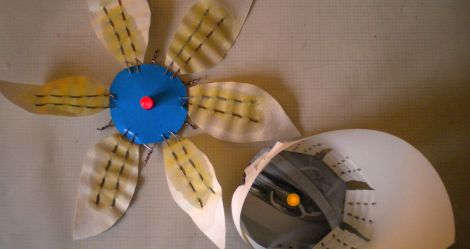
She wanted to keep things safe and simple due to the class size, so she didn’t want to rely on using soldering irons for the demonstration. Instead, she showed the children how batteries function by building simple voltaic cells with paper flowers, salt water, and LEDs. The paper flowers’ absorbency was used to act as a salt bridge between the wire pairs that adorned each petal. After salt water was applied to each of the flower’s petals, the center-mounted LED came to life, much to the amazement of her class.

The concept is quite simple, and the LED flowers are pretty easy to build, as you can see in her Instructables tutorial.

We think it’s a great way to demonstrate these sorts of simple concepts to kids, and hope to see more like it.

[via Adafruit blog]

I2C 101

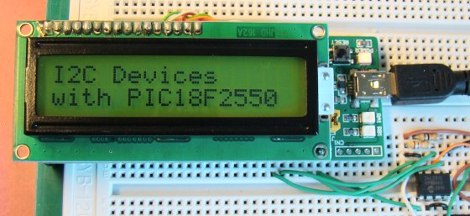
Embedded Labs has come out with a very detailed I2C 101  tutorial, that you should check out if you have any questions on the system. I2C is a short distance serial interface that only requires 2 bus lines. Keep in mind that as wires go down complexity goes up. While there are more than a few I2C devices out there in the wild, and the 2 wire system does make wiring a breeze sometimes, the information required to make use of it often seems confusing to someone who is just starting with it.

The tutorial covers basic theory, stop / start conditions, addressing, data transfer, and acknowledgment plus illustrations. A couple of specific examples are given in the form of a 24LC512 serial eeprom, and a DS1631 digital thermometer complete with code.