Using The Basic SNES Hardware To Play Minecraft

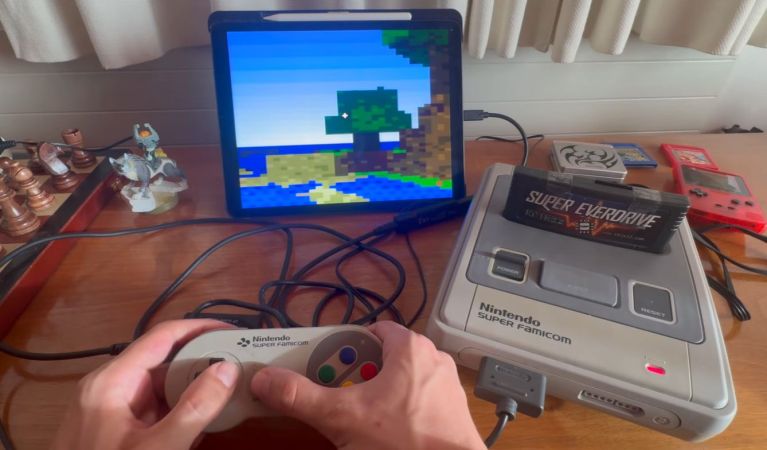
After previously putting a very basic version of Minecraft on the Game Boy Color, [Tobi] decided to have some fun and port that version also to the Super Nintendo (SNES), just to see what would happen with its more powerful hardware. Even without using an add-on chip like the Super FX 3D chip that made games like Star Fox and Doom possible with its 3D-rendered geometry, the basic SNES hardware can already provide a serviceable Minecraft experience.

You can download the SFC file here, featuring a starting world in which you can do all the usual Minecraft-ing shenanigans, like world destruction and construction. Unsurprisingly the game’s resolution is much higher than on the GBC, though the brief glimpse [Tobi] shows of Minecraft on the Game Boy Advance (GBA) with its proper 3D-rendering hardware are leaps ahead of what the basic SNES can do.

This of course raises the question of what Minecraft on the SNES could look like once you add the Super FX or similar 3D accelerator chips for the SNES into the mix. Rather than just being limited to sprite-based graphics and transformations, suddenly you can use real polygons.

Continue reading “Using The Basic SNES Hardware To Play Minecraft”

MicroPython Is This Summer’s Hottest Title For The SNES, Thanks To Claude Fable

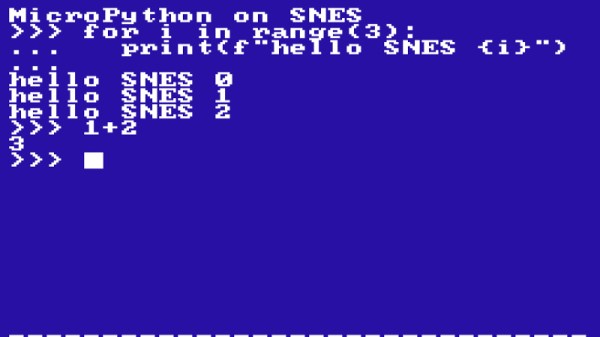
MicroPython, for the uninitiated, is a pared-down version of python meant to run on today’s powerful microcontollers. As impressive as it was for its day, the SNES is not quite in their league in terms of computing power. Time marches on, and so while there may be other indie releases worth mentioning, we’re declaring the hottest SNES game this season to be [Fabian Kübler]’s port of MicroPython.

Well, except he didn’t exactly do the porting himself: the Antrhopic LLM Claude generated the code, and performed most of the testing, as [Fabian]’s test of its new Fable 5 model. A brief pause during an export ban showed that Opus would crash and burn on the same task, but Fable was able to get things quickly back on track. It might be “AI slop” by some definitions, but the port scales 430 out of 468 on MicroPython’s core test/basics, which makes it usable to play some simple python games… slowly.

As you can see for yourself in an embedded emulator if you check out [Fabian]’s blog, spooling up MicroPython takes about twenty seconds at 3.58 MHz, and after that you can watch some sprites bouncing around at a blistering 0.8 FPS. [Fabian] seems satisfied with that performance, and impressed with Fable’s efforts at optimization. What to you think? Does the hardware have much more to give, or is that about it, given the nature of the Pythonic beast? Perhaps some plucky human could become a digital John Henry by producing a better, faster port — if you do, please let us know. If you’d rather just to see what Fable can do, the project is available on GitHub, so you can judge for yourself how sloppy the code is or test out the ROM.

Putting Python onto limited hardware may not to be to everyone’s taste, but there’s a good case to be made for it. The SNES may actually be too limited, though. It makes sense — the kind of micros you run MicroPython on can emulate the SNES.

SNES Controllers Are (Almost) SPI-Compatible

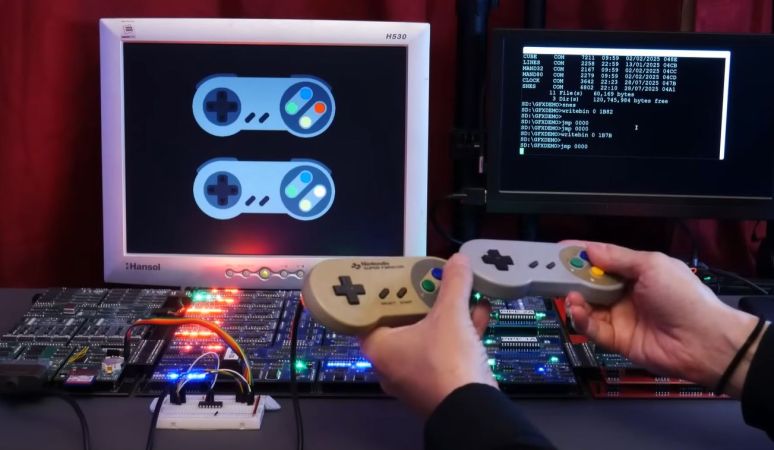
Considering that the Serial Peripheral Interface bus semi-standard has been around since the early 1980s, it’s perhaps not that shocking that the controllers of the Super Nintendo Entertainment System (SNES) would take at least some strong design hints for the used protocol. This does however raise the question of exactly how compatible a SNES controller is when connected to the SPI master peripheral of any random MCU. Recently [James Sharman] set out to answer this question decisively.

The impetus for answering this question came after [James] designed a separate SNES controller board for his homebrew computer system, which led to many comments on that video saying that he could just have hooked the controller up to the SPI board in said homebrew system.

Here the short answer is that the SNES controller protocol is very close to SPI Mode-1, with a similar arrangement of clock/data/chip select (latch) lines and clocking. If you think of the SNES controller as an SPI device with just a MISO line, you’re basically there already. The only niggle that popped up was that the ‘MISO’ line does not get pulled into a high-impedance state when the active-low latch connection is pulled high.

This was fixable by introducing a 74HC125 tri-state buffer IC, after which both the original SD card and twin SNES controllers could be used simultaneously.

Continue reading “SNES Controllers Are (Almost) SPI-Compatible”

Fixing The Damage Of A Botched SNES SuperCIC Mod

Not what you want to see when testing that 'repaired' SNES. (Credit: Skawo, YouTube)
Not what you want to see when testing that ‘repaired’ SNES. (Credit: Skawo, YouTube)

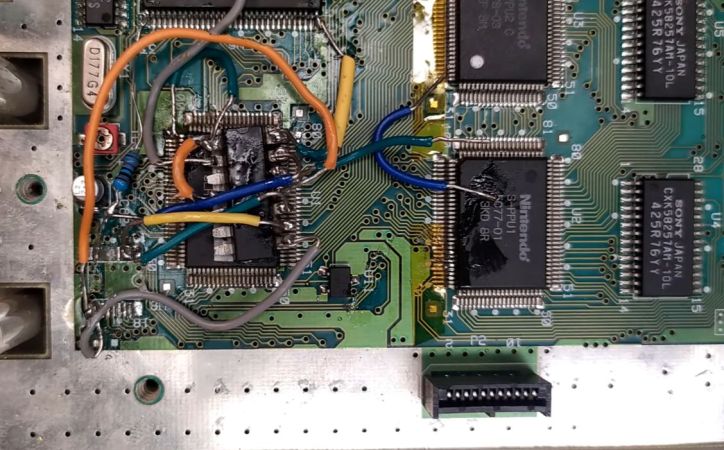
The good part about older game consoles like the Super Nintendo is that they have rather rudimentary region locks, but unfortunately this also gives some people the idea that installing something like the SuperCIC mod chip to make a SNES region-free is easy. The patient that arrived on [Skawo]’s surgery table was one such victim, with the patient requiring immediate surgery to remove the botched installation before assessing the damage.

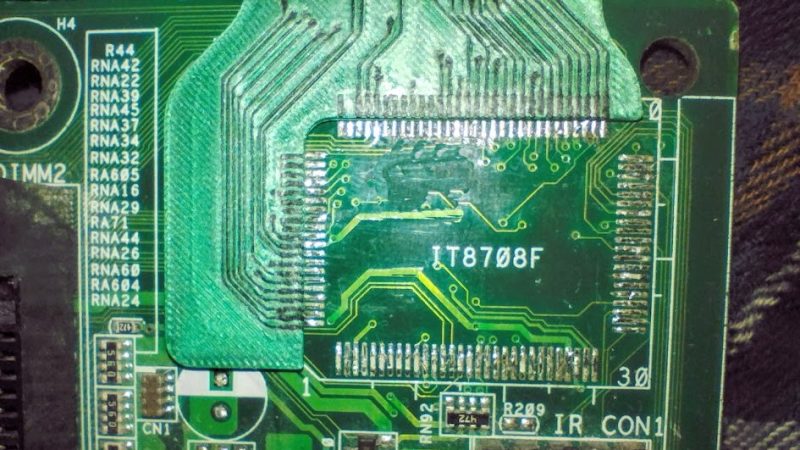
Here the good news was that the patient features the revision B CPU, making it a good console to rescue. The bad news was that the pads of the old CIC chip had been ripped up, there was a solder bridge on S-PPU1 between two pins and both the installed wiring and soldering were atrocious, requiring plenty of touch-ups.

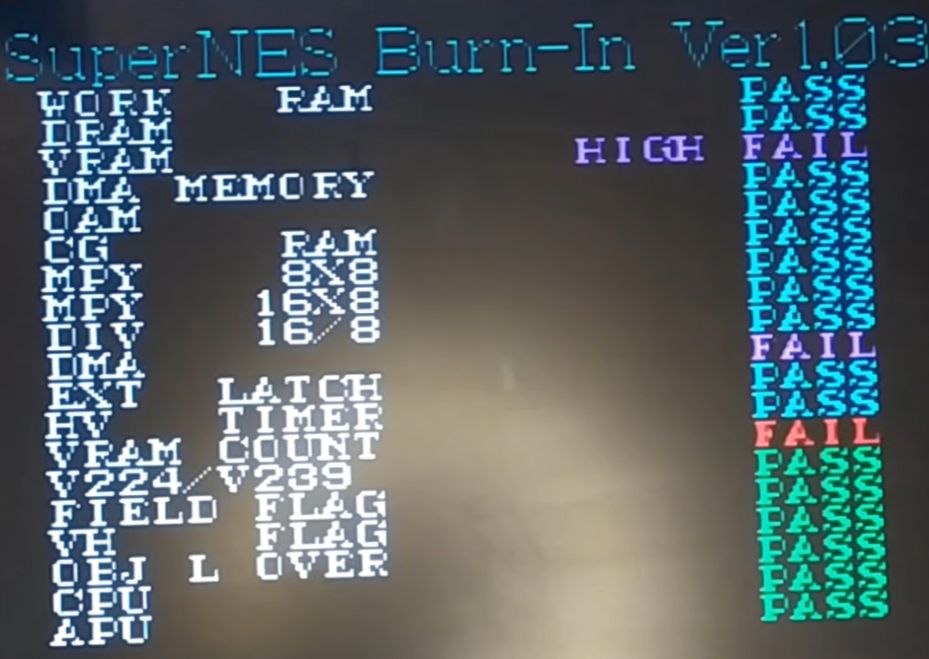
With the CIC pads already a loss, finishing the SuperCIC mod seemed like a good plan, also since this would make for a nice region-free console. This mod involves a PIC16F630 with special firmware that works with the corresponding CIC IC in each cartridge, while also switching between 50/60 Hz mode to fit the cartridge’s region. After an initial test with PAL and NTSC cartridges everything seemed all right. Then [Skawo] ran the SuperNES Burn-In test from its cartridge, which gave dire news.

Continue reading “Fixing The Damage Of A Botched SNES SuperCIC Mod”

A SNES CPU Replacement Via FPGA

Let’s say you had a SNES with a busted CPU. What would you do? Your SNES would be through! That is, unless, you had a replacement based on an FPGA. [leonllr] has been developing just such a thing.

The project was spawned out of necessity. [leonllr] had purchased a SNES which was struck down with a dead CPU—in particular, a defective S-CPU revision A. A search for replacements only found expensive examples, and ones that were most likely stripped from working machines. A better solution was necessary.

Hence, a project to build a replacement version of the chip using the ICE40HX8K FPGA. Available for less than $20 USD, it’s affordable, available, and has enough logic cells to do the job. It’s not just a theoretical or paper build, either. [leonllr] has developed a practical installation method to hook the ICE40HX8K up to real hardware, which uses two flex PCBs to go from the FPGA mainboard to the SNES motherboard itself. As for the IP on the FPGA, the core of the CPU itself sprung from the SNESTANG project, which previously recreated the Super Nintendo on Sipeed Tang FPGA boards. As it stands, boards are routed, and production is the next step.

It’s nice to see classic hardware resurrected by any means necessary. Even if you can’t get a whole bare metal SNES, you might be able to use half of one with a little help from an FPGA. We’ve seen similar work on other platforms, too. Meanwhile, if you’re working to recreate Nintendo 64 graphics chips in your own basement, or something equally weird, don’t hesitate to let us know!

The SNES Seems To Be Getting Faster Over Time

Every Super Nintendo console should run at the same speed. They were all built in factories with the same components so they should all operate at the steady clip mandated by Nintendo all those years ago. Except, apparently, the SNES is speeding up as it gets older.

The matter was brought to the public’s attention by the [TASBot] team, a group within the speedrunning community. If anyone was going to notice vintage consoles suddenly running a hair faster, you could bet it would be the speedrunners. Soon enough, a call was put out to crowdsource some data. Submitters were asked to run a set piece of code to test the DSP sample rate on consoles when cold and warm, to get the best idea of what was going on.

As reported by Ars Technica, the group seems to have pinned down the problem to the SNES’s Audio Processing Unit. It’s supposed to run at 24.576 MHz, with a sample rate of 32,000 Hz. However, over the years, emulator developers and speedrunners had noticed that 32,040 Hz seemed to be a more realistic figure for what real consoles were actually running the DSP sample rate at. Developers found that building emulators to run the DSP at this rate was important to run commercial games as expected, suggesting the hardware might have always been a little faster than expected.

However, more recently, it seems that the average speed of the DSP sample rate has increased further. The average result collected by [TASBot] from modern consoles is 32,076 Hz. What’s more interesting is the range of submitted figures—from 31,976 Hz to 32,349 Hz. It seems that the DSP’s ceramic resonator—used instead of a quartz crystal—might degrade over time, causing the speedup. [TASBot] team members also tested temperature changes, but only found a 32 Hz variation from a frozen SNES to one at room temperature.

The fact that console components degrade over time isn’t exactly news; we’ve featured plenty of articles on leaky batteries and corroded traces. Still, for speedrunners, the idea that the hardware standard itself can shift over time? It’s like feeling quicksand under your feet. What even is reality anymore?

[Thanks to s7726 for the tip!]

Are CRT TVs Important For Retro Gaming?

We always thought the older console games looked way better back in the day on old CRTs than now on a modern digital display. [Stephen Walters] thinks so too, and goes into extensive detail in a lengthy YouTube video about the pros and cons of CRT vs digital, which was totally worth an hour of our time. But are CRTs necessary for retro gaming?

The story starts with [Stephen] trying to score a decent CRT from the usual avenue and failing to find anything worth looking at. The first taste of a CRT display came for free. Left looking lonely at the roadside, [Stephen] spotted it whilst driving home. This was a tiny 13″ Sanyo DS13320, which, when tested, looked disappointing, with a blurry image and missing edges. Later, they acquired a few more displays: a Pansonic PV-C2060, an Emerson EWF2004A and a splendid-looking Sony KV24FS120. Some were inadequate in various ways, lacking stereo sound and component input options.

A poor analog cable coupled with rendering inaccuracy gives a nice filtering effect

A large video section discusses the reasons for the early TV standards. US displays (and many others using NTSC) were designed for 525 scan lines, of which 480 were generally visible. These displays were interlaced, drawing alternating fields of odd and even line numbers, and early TV programs and NTSC DVDs were formatted in this fashion. Early gaming consoles such as the NES and SNES, however, were intended for 240p (‘p’ for progressive) content, which means they do not interlace and send out a blank line every other scan line.  [Stephen] goes into extensive detail about how 240p content was never intended to be viewed on a modern, sharp display but was intended to be filtered by the analogue nature of the CRT, or at least its less-than-ideal connectivity. Specific titles even used dithering to create the illusion of smooth gradients, which honestly look terrible on a pixel-sharp digital display. We know the differences in signal bandwidth and distortion of the various analog connection standards affect the visuals. Though RGB and component video may be the top two standards for quality, games were likely intended to be viewed via the cheaper and more common composite cable route.

Continue reading “Are CRT TVs Important For Retro Gaming?”