Hacklet 83 – Tiny Robot Projects

Hackers, makers, and engineers have been hacking on robot projects since the era of clockwork mechanics. Any robot is a cool project, but there is something particularly attractive about small ones. Maybe it’s the skill required to assemble them, or perhaps it’s the low-cost. Either way, there are lots of palm-sized robot projects on Hackaday.io. This week on the Hacklet, we’re going to highlight a few of them!
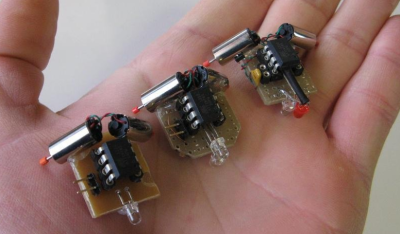
tinyrobot2We start with the granddaddy of them all, [shlonkin] and Tiny robot family. [Shlonkin] built line following robots that can hide under a US half-dollar coin. The robots are simple circuits – an ATtiny85 with an LED and pair of phototransistors. The code is provided both in Arduino’s wiring, and in straight C++. Two coreless motors, normally used in cell phones vibrators or quadcopters, provide the locomotion. These robots only know one thing – moving forward and following a line. They do it well though! We love this project so much that we hosted a tiny robot workshop at the 10th anniversary back in 2014.
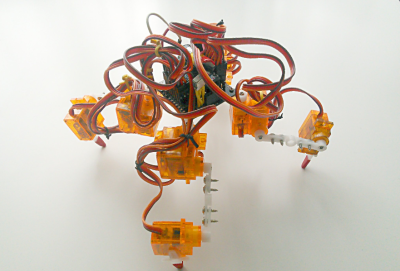
toteWhen it comes to tiny walking robots, [Radomir Dopieralski] is the king. Many of his projects are small biped, quadruped, or even hexapod robots. He’s done things with 9 gram nano servos that we thought were impossible. Tote, an affordable spider robot, is his latest creation. Tote is a four-legged bot utilizing 12 9 gram servos. [Radomir] created a custom PCB for Tote, which acts as a carrier for its Arduino Pro Mini Brain. This robot is easily expandable – [Radomir] has experimented with the Teensy 3 series as well. Controlling the robot can be anything from an ESP8266 to an infrared remote control.
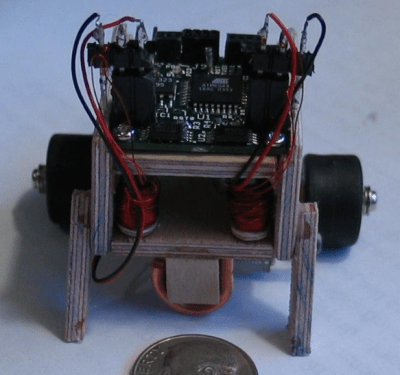
botbot[Alan Kilian] may well have the ultimate tease project with Hand-wound inductors for a tiny robot. [Alan] was using some tiny GM-10 motors on his micro-bot. The motors didn’t have inductance for the locked-antiphase drive controller. His solution was to wind some coils to provide a bit of added inductance. The mod worked, current consumption dropped from 116 ma to about 6 ma. We want to know more about that ‘bot though! It’s controlled by a Megabitty, [Monty Goodson’s] ATmega8 controller board from sometime around 2003. The lilliputian board has been very popular with the nano sumo crowd. Other than the controller, motors, and the plywood frame, [Alan] has left us guessing about his robot. If you see him, tell [Alan] to give us more info on his micro robot’s design and construction!
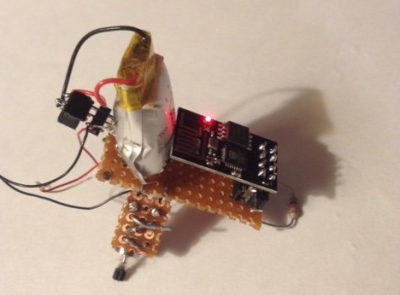
 

espbot[Ccates] jumped on the tiny robot bandwagon with Tiny wi-fi robot. Rather than go with an Arduino for control, [Ccates] grabbed the popular ESP-8266 WiFi module. The construction of the bot is inspired by [shlonkin’s] tiny robot family up above. This bot is controlled by the Xtensa processor embedded in the ESP-8266. Since it only drives forward, it only takes two GPIO pins to control the transistors driving the motors. Even the diminutive ESP-01 module has enough I/O for that. We’d love see some sensors and a full H-bridge on this micro beastie!


If you want to see more palm-sized robot projects, check out our new tiny robot projects list! These ‘bots are small, so I may have missed yours. If that’s the case, don’t be shy, just drop me a message on Hackaday.io. That’s it for this week’s Hacklet. As always, see you next week. Same hack time, same hack channel, bringing you the best of Hackaday.io!


The Latest, Best WiFi Module Has Been Announced

A little more than a year ago, a new product was released onto the vast, vast marketplace of cheap electronics. It was the ESP8266, and this tiny and cheap WiFi module has since taken over the space of hobbyist electronics and become the de facto standard for connecting tiny microcontrollers to the Internet.

Now there’s an upgrade on the horizon. [John Lee], the public face of Espressif, the makers of the ESP8266, has announced the next product they’re working on. It’s called the ESP32, and if the specs given are correct, it looks to be the next great thing for the Internet of Things.

The ESP32 will now contain two Tensilica processors running at 160MHz, compared to the ‘8266’s one processor running at 80 MHz. The amount of RAM has been increased to 400 kB, Bluetooth LE has been added, WiFi is faster, and there are even more peripherals tucked away in this tiny piece of silicon.

The new ESP32 includes new, simplified APIs and unlike when the ESP8266 was announced, documentation in English.

Right now, Espressif is beta testing the ESP32, with about 200 boards manufactured so far. If you’re one of the few lucky people who have one of these boards on your workbench, we’d love to see your take on it.

IPhone Jailbreak Hackers Await $1M Bounty

According to Motherboard, some unspecified (software) hacker just won a $1 million bounty for an iPhone exploit. But this is no ordinary there’s-a-glitch-in-your-Javascript bug bounty.

On September 21, “Premium” 0day startup Zerodium put out a call for a chain of exploits, starting with a browser, that enables the phone to be remotely jailbroken and arbitrary applications to be installed with root / administrator permissions. In short, a complete remote takeover of the phone. And they offered $1 million. A little over a month later, it looks like they’ve got their first claim. The hack has yet to be verified and the payout is actually made.

But we have little doubt that the hack, if it’s actually been done, is worth the money. The NSA alone has a $25 million annual budget for buying 0days and usually spends that money on much smaller bits and bobs. This hack, if it works, is huge. And the NSA isn’t the only agency that’s interested in spying on folks with iPhones.

Indeed, by bringing something like this out into the open, Zerodium is creating a bidding war among (presumably) adversarial parties. We’re not sure about the ethics of all this (OK, it’s downright shady) but it’s not currently illegal and by pitting various spy agencies (presumably) against each other, they’re almost sure to get their $1 million back with some cream on top.

We’ve seen a lot of bug bounty programs out there. Tossing “firmname bug bounty” into a search engine of your choice will probably come up with a hit for most firmnames. A notable exception in Silicon Valley? Apple. They let you do their debugging work for free. How long this will last is anyone’s guess, but if this Zerodium deal ends up being for real, it looks like they’re severely underpaying.

And if you’re working on your own iPhone remote exploits, don’t be discouraged. Zerodium still claims to have money for two more $1 million payouts. (And with that your humble author shrugs his shoulders and turns the soldering iron back on.)

Building Memristors For Neural Nets

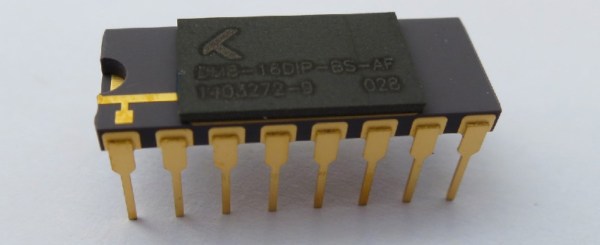
Most electronic components available today are just improved versions of what was available a few years ago. Microcontrollers get faster, memories get larger, and sensors get smaller,  but we haven’t seen a truly novel component for years or even decades. There is no electronic component more interesting with more novel applications than the memristor, and now they’re available commercially from Knowm, a company that is on the bleeding edge of putting machine learning directly onto silicon.

The entire point of digital circuits is to store information as a series of ones and zeros. Memristors as well store information, but do so in a completely analog way. Each memristor changes its own resistance in response to the current going through it; ‘writing’ a positive voltage lowers the resistance, and ‘writing’ a negative voltage puts the device back into a high resistance state.

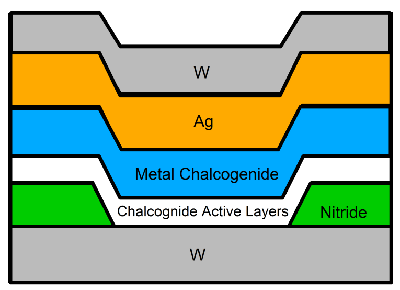
Cross section of the metal chalcogenide memristor. Source: Knowm.org

This new memristor is based on research done by [Dr. Kris Campbell] of Boise State University – the same researcher responsible for silver chalcogenide memristors we saw earlier this year. Like these earlier devices, the Knowm memristror is built using silver chalcogenide molecules. To lower the resistance of the memristor, a positive voltage ‘pulls’ silver ions into the metal chalcogenide layer. The silver ions stay in this chalcogenide layer until they are ‘pushed’ back with the application of a negative voltage. This gives the memristor it’s core functionality – being able to remember how much current has gone through it.

This technology is different from the first memristors made by HP in 2008, and has allowed Knowm to create functional memristors on silicon with a relatively high yield. Knowm is currently selling a ‘tier 3’ memristor part that only has two out of eight devices failing QC testing. A ‘tier 1’ part, with all eight memristors working, is available for $220 USD.

As for applications for this memristor, Knowm is using this technology in something they call Thermodynamic RAM, or kT-RAM. This is a small coprocessor that allows for faster machine learning than would be possible with a computer with a much more traditional architecture. This kT-RAM uses a binary tree layout with memristors serving as the links between nodes.

While it’s much too soon to say if a kT-RAM processor will be better or more efficient at performing machine learning tasks in real life, a machine learning coprocessor does have a faint echo of the machine learning silicon developed during the 80s AI renaissance. Thirty years ago, neural nets on a chip were created by a few companies around Boston, until someone realized these neural nets could be simulated on a desktop PC much more efficiently. The kT-RAM is somewhat novel and highly parallel, though, and with a new electronic component it could be just what is needed to push machine learning directly into silicon.

Continue reading “Building Memristors For Neural Nets”

Hack The Steam Controller?

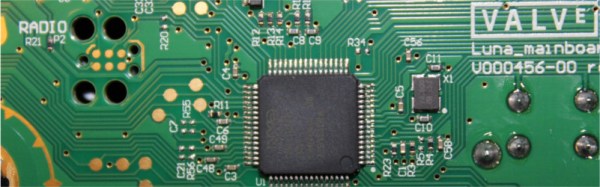
[willrandship] sent in a conversation from Reddit discussing the programming ports inside the Steam controller and their potential for hacking. From the posts and the pictures it seems the radio/SoC and the MCU can be programmed on the board, or at least they both have JTAG headers. The JTAG headers are in the form of “Tag-Connect” pads on the board so it will require the dedicated cable or soldering some hardware to the board temporarily.

From the pictures we can see a NXP LPC11U37F ARM Cortex-M0 and a Nordic nRF51822 ARM Cortex-M0 SoC with integrated Bluetooth low energy. There are only a limited number of Steam Controllers in the wild at this time so we don’t expect much in the way of hacking them thus far. There is a Steam Controller hackaday.io project just started for anyone who would like to contribute to the Steam Controller hacking.

Continue reading “Hack The Steam Controller?”

Stellarator Is Germany’s Devilishly Complex Nuclear Fusion

You may not have heard of a Stellarator before, but if all goes well later this month in a small university town in the far northeast of Germany, you will. That’s because the Wendelstein 7-X is finally going to be fired up. If it’s able to hold the heat of a fusion-capable plasma, it could be a huge breakthrough.

So what’s a stellarator? It’s a specific type of nuclear fusion containment geometry that, while devilishly complex to build and maintain, stands a chance at being the first fusion generator to achieve break-even, where the energy extracted from the fusion reaction is greater or equal to the energy used in creating the necessary hot plasma.

There’s an awesome video on the W7-X, and some of the theory behind the reactor just below the break.

Continue reading “Stellarator Is Germany’s Devilishly Complex Nuclear Fusion”

Lithium-Air Might Be The Better Battery

Researchers at Cambridge University demonstrated their latest version of what is being called the Lithium-Air battery. It can be more accurately referred to as a Lithium-Oxygen but Air sounds cooler.

The early estimates look pretty impressive with the energy density being 93% efficient which could be up to 10 times the energy density of Lithium-Ion and claims to be rechargeable up to 2,000 times.  Recent improvements toward Lithium-Air batteries include a graphene contact and using lithium hydroxide in place of lithium peroxide which increased both stability and efficiency.

Here’s the rub: Lithium-Air batteries are still years away from being ready for commercial use. There are still problems with the battery’s ability to charge and discharge (kind of a deal breaker if the battery won’t charge or discharge right?) There are still issues with safety, performance, efficiency, and the all too apparent need for pure oxygen.

Do batteries get you all charged up? Check out our coverage of MIT’s solid state battery research, or have a look at the Nissan Leaf and/or Tesla battery packs.

Thanks to [Jimmy] for the tip.