
Upverter 2.0 Launches

Disclosure: I currently work at Upverter

We’ve featured Upverter here in the past. At that time, the EDA tool was capable of collaborative schematic capture. Today, Upverter is launching version 2.0 of their tool which includes many new features allowing for end-to-end electronics design.

Upverter now has a PCB editor, allowing you to manufacture your designs. They are working with PCB manufacturers to make it easy to choose a fab and submit design files. Other new features include a Spice based simulation engine allowing in-browser simulation, and product lifecycle management features to help manage your project’s bill of materials.

When we last looked at Upverter, it was just a tool for creating and sharing schematics. With today’s launch, the tool can be used for designing electronics from start to finish. Since Upverter is free for open source projects, it will be interesting to see how hackers use it.

You can check out a tour of the new features. Any thoughts on using a cloud based EDA tool? Let us know in the comments.
Custom Circuit Drives A Small Round CRT Display

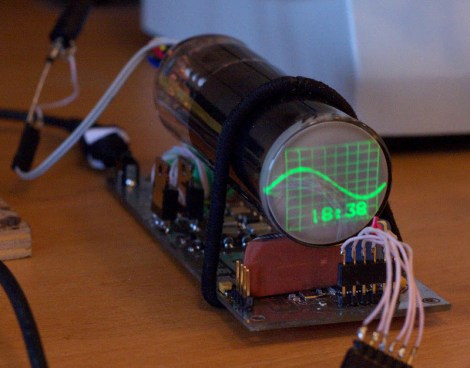
[Svofski’s] latest hack seeks to do no more than look cool on his desk. We’d say mission accomplished. He doesn’t even need anyone around to be proud of the small round CRT display unit he put together. Just having it hum away next to him will be more than enough to keep him going when regular work gets a bit tedious.

One of the biggest challenges when working with a cathode ray tube is the supply. He compares the requirements with that of Nixie tubes, and this is quite a bit more challenging since he wants to generate the 750V from a 12V DC source. To pull it off he hand wound his own transformer. There are two secondary coils, one for the cathode heater and the other as the supply. You can see a brief clip of the unit in action after the break.

Take note of the PCB section of his writeup. He took a meandering route through several different software packages before printing the board. It started with Eagle, moved to freerouting.net, which produced a Specctra file that he converted to gEDA using a Python script.

Continue reading “Custom Circuit Drives A Small Round CRT Display”

Building A 100 MHz Frequency Counter

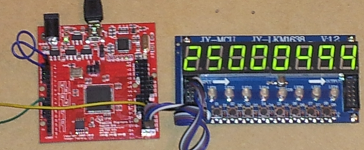
The great thing about building with gates is the crazy speeds you can achieve by using hardware directly (as opposed to working with simple microcontrollers). This 100 MHz frequency counter is a great example. [Michael] just finished building it using a Papilio board.

Of course we’re not talking about discreet chips here. The Papilio is an FPGA development board which means he is building with hardware gates, but that is still done by writing code. Above, the rig is measuring a 25 MHz being generated by a second FPGA board. Using the Papilio’s on board 32 MHz clock the device is capable of counting a frequency up to 100 MHz. You can see it measuring a 96.875  MHz signal in the video after the break. One interesting thing about that clip is that near the end he touches the crystal’s case with his finger and the Hertz really jump for a moment.

If the 8-digit display looks familiar that’s because [Michael] recently published a library to use it with an FPGA.

Continue reading “Building A 100 MHz Frequency Counter”

Portal Gun Hack Approaches 1.5 Million Views. More Fun Hacks To Come!


The quick and simple portal gun hack was published a little ver a week ago and has cleared almost 1.5 million views. This is just a taste of things to come as we plunge into creating more fun original content for hackaday. If you haven’t yet, you should go subscribe to our youtube channel.

We have many more exciting projects planned for the near future. Projects involving high voltage, lasers, and thermite! We could always use more ideas though. What projects would you like to see done? Think big, we want to remind people just how awesome hacking can be!

We now have access to some high speed cameras, a wonderful and professional gentleman named [Jay] who is an astounding video editor, and quite possibly the brightest readership in the universe. Let us know your ideas for awesome projects!

Continental Europe’s First Maker Faire

Continental Europe’s first official sanctioned Maker Faire is well underway in the Netherlands, tucked away at the Open Lab Ebbinge in the city of Groningen.

Of course the Groningen Maker Faire will feature cool builds like the bike-mounted workshop built by [Bertoa] we’ve seen and a few wind-powered beach animals inspired by the work of [Theo Jansen]. Also on the schedule are a 3D printed zoetrope, delta robot pick and place, radio controlled submarines, and of course a fleet of electric go karts.

A few of the talks involve a mashup of Google Earth and 3D modeling from [Ronald van Aalst] [Dick Stadaand], and a very interesting talk on disability insurance for self-employed entrepreneurs from [Biba Shoemaker] and [Andre Jonkers].

[buZz] from the NURDspace hackerspace in Wageningen wrote in to tell us he’ll be participating in the Groningen Maker Faire’s Scrapheap Challenge, an awesome contest that pits teams against each other to build something in a setup very similar to the fondly remembered Junkyard Wars.

Of course, Hackaday’s writers and editors are about 3,000 miles away from continental Europe’s first Maker Faire, so we can’t provide any live updates. If you have any pictures or video, send them in and we’ll put them up.

Acoustic Barcodes Deliver Data With A Fingernail And Microphone

Either through QR codes, RFID, or near field communication, there seems to be some desire to share tiny pieces of data in a more physical and accessible form. [Chris Harrison], [Robert Xiao], and [Scott E. Hudson] of the HCI Institute at Carnegie Mellon have come up with a fairly interesting solution of making data more physical. They call it Acoustic Barcodes, and it’s able to store over a billion unique IDs in a small strip of plastic.

By engraving a barcode pattern into a piece of wood, stone, glass, or plastic, the guys then attached a microphone to the barcode and ran their fingernails across their invention. A computer interprets the sounds of a finger scraping against the acoustic barcode and produces a series of 1s and 0s.

This binary code can be used to look up various items in a database, or perform actions on a computer. In the video after the break, you can see these acoustic barcodes attached to a whiteboard to provide real tactile control of a video projector.

You can check out a PDF of the Acoustic Barcode paper here.

Continue reading “Acoustic Barcodes Deliver Data With A Fingernail And Microphone”

Hackaday’s Portal Gun Actually Levitates A Companion Cube

I was out to lunch with a couple friends, brainstorming ideas for fun projects when one of them says “Wouldn’t it be cool if we could build a working gravity gun?”. We all immediately concurred that while it would in fact be cool, it is also a silly proposition. However, only a few seconds later, I realized we could do a display piece that emulated this concept very easily. Floating magnetic globes have been around for quite some time.

I determined I would tear the guts out of a stock floating globe and mount it on a portal gun, since they’re easier to find than a gravity gun. I would also build a custom companion cube to be the correct size and weight necessary.

Continue reading “Hackaday’s Portal Gun Actually Levitates A Companion Cube”