NC Maker Faire 2012: Robot Hockey

nc-robot-hockey

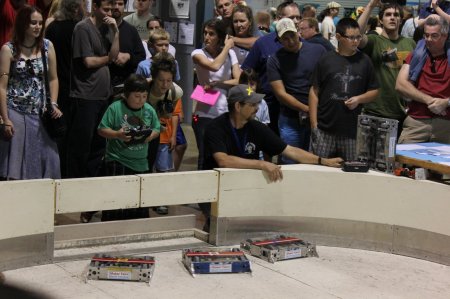
Robot combat has inspired makers probably since the first one was conceived.  Whether it’s an epic struggle between two future superpowers, or simply a friendly match of robot hockey, it’s always fun to watch. NC Maker Faire 2012 was no exception as [Carolina Combat Robots] had a small arena with remote control robots going at it. The matches were incredibly popular, and I was glad to be able to see some of it from my table next door!

Check out the video after the break for some footage of these ‘bots in action! Continue reading “NC Maker Faire 2012: Robot Hockey”

AVC From The Vehicle’s Perspective

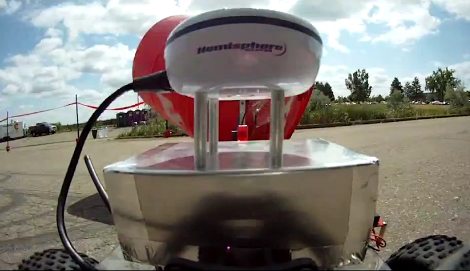
Team 0x27 was the winner of this year’s AVC, the Autonomous Vehicle Contest put on by SparkFun Electronics. You’ll find video of the two runs from this entry (the third run did not finish). We love it that there’s an on-board camera recording both video and sound of the race from the vehicle’s point of view. They haven’t updated their team page yet but we’re sure they will once their done celebrating.

On the first run the team opted not to use obstacle avoidance, and here you can see it annihilating one of the barrels from the course (this is the second one it took out with hulk-like rage). These collisions didn’t keep it from finishing the circuit. On the second run it didn’t slam into anything. Because of the hoop-deduction (a bonus for threading the needle during the run) the official time came in at 2.08 seconds. Still, the unadjusted time of 32.08 seconds is a course record and beat the fastest finisher from the airborne group of compeititors. Nice.

Seriously, this video just cracks us up!

Continue reading “AVC From The Vehicle’s Perspective”

Mini Waterproof LED Lanterns Charge Without Wires

inductive-charge-led-lights

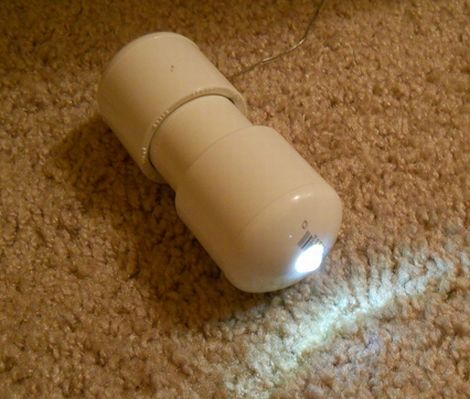
If you’re in search of a flashlight that can stand up to the elements, or simply looking for an easy way to spruce up your pool for those hot summer nights, check out these rechargeable PVC LED lights. Inspired by a post in Make: Magazine featuring Indestructible LED Lanterns, [John Duffy] decided to take the project one step further.

While he liked Make’s iteration of the waterproof lantern, he thought it would be best to permanently seal the lights for maximum durability. Not satisfied with a one-use light, he equipped the PVC lanterns with a single rechargeable AA battery, step-up circuitry to drive the LED, and an inductive charging coil.

His floating, waterproof lights sport a slightly bigger footprint than their predecessors to house the extra electronics, but we think that’s more than a fair trade off considering they can be charged wirelessly.

Place your Digikey/Mouser/Jameco orders now and check out [John’s] how-to video – you just might get some of these built in time for the weekend!

[via HackedGadgets]

Continue reading “Mini Waterproof LED Lanterns Charge Without Wires”

Mini Maker Faire In Eugene, OR This Weekend

[Rick Osgood] wrote in to tell us about the Eugene, OR Mini Maker Faire going on this weekend. The event is being hosted on the grounds of the Science Factory with a lot of help from the Eugune Makerspace

So far, Steamworks Cycles, the South Eugene Robotics Team, Oregon Rocketry and Eugene Rocketery will be at the Maker Faire showing off their skills and wares. It looks like an excellent place to spend the day, with events hosted by the Science Factor and the Eugene Makerspace all day long.

Tickets are $4.00 a pop; easy enough on our wallets, but unfortunately the official Hackaday transporter pad won’t be ready in time for this weekend. If anyone would like to write a blog post about the sights and sounds of the Eugene Mini Maker Faire, send it in and we’ll put it up.

Introducing Hack A Day: The Retro Edition

Hack a Day hasn’t change its format since 2004. Even though MAKE has gone Web 2.0 with buttons using mouseover, and Instructables has fancy drop-down menus, Hack a Day has been a constant black background, green text child of the web circa 2004. A while ago, we decided it was time for an update to our layout. Today we’re pleased to announce an open beta test for our upcoming update – Hack a Day: the retro edition.

In case you’re wondering, yes, this is a joke, and no, we’re not going all Web 0.1a on you.

The retro edition is a little side project to our upcoming update where we’ll be rolling out a new template for Hack a Day. We’re going to fix a lot of the problems with the current template – searching, and an admittedly terrible commenting system design – and generally ‘cleaning up’ the design. We already have the store up and running, so progress on the update is slowly being made.

As far as the retro edition goes, we’re keeping that. We’ve had a few nerd-offs trying to load Hack a Day on the oldest computer possible, so a version of Hack a Day built for computers from 1983 seemed like a worthwhile goal. Think of it as a challenge: if you can send in a picture of your Commodore PET loading up the retro edition, we’ll add you to the retro successes page.

There’s a bit more we’d like to do with the retro edition, namely guides to getting your old computers up on the Internet. As a little bonus (and in keeping with the retro theme), we’re putting up a few classic Hack a Day posts from the days of yore.

So, there you go. We’ve tested the retro edition on a Mac PowerBook 170 and a Quadra 700, but feel free to dig out your old hardware and give this a spin.

EDIT: As far as the ‘retro competition’ goes, [Jaromir] wrote in and brought up an interesting point: Loading that .GIF logo would be really hard on computers with kilobytes of ram, so I’m changing that to a .BMP. Just so we’re all clear, there are no official rules, you’re competing against yourself, and if you can get a picture of an old computer loading this site, you’re going to be listed on the ‘successes’ page.

Visual Rain Sensor — So You Never Have To Look Outside

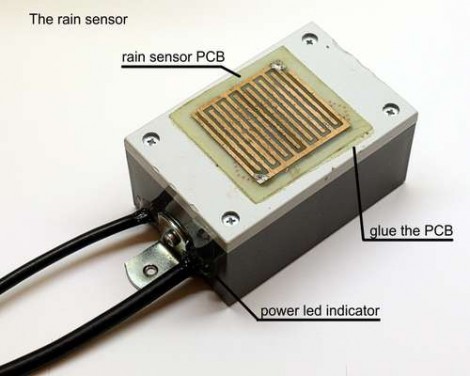
Now you can find out how hard it is raining outside without leaving the confines of your mancave/womancave. Pictured above is the sensor portion of what [Frapedia] calls his visual rain sensor.

Most rain gauges just use a graduated cylinder to capture water as it falls from the sky. That will give you a reasonably accurate measure of how much it rained, but it tells you nothing about how hard it rained. The measurement made here is based on sound. The harder it rains, the lounder the sound will be from water hitting an up-turned metal bowl. The unit above turns the system on when water bridges the traces, then a microphone is used to monitor the sound from the bowl. This is visualized by a VU-meter chip on a column of LEDs mounted inside the house.

After the break you can see the project box that houses the status display. We say it’s too small an needs to be replaced with a much larger LED meter.

Continue reading “Visual Rain Sensor — So You Never Have To Look Outside”

3d Printing, The New Frontier Of Piracy?

We’ve all heard the countless arguments about piracy in digital media. However, it appears that 3d printing or other rapid prototyping systems are bringing legal issues to a more physical world. The story goes like this: [Thomas]  bought a 3d printer. He’s a big fan of warhammer figurines. He spends tons of time creating some custom warhammer figures, and uploads them to thingaverse. Games Workshop, the owners of Warhammer, unleashed the lawyers and had the items removed.

There are so many angles to this story, the mind boggles. If I were an artist, and someone else was uploading copies of my work, essentially stopping my revenue, it would suck. Then again, if I were lucky enough to have a fanatical fan base that spread the love for my product with excitement and zeal, I might want to encourage them. Neither of those thoughts however, cover the legal issue at the base here. We don’t have an answer for you. Sorry. You’ll probably be seeing this issue pop up more and more often in the future.

We encourage you to make our logo. Though we haven’t bothered to ask our lawyers.