Weekly Roundup 2/18/12


In case you missed them the first time around, here are our most popular posts from the previous week:

Our most read post is one about [Ben’s] project where he created an electric motorcycle that has a range of 20 miles. This is a pretty comprehensive tutorial that goes into some good detail about what you will need to do to convert a motorcycle over to electric.

Coming in at second place is [dmw’s] project where they created their own keyboard from scratch. We’re not too sure about the choice to stick the space bar(s) up in the corners but otherwise it looks like a really nice build.

Are you one of *those* people who likes to make the presents that they give as difficult as possible to open? Our #3 post of the week is one project that you should definitely check out. In this post, [Neowinian^2] shows how he and some friends encased some wedding cash inside of a giant cube of sugar!

Have you always wanted to say that you took some classes at MIT but were caught by the little technicality that you didn’t live in Boston? Fret no more my friend, MIT has just announced an online class program. You won’t be able to get a MIT degree remotely quite yet but this is a step in that direction.

Finally, we get to another keyboard project. This keyboard is a programmable keyboard that almost looks like the keypad on the end of an accordion (plus some other goodies). This keyboard was built by [Tim Tyler] and is designed to allow you to take full advantage of your thumbs instead of banishing them to the space bar.

MITx First Course Announce – 6.002x: Circuits And Electronics

The Massachusetts Institute of Technology just announced the first course offering in their new online classes program. Great news, it’s an analog design course which is right up our alley. The prototype session will be 6.002: Circuits and Electronics.

If you’re a fan of our links posts you may remember hearing about the MITx program a month ago. After seeing the popularity of the Stanford program MIT is throwing their hat into the ring too. So what is this all about? How does it work and what will you learn? There’s bits of information all over the place. We recommend reading the news link at the top of this feature first. Next you should wade through the 6.002x FAQ and if you’re still interested there’s a big maroon enrollment button at the bottom of the course summary page.

Whew, that’s a lot of links. Anyway, expect to spend 10 hours a week on the class; but it’s all free. Future offerings will be free as well, but MIT plans transition to a pay-for-certificate option: “students who complete the mastery requirement on MITx will be able to receive the credential for a modest fee.” If you still haven’t made up your mind take a gander at the promo clip after the jump.

Continue reading “MITx First Course Announce – 6.002x: Circuits And Electronics”

Weekly Roundup 2/11/12


In case you have been on vacation, here is the best that we have had on our blog in the past week:

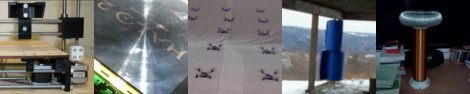
In first place is a post about [the University of Pennsylvania’s] quadcopter team. This time they have a group of twenty quadcopters flying in formation.

In second place is a post about a nice project by [Joel] where he converted an overhead projector into a TV projector by projecting through a LCD TV. He went all-out on this one by using a CNC machine to cut out a special holder for the LCD and the fans necessary to cool it.

Next up we have a post about a project where a 55 gallon plastic barrel is turned into a wind turbine. We’re not sure about how much power this would produce but it would probably be fun to play around with.

Following that is a follow up post about Printrbot, an inexpensive 3D printer which we previously posted about. It was a successful Kickstarter project a couple of months ago and now the design files have been released into the wild. Check it out!

Finally we finish off with a post about how to build a solid-state Tesla coil. It’s presented in an Instructable with 12 easy steps so that you too can feed your high-voltage addiction.

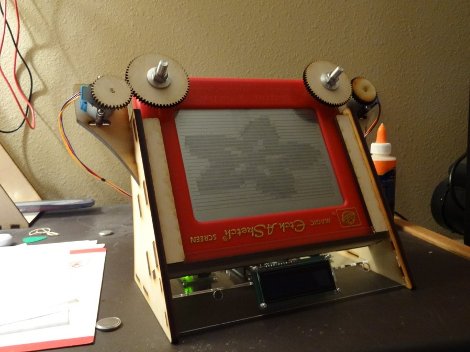
Robotic Etch-a-Sketch Draws Grayscale Images

[Patrick] decided to make a computer controlled etch-a-sketch. While the idea is not that new, there is always a different way to accomplish a goal. An Arduino is used to control a pair of stepper motors which were sourced for pretty cheap, and even came with their own driver. Next a stand was mocked up using foam board, which helps determine where all the parts should live.

Next was a way to attach the steppers to the knobs, gears would be used and a collet meant for model airplanes was sourced to make the mechanical connection between gear and shaft. With everything set in place via foam board and paper printouts, it is off to get some thin plywood. The plywood is sent though a laser cutter creating most of the stand and gears. Now its all software, a program was whipped up for OSX which converts low res pictures into squiggly lines perfect for the etch-a-sketch to draw on its screen.

The results are quite impressive, join us after the break for a quick video.

Continue reading “Robotic Etch-a-Sketch Draws Grayscale Images”

Kinect For Windows Released

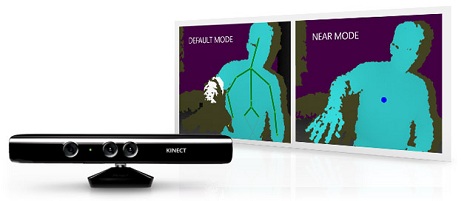
Even though we’ve seen dozens of Kinect hacks over the years, there are a few problems with the Kinect hardware itself. The range of the Kinect sensor starts at three feet, a fact not conducive to 3D scanner builds. Also, it’s not possible to connect more than one Kinect to a single computer – something that would lead to builds we can barely imagine right now.

Fear not, because Microsoft just released the Kinect for Windows. Basically, it’s designed expressly for hacking. The Kinect for Windows can reliably ‘see’ objects 40 cm (16 in) away, and supports up to four Kinects connected to the same computer.

Microsoft set the price of Kinect for Windows at $250. This is a deal breaker for us – a new Kinect for XBox sells for around half that. If you’re able to convince Microsoft you’re a student, the price of the Kinect for Windows comes down to $150. That’s not too shabby if you compare the price to that of a new XBox Kinect.

We expect most of the builders out there have already picked up a Kinect or two from their local Craigslist or Gamestop. If you haven’t (and have the all-important educational discount), this might be the one to buy.

Analog Joypad For Your Retro PC

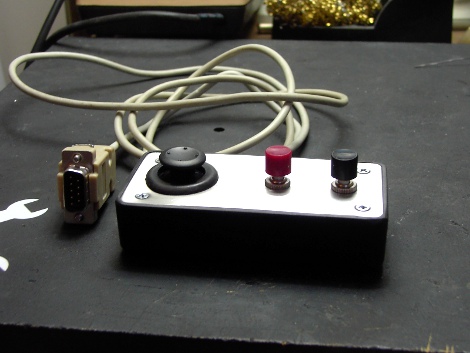
Part of the fun with old computers is playing some old school games, and while you could play them with a keyboard it is much more fun with a joystick. You can get old joysticks all day long on auction sites, but you have to watch out. Some are digital, which wont work for many games on many systems. Some were cheap to begin with and probably worn out, and many are flight sticks … ever play pac-man with a giant flight stick?

What I really wanted was a game pad like device for my 1986 Apple //c , using one of the modern thumbstick analog controllers. Using a thumbstick out of an old XBOX(1) controller, some generic parts from Radio Shack, and a little bit of effort , I ended up with exactly what I wanted.

Join us after the break and I will show you how to get there!

Continue reading “Analog Joypad For Your Retro PC”

The Phone Box

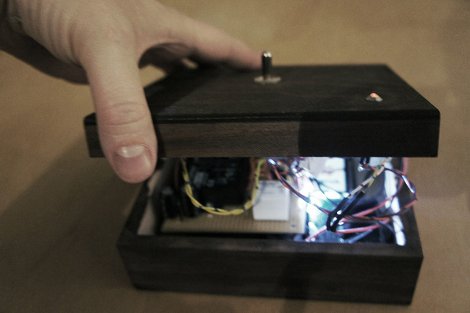
[Nerdindustries] had a interesting idea; “what if you could just flip a switch and call someone?”. This happens a lot, especially in companies where your trying to catch a certain someone who is always swamped in phone calls. The Phone Box is a basic Nokia cellphone that has a number stored into its speed dial. To help aid in communication the phones output is directed to a three and a half watt amplifier module ensuring that your going to hear it.

A delay circuit was made out of a basic RC network, so when you hit the switch the phone has a chance to power up and fully boot. Once the delay triggers it presses the speed dial button and off you go. Now someone has already asked “Why don‘t you just call them?”, and we got a kick out of the first answer “calling someone is NOT nerdy.”

Join us after the break for a quick video.

Continue reading “The Phone Box”