Weekly Roundup 1/21/12


In case you were asleep at the wheel, here are our top stories of the week.

Our most popular post was one that shows you how to make your own ‘personal assistant’ using Wolfram Alpha, text to speech software, and the phone network. It still won’t get your coffee though. You’ll just have to do that yourself.

Coming in at second place was a post about how to use your Android camera phone as a Geiger counter. Of course, this hack will work with any device that uses a CMOS sensor to do its imaging but they have gone and wrapped it up into a nice app.

Do you have access to a laser cutter and a burning desire (pun intended) to make gears? In this post Alex makes some acrylic gears using an Epilog laser cutter.

When is our government going to get it through their heads that we don’t want the internet to be controlled by a small group of corporations? Probably when the lobbyists stop giving them money by the boat load to do just that… It seems like several times a year a bill comes through that would severely restrict the internet or would at least allow someone to shut down a website without any sort of due process. Luckily, groups like the EFF are paying attention and are well organized for getting the word out there. This post was our stand against the current bills that threaten our internet freedom.

Finally, on a lighter note, we have a post about how to do ultrasonic welding on the cheap using a ‘heat staker’ and a small drill press.


FLORA: A Better Arduino LilyPad

[Ladyada] has been working on FLORA, her wearable electronics platform, for a few months now. Even though it has just been announced the specs look much better than the previous queen of the hill, the Arduino LilyPad.

Going down the spec sheet for both the FLORA and the LilyPad, we see that FLORA has twice as much flash and SRAM as the LilyPad. The LilyPad has more options for I/O, but [Ladyada]’s FLORA has the benefit of not using an ISP header for programming; FLORA is completely USB-compatable. FLORA is also about a quarter-inch in diameter smaller than the LilyPad, something to take into account when you’re going for a wearable project.

On top of Bluetooth, GPS, accelerometer, compass and other modules planned for FLORA ( it doesn’t look like they’re available yet, though), FLORA has USB HID support so it can operate as a USB keyboard, mouse, MIDI device, or connect to a cell phone. If you’ve ever wanted a keytar cardigan, this is the board for you.

Check out [Ladyada]’s video demo of a LED-equipped fabric after the break.

Continue reading “FLORA: A Better Arduino LilyPad”

Stop The Internet Blacklist Legislation

It doesn’t take much imagination at all to see what a horrible effect this censorship could have on sites like Hackaday. Please do your part to stop internet censorship.

Imagine how many companies would rather us not share with you how our brilliant readers have hacked their hardware to do bigger and better things than they were sold to do. Sites like Hackaday would not survive this censorship.


Intelligent Flashlight Will Literally Show You The Way

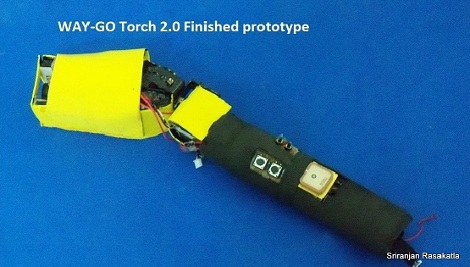
Flashlights are so 20th Century. Be it the incandescent type that popped up very early on, or LED models with came around in the 90’s, there’s not much excitement to the devices. But [Sriranjan Rasakatla] is doing his best to change that. This is his WAY-GO Torch, an intelligent flashlight (a Smart Light?) that will not just light your path, but overlay useful data on it.

At the front of the unit a pico projector is housed on a jointed assembly. This allows the device to project data on the ground in front of you. Using a digital compass and GPS module, it can show the polar coordinates, guide you on your way, or provide information about the buildings around you. The motorized mount provides image stabilization based on IMU data. Check out the demonstration video after the break. It shows general functionality in the first part of the clip, with some footage of the stabilization system at about 4:30.

This really does seem like it came right out of a Sci-Fi novel. It’s useful, but the complexity makes it surprising that [Sriranjan] was able to pull it off. We wonder how the battery life is on the device, but it can’t be any worse that one of those really huge flashlight builds.

Continue reading “Intelligent Flashlight Will Literally Show You The Way”

Weekly Roundup 1/14/12

For those of you who haven’t been paying attention in class, here is the best of what has hit our blog this past week:

In the #1 spot is a post about a project where some pretty ambitious hackers found a way to run Linux on a digital picture frame. Bravo!

Next up is a post where [Chris] needs some help getting his 1/10th scale, cycle accurate Cray I ‘supercomputer’ to boot.

In third place is a post about a very elaborate 737 cockpit simulator that was built over the past couple of years. This is a pretty intense build with lots of details about how it was done.

Following that is a post about a 3D-printed device that is similar to a phenakistoscope but instead of using slits to allow you to see the models in succession, it blinks some LEDs at the appropriate times.

Finally rounding things out in fifth place is a post about Makerbot Industries’ most recent release, which will let you print out your own phenakistoscope. This 3D printer is bigger than their makerbot and optionally sports two extruders instead of one so that you can do dual colors or possibly dual materials.

Using 555 Timers To Add “free Play” Functionality To Classic Arcade Machines

freeplay-arcade-board

[John Zitterkopf] is in the middle of restoring a vintage Sega Star Trek Captain’s Chair arcade game for the upcoming 2012 Texas Pinball festival, though one prerequisite for the show is that the game supports some sort of free play mode. At this point he doesn’t have the option of tracking down a freeplay ROM for the device, so he had to come up with a solution of his own.

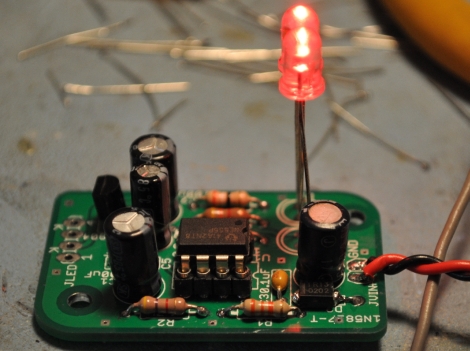
He did not want to alter the machine’s operation in any significant manner, and this meant preserving the functionality of the coin chutes. To do this, he put together a small circuit that uses a pair of cascaded 555 timers to provide the machine with the proper signaling to simulate coin insertion, while still accepting coins. You might initially think that this could be easily accomplished by shorting a pair of contacts in the coin chutes, but as [John] explains, the process is a tad more complex than that.

If you have some old arcade games kicking around and are looking for a non-invasive way to make them free to play, be sure to check out his site for schematics and a complete BoM.

OK, You Might Not Be Paranoid – Perhaps That Priority Mail Box IS Spying On You

rc-box-bot

[Thomas Renck] recently picked up a 1000mW wireless video transmitter that he ultimately planned to mount in an RC plane. Before he strapped it on a plane to potentially kiss it goodbye for good, he wanted to play with it a while to see what it was capable of.

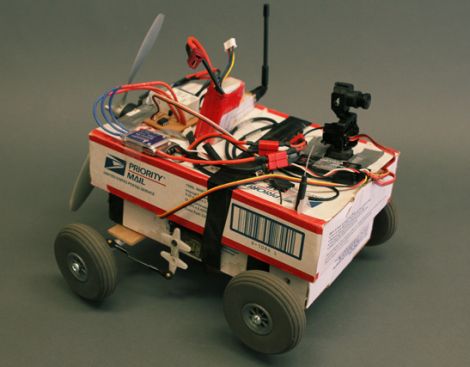
After a friend helped him determine the camera’s maximum range (about 1900 feet on open ground), he thought it would be fun to strap it on his nitro R/C truck. That didn’t work out so well due to some vibration issues, so he constructed a makeshift R/C car from the shipping box the camera arrived in, along with some other odds and ends.

As you can see in the video below, the propeller-driven “Boxmobile” zips along quite nicely. The video feed from the camera is pretty impressive too, allowing him to easily guide the car while it’s well out of sight.

At nearly $350, the self-proclaimed “ghetto-bot” is certainly not cheap, though we hear body repairs are a piece of cake!

Continue reading “OK, You Might Not Be Paranoid – Perhaps That Priority Mail Box IS Spying On You”