On The Life Of [Dennis Ritchie]

Chances are you have already heard of the passing of [Dennis Ritchie]. We admit, we’re among the throngs who knew little of his life, but [Cade Metz] has posted an excellent remembrance of his life which we think is well worth reading.

[Dennis] passed on October 12th at the age of 70. This image shows him receiving the National Medal of Technology awarded to him by [Bill Clinton] in 1998. His legacy lives on in the work that earned him this award as the creator of the C programming language; a side project which he developed to help him achieve the creation of a new system kernel called UNIX. This work, of course, was the precursor that led to universal software packages like OSX, iOS, Linux, and even Windows (which at one point was itself written using the C language).

There has been some Internet fodder regarding media coverage of [Steve Jobs’] death and not of [Dennis’] passing. It’s harder for those lacking experience with programming to comprehend [Dennis’] contributions. We’re glad to have an opportunity to pass on the story of his life and to take a moment to appreciate his accomplishments.

[Thanks Dave]

[Photo Source]

Weekly Roundup 10/15/11

In case you missed them the first time around, here are our most popular posts from the past week.

Our most popular post of the week was one about a rocket that was built by the [Qu8k team] that was their entry for the Carmack Prize, which put up a purse of $10,000 for proof and a nice writeup about a rocket that can launch to at least 100,000 feet. The rocket that we posted about managed to launch to 121,000 feet!

Next, we had a post about another space-related project called KickSat where they are hoping to launch many single-circuit-board satellites into space.

Our third most popular post is about an octocopter built by the German effects company OMStudios to fly a RED Epic camera around and above film shoots because training large birds to do it just wasn’t working.

Next we had a post about how to build your own 23″ Android tablet. Now you can make *everyone* around you jealous of your mad Angry Birds skills.

Surprisingly, our previous hackaday-original post about how to put your logo into a QR code hit the top five list again.

Since we have previously featured the QR code post in our weekly roundup in the past, we’ll break the rules and give you another so that we are featuring five new posts for this week. At number six, we have a post about how to play dubstep live on real instruments.

Video: Learning To Program For The ATmega328p Part I

Many of you are familiar with the Arduino. Many of you hate it…* This post isn’t about the Arduino. It is about the processor that is at the heart of many Arduino boards. If you are in the camp of people who can’t understand why others dislike the Arduino so much, this series is for you. In this series of videos, [Jack] will explore how to program for the ATmega328p processor using C. If you have been programming for the Arduino, you may have had some issues with the speed of your code at points. Programming in C will allow you to wring out nearly the last ounce of processing power that the ATmega processors can provide. It will also let you access the peripherals on the processor directly and to switch between different processors when you need more (or less) capabilities.

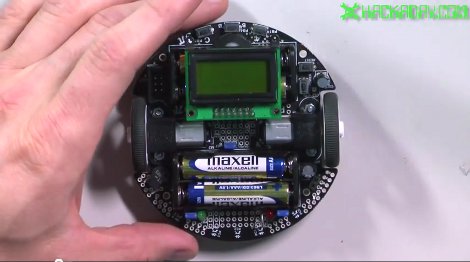
In this first video, [Jack] shows you all of the features of the 3pi robot, which he will be using as a fancy development board for the ATmega328p. He then shows you how to get your development environment set up and then walks you through one of the sample programs provided for the 3pi robot.

*Here at Hackaday, we are officially neutral in the ongoing Arduino love/hate war. We don’t care what microcontroller is used in the hacks that we show, only that they are cool.

Video is after the break!
Continue reading “Video: Learning To Program For The ATmega328p Part I”

Announcing Our Next Theme: Halloween Hacks

It seems every year, Hack A Day is a little bit behind the times when it comes to Halloween hacks. Builds like the Mario costumes and the house singing Thriller are great, but it makes a lot more sense for us to post them before Halloween.

To introduce our Halloween theme, we’d like to present [heavyweighthowe]’s Halloween project. It’s a small lighting automation build that syncs a string of lights to the theme of the best Halloween Christmas 2nd best [Tim Burton] movie, The Nightmare Before Christmas. [heavyweighthowe] used Vixen to sequence the lights and an Arduino to interpret the serial commands from Vixen. It’s a nice build that would look great sitting on a porch next to a giant bowl of candy.

If you’ve got a Halloween build you’d like to show off, like a haunted house ride an awesome costume or even a really great Jack-O-Lantern, send it in on the tip line. We’re planning on putting up at least one Halloween post a day, so keep sending in those builds.

Sustainability Hacks: The Final Word

This theme has been tricky to write for. On one hand, here at Hackaday, we are excited about doing anything that will allow us to not consume as many resources but on the other hand, when you really look closely at things, pretty much everything that we do in our modern lives isn’t sustainable. We can certainly find ways to get by with less but doing without really isn’t an option. The exciting thing about the current state of technology is that things are becoming a lot more efficient so the things that we do every day, such as using a computer require less and less energy. Even our cars, which for nearly 100 years drove around at 25 miles per gallon are starting to slowly require less fuel to get from point A to point B. We have a long way to go but there are signs that we (or our children) might not have to give up a modern life to continue on when coal and oil start to become scarce.

Shown above is an oil lamp made to look like a light bulb created by Opossum Design. It is an interesting use of modern technology to create light in a much more sustainable way.

Tomorrow we will be starting a new unofficial theme that will continue for the rest of October. For the past several years, we have been a bit behind the curve about Halloween stuff but we intend to make up for that in a big way. Halloween is one of those holidays that brings out the tinkerer in a lot of us. We would like to show off those projects. Hit us up on our tip line. If we like what we see, we will post about your project. We’re expecting a bunch of projects so unlike our prior themes, if we happen to get more than one that we like on a given day, we’ll post more.

Adafruit Celebrates Ada Lovelace Day

ada_lovelace_day

If you weren’t aware, today is [Ada Lovelace] day, so [Ladyada] and Adafruit Industries are spending the day celebrating the achievements of women in the fields of technology, art, engineering, and electronics. Specifically, the focus is on fellow female makers/hackers who are helping shape and promote the industry.

Once every hour, Adafruit Industries is profiling one influential woman, paying tribute to her work and contributions to the tech/maker/art/science space. You’ll see a lot of familiar faces throughout the day, including electronics extraordinaire [Jeri Ellsworth], Make’s own [Becky Stern], as well as [Sherry Huss] and [Louise Glasgow], two of Maker Faire’s leading ladies.

The bios are certainly worth taking a look at – aside from some of the more familiar faces, it’s a great chance to learn about a few makers who you may not have heard of before.

As an added bonus, Adafruit is offering 10% off all purchases from the store using a coupon code that can be found on their site, so be sure to check it out!

Video: Everything You Wanted To Know About DC Motors

Continuing on with our series of Hackaday original videos, this week we are presenting a video all about DC motors. DC motors are relatively simple electromechanical devices that turn electrical energy into rotational movement. In this video, [Jack] takes apart a small DC motor and shows off all of the parts inside and describes how it all works. He also talks about how to modify DC motors to increase their speed or torque as well as how to change their directional preference. In this video, he rewinds a motor and shows how this changes the performance characteristics of the motor.

Is mechanical stuff not your thing? Stay tuned for next week when we launch into a series of videos where we show how to program for the Atmel ATmega328 processor using C. In this series, we’ll show you the real nuts and bolts of programming for this processor by working with its I/O pins,timers, A/D, interrupts, and more.

Video after the break.
Continue reading “Video: Everything You Wanted To Know About DC Motors”