The DIY Nuclear Reactor

“Wednesday, I was arrested and sent to jail,” is what your blog might say if you decide to try and duplicate this project.  You may, however, be fortunate to be still writing your blog, as ATTEMPTING TO BUILD YOUR OWN REACTOR can be quite dangerous. That’s what [Richard] did using household items such as clock fingers for Radium, and smoke detectors for Americium. After the radioactive elements were separated from their household “containers” and melted down, they created a small explosion on his stove.

This attempted experiment is based on one that was done by [David Hahn], AKA, “The Nuclear Boyscout”, in order to obtain his nuclear energy badge.  For what it’s worth, [David] did attain the rank of Eagle Scout, however, he turned his parent’s house into a Superfund EPA cleanup site in the process.

The video after the break describes the process of making a reactor from household materials. This video may be entertaining, but duplicating it is not recommended (and would be somewhat expensive). Continue reading “The DIY Nuclear Reactor”
The Lego Synchro Drive

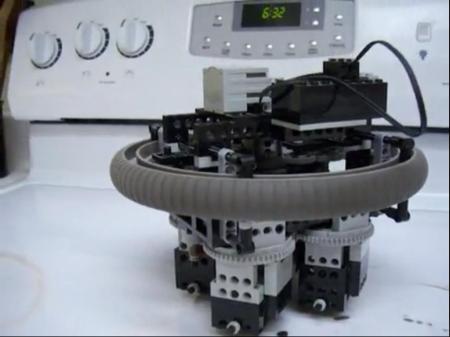
[M-byte] wrote in to tell us about the Lego Synchro Drive. Although not a new hack, this autonomous vehicle is quite amazing in it’s simplicity.  Using only one motor turning at a constant speed, this device is able to navigate obstacles by simply turning.

As [m-byte] was quick to point out, this is a simple task using modern electronics, but this drive is made using only Lego Technic parts. The machine’s motion is quite pleasing. When it hits an obstacle, the outer rotating ring stops, allowing the casters on the bottom to switch direction. One could see this invention coming out of Leonardo da Vinci’s notebook (minus the Legos).

Check out either of the embedded videos after the break to see this device in action. If you’d like to build one yourself, follow this link for very well illustrated directions. Continue reading “The Lego Synchro Drive”

Come See What’s Cooking In The Arduino Kitchen

arduino_labs

The crew that brought you the Arduino is always hard at work trying to bring the community closer together and to foster collaborative development. They recently rolled out a new feature on their site that is sure to be of interest to Arduino veterans and neophytes alike.

Arduino Labs is a platform which the team plans on using as an incubator of sorts, for projects that are underway, but not fully baked. Currently, they have highlighted two in-progress initiatives, including the Arduino Mega ADK, as well as a GSM/GPRS shield that the team has been developing in collaboration with Telefonica I+D.

As of right now, the site looks to be a one-way information outlet for the Arduino team to the community, but they stress that their aim is to create a more open development process within the Arduino project. While there is no official statement on the matter, we hope that the site will eventually allow members of the community to offer both their feedback and lend manpower to forthcoming projects.

[via Adafruit blog]

Want To Play Pong On Your Oscilloscope?

I always have! I don’t know why, but I like the idea of using an oscilloscope screen as a general use video display. Why not? In my case it sits on my desk full time, has a large screen area, can do multiple modes of display, and is very easy control.

Making an oscilloscope screen do your bidding is an old trick. There are numerous examples out there. Its not a finished project yet, so be nice. It is actually rather crude, using a couple parts I had on hand just on a whim. The code is a nice mixture of ArduincoreGCCish (I am sorry, still learning), and includes the following demos:

  1. Simple low resolution dot drawing
  2. A font example
  3. A very quickly and badly written demo of pong

The software runs on an Attiny84 micro controller clocked at 16Mhz, paired up with a Microchip MCP42100 dual 100k 8 bit digital potentiometer though the Attiny’s USI (Universal Serial Interface) pins. This is a fast, stable and accurate arrangement, but it requires sending 16 bits every time you want to change the value of one of the potentiometers so its also very piggy. I was just out to have some fun and did not have a proper 8 bit DAC. This was the closest thing outside of building one.
Join us after the break for pictures a (very) brief video and more.

Continue reading “Want To Play Pong On Your Oscilloscope?”

Comment System Updates

We’ve been working hard on this one and finally made a tiny bit of progress.

You will find that comments are now nested.  We can see there are some slight visual issues, but we’re working on it. Please be patient with us.
Another edition you will find is the “report” button. If you find comments offensive, click that button to let us know.

Again, we’re still working through this and have a decent list of quirks that need worked out but it seems to be mostly functional.

Live NBA Scoreboard With Huge 7-segment Displays

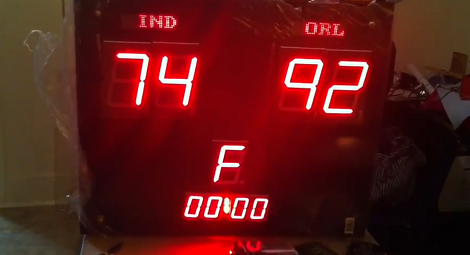
[Kianoosh] was in Las Vegas over spring break and was fascinated by the real-time sports scores displayed at the casinos. He figured that this would be an easy enough project to duplicate, so he built a gigantic NBA scoreboard that updates live from the NBA website.

The build uses the OS X Automator to pull scores down from the NBA’s mobile site. Sending this through a parser written in Java, the scores are then sent to an ATMega32 over an XBee. [Kianoosh] posted all the code and schematics, as well as a PDF writeup. Because the scoreboard is sport-agnostic, [Kianoosh] plans on writing new code for the NFL, MLB, and NHL. We’re really impressed with this build, and with the giant 7-segment LEDs, this would be a great addition to a sports bar (or really any bar).

Continue reading “Live NBA Scoreboard With Huge 7-segment Displays”

Making And Selling Star Wars Costumes Ruled To Be Legal


[Andrew Ainsworth] has been making and selling costumes based on Star Wars character (some original, and some of his own creation) for several years. Lucasfilm sued him for $20 million back in 2004 claiming infringement of intellectual property rights. He stopped selling them in the US (as it was a US copyright) but now the UK Supreme Court has ruled in his favor, siding with his claim that the costumes are functional items and not works of art.

Good for him, but copyright issues aren’t what interests us here. The BBC clip showing him using a vacuum former to make the Stormtrooper helmet really caught our attention. A bit of further searching led us to find the thirteen minute video after the break showing the entire process, from sculpting the mold by hand, to forming the components, and the final assembly seen above. It’s a fascinating process that makes use want to build our own vacuum former (preferably on a larger scale than this one). It would come in handy whether it’s Star Wars, Daft Punk, or any number of other projects you’ve got in mind.

Continue reading “Making And Selling Star Wars Costumes Ruled To Be Legal”