Hackaday Comment Policy; We’re Cleaning Up.

Sit down for a moment commenters, we need to talk.
Yes, you all knew this post was coming one day. We’ve talked about this topic at length internally, and we have decided that we’re going to clean up our act. For some time, Hack a Day has been growing a reputation as the prime source of extremely negative, vulgar, rude, sexist, and inflammatory comments in the hacking community. We’ve had complaints from readers (yes there are readers that aren’t commenters, thousands of them) and fellow members of the hacking community about this problem for a long time. [Eliot] even mentioned it back in 2009 when a job applicant expressed concern. We’ve nicely tried to steer things to the positive in a variety of ways, from suggesting commenters to be more supportive, jokingly making a troll detector, and simply stating that the comments need to stay “on topic and nice”.

When we see things like these  tweets by [Jeri Ellsworth], we hang our heads in shame.

She’s not the only one. We actually get this quite regularly. As our readership grows, we see it more and more often. We get emails explaining that people have done a hack but don’t really want to post it because the commenters will just tear it apart in an unnecessarily aggressive and negative way. We have actually had people ask us to remove their projects and comments due to uncivil behavior. Constructive criticism is good, but insulting and angry deconstruction isn’t helpful to anyone.

We’re better than that aren’t we? We are fast, agile and fairly unrestricted in our content. We should be at the center of this community, not on the outer edges, reviled by many for the behavior of a few. Hackaday should be the teacher at the front of the classroom, not the kid in the back throwing wadded up paper at the kids in the front.

What we’re doing:
First off, as far as we can foresee, we will never close the comments section of our web site down. Hackaday should be a home for the entire hacking community and as such, you will always be able to settle in and have a reasonable discussion. We do not want to implement any sort of G+ integration or similar, nor do we want to require registration to leave a comment. We will if we absolutely have to, but lets try to avoid that.

Comment sections and forums have often been a place where negative comments can get out of hand. There are many theories for why this happens, but the result is usually the same: rules and moderation. Many sites have already laid down the law and are adhering to their goals of keeping things civil. We realize that we are to blame if our image is this poor, so we are doing something about it.

From this point moving forward, Hackaday comments will be civil. If you are posting an empty in-joke (“where’s the Arduino?”), a declaration of “not a hack”, a racist, sexist, completely off topic, platform-hating, or personally insulting comment, your post will be deleted. This will be at the discretion of whichever Hackaday staff member happens to see your comment first.

Can you criticize Hackaday?
You can’t walk into a business and start screaming about how much they suck without being escorted out immediately.  Same thing applies here.

We are always hard at work trying to find interesting hacks, makes, repairs, tweaks, videos, etc. that appeal to a wide spectrum of readers. We put this web site together for you, as well as 200,000 other individuals.  Not everything will appeal to everybody. That would be impossible. However, if you don’t like a post or project, just skip it – we’ll have another one ready in short order. We will feature projects that appeal to the seasoned EE as well as the complete beginner. We were all beginners at one time, and it would have been great to have something like Hack a Day around back then to show us hacks ranging from simple to advanced.

From time to time however, Hack a Day can be a less than desirable place to hang out, especially for those who are coming here for the first time. We don’t want to chase off young, creative minds. As a community, we should be helping those that are just starting to venture into hacking electronics.

If you have a problem, email us. You’ll probably actually get a response that way too.  My email is Caleb@ and you’re always welcome to email me personally. Again, please be civil (yep, I’ve had my share of death threats).

Grammar/spelling corrections and dead links:
No need to comment, just email us. A message to team@ will suffice, but you will probably get a quicker response by emailing the author directly. We know we have issues – we’re often so excited about a hack that some little goof slips by. Email us and we’ll fix it. Don’t write a 3 paragraph comment about how important the oxford comma is, or how we’re obviously incapable of functioning because we accidentally flubbed a word. We promise we will never intentionally screw up some grammar, spelling, or punctuation.

What you can will do to help:
Be constructive.

Every project here probably has an area that could be improved, or a part that was done inefficiently. Support your fellow hackers by offering your expertise. Explain why something isn’t working, or how you would improve it. Don’t slam them for their shortcomings. Also keep in mind that different people go about things different ways. Poster X didn’t build something the way you did?  Offer an alternative without being insulting. If someone chooses to use their brand new Core i7 monster system to drive a few LEDs, that’s their prerogative. Inside, we all know that it is not the most efficient use of money or technology, there’s no reason to beat that dead horse in public.

You know what else encourages hackers to do more projects? A pat on the back. I talk to people all the time who say that they just don’t have any constructive criticism for the projects, so they don’t comment. Well, that and they know they’ll bring the ire of the worst commenters if they happen to ask a silly question. Drop in and say what you like about a project. Those positive posts might just be enough to encourage that hacker to take it a step further. How many projects have you seen dropped simply because people thought there wasn’t any interest? Tons. If you like a project, let them know.

To encourage this, the writers are going to be keeping an eye on the comments. Randomly, when we see someone being exceptionally helpful, we’ll contact them and send them a prize. This will most likely be in the form of a hackaday sticker, but we’ll see if we can’t find some other fun things as well.

Help us make Hack a Day great. Please.

[Update: we’re working on a comment flagging system currently]

[Update: threading and comment reporting have been added]
Hacking 14 Year Old Power PC Mac Back To Life

For a while now I have been battling a dying 2.6Ghz dual core computer, but due to laziness and budget I just let it ride. At first it would occasionally crash in games, then it got to where it would crash during routine activities. After a year of this it would nail 105 degrees C in like 20 seconds and that is where the drama starts!

I threw my 2ghz “electronics” computer into my main machine’s case and used that for a few months. It’s motherboard had suffered from every electrolytic capacitor on it being puffy, but it has worked fine for nearly 5 years. I was surprised by the sound of what ended up being 2 caps blowing off of the geforce 7600 video card. In shock and excitement I removed the blown caps, slapped her back in and got another 4 months out of it before 2 more capacitors blew and took out a voltage regulator (and who knows what else with it).

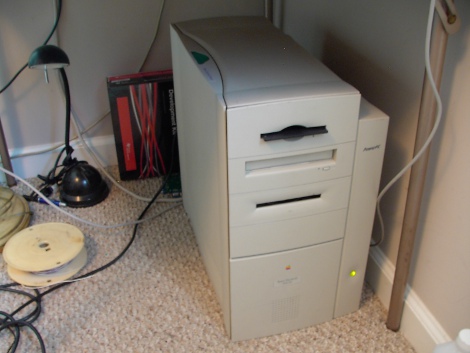
Only armed with the craptop, I was stuck in a pickle! Then a co-worker came up to me and said “hey man you want this mac I only want its zip drive”. Well of course, going bonkers without my avrgcc, datasheets, and calculators, I took on the 14 year old Apple Power Macintosh 9600/300 as my bench machine, and I will now show you how I turned it from a novelty relic to a daily useful machine after the break.

Continue reading “Hacking 14 Year Old Power PC Mac Back To Life”

Radio Shack Will Now Stock Cellphones, Cellphone Accessories, Arduinos

A few months ago, we covered Radio Shack’s efforts to suck less, and the Radio Shack DIY team has now come back with the top ten suggestions submitted. Of course Arduinos make the list at number 1, which we somewhat expected for beginner projects.  Here’s the entire list in order:

  1. Arduino
  2. More kits and project suggestions
  3. More introduction/instructional books
  4. Larger LED selection
  5. Larger resistor selection
  6. TONS more capacitors
  7. DIY audio and speaker equipment
  8. HAM radio gear
  9. More competitive pricing
  10. Stronger sales force

Sandia Labs “Hopper” Robot

Made by Boston Dynamics under contract from Sandia Labs, this “hopper” is quite incredible as you can see in the video after the break. Boston Dynamics is no stranger to great robotics designs, including the well known “Big Dog” four-legged robot. This robot, although possibly less advanced, has a very unique trick up it’s sleve.

This robot’s distinguishing feature is that it can navigate autonomously not only with wheels, but also with a powerful single leg that allows it to jump over obstacles of up to 25 feet. Although envisioned to “deliver a payload” in an urban environment, one could imagine a terrifying  horde of these ‘bots jumping into action armed with bombs or other weapons.

According to Sandia’s website is that this form of locomotion has been “shown to be five times more efficient than hovering” when trying to get around obstacles under 10 meters. Technical challenges that have been overcome include managing the shock of landing and producing a leg powerful enough to jump to this height. Continue reading “Sandia Labs “Hopper” Robot”

Hackaday In The Social Tangle

Like any other organization out there, we’re always trying to find new ways to reach our audience. Admittedly, we’re not the fastest when it comes to adopting a new social communication site. We’re working on it though, trying to be a bit more interactive … or just plain active.

So, if you’re looking for other ways to get your hacking fix, or see some interesting commentary, find us on facebook, twitter, our own forums, and now G+. We just signed up to G+ and our name is “Hackie Smith”. If you need an invite, email us at theofficialhackaday@gmail.com see below.   Sometimes there’s good discussion in those places that doesn’t end up here on the site.

You can also find several of us spattered across the web in sites like Reddit and Slashdot.

[Update: Our g+ page got shut down. Feel free to find any of the writers on g+. I’ll give out invites, look for “Caleb Kraft” or 60mango@gmail]

Did Microsoft Steal The Kinect?

In 2009, while Microsoft was busy designing and marketing what would become the Kinect, [Carlos Anzola], an inventor, tinkerer, and self-ascribed geek from Bogotá, Colombia, had been working for years on a nearly identical gesture interface for the PC. His creation, the Human interface Electronic Device, or HiE-D – pronounced ‘Heidi’ – was capable of gesture recognition years before Microsoft would release the Kinect.

After developing his gesture recognition device in 2007, Microsoft showed interest in [Carlos]’ device – going so far as to request a prototype. Microsoft suggested that he should apply for a patent on his technology. [Carlos] did just that, sending in patent applications to both the United States Patent and Trademark Office and the World Intellectual Property Organization a mere two days before the announcement of Project Natal and a full seven months before Microsoft applied for their Kinect patent.

Since the release of the Kinect, [Carlos] has been showing the HiE-D around Bogotá and has put a few videos of his technology up on Youtube, one of which can be seen below. You can also check out his Youtube channel for some great demos.

[youtube=http://www.youtube.com/watch?v=f5jfOJ3TwyI&w=470]

Continue reading “Did Microsoft Steal The Kinect?”

Scavenging Ambient Electromagnetic Energy

energy_harvesting_from_radio_waves

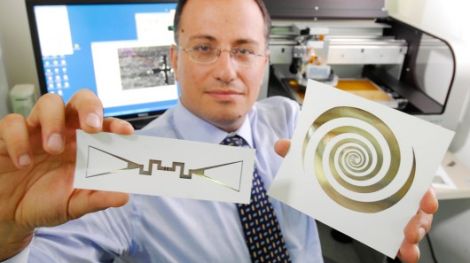
At this very moment, unseen radio waves are bouncing off almost everything that surrounds you. Emitted by everything from radio and TV stations to cell phone networks and satellites, these waves are full of unharnessed energy. That is, until now. Researchers at the Georgia Tech School of Electrical and Computer Engineering have been working diligently to harness this unused energy, and recently unveiled their new antenna technology at the IEEE Antennas and Propagation Symposium.

The team, led by professor [Manos Tentzeris] has been working to develop ultra-wideband antennas to tap into the energy all around us. Using printers filled with a specially-formulated ink compound, they have been able to print these antennas on paper and polymer substrates. The antennas can harness energy stored in radio frequencies ranging from 100 MHz all the way up to 60 GHz, depending on the printing medium.

The team can currently power temperature sensors using television signals, and is preparing a demo in which they will power a microcontroller simply by holding it up in the air. The technology is still in its infancy, but the list of applications is almost endless. We doubt you’ll be powering your TV with this technology any time soon, but it definitely holds promise for things such as wireless sensor mesh networks and the like.

[Thanks, morganism]